Azmeraw Mossie Bekele, Sheferie Mekuria Bereded, Abebe Tiegist Dejene, Abedalla Muhajer Kedir
Department of Horticulture, College of Agriculture and Natural Resources, Salale University, P.O.B. 245, Salale/Fiche, Ethiopia.
Department of Plant Science, College of Agriculture and Environmental Science, Bahir Dar University, P.O.B.79, Bahir Dar, Ethiopia.
Heliyon. 2024 Jul 31;10(15):e35504. doi: 10.1016/j.heliyon.2024.e35504. eCollection 2024 Aug 15.
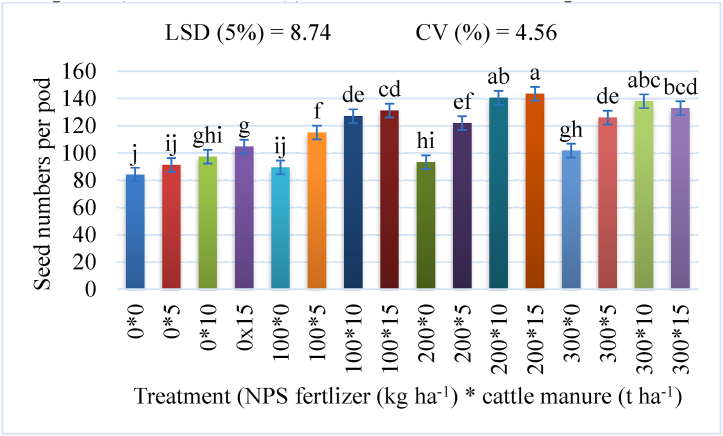
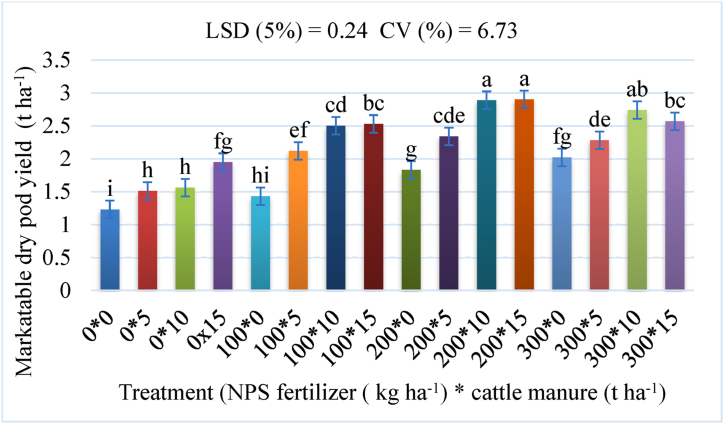
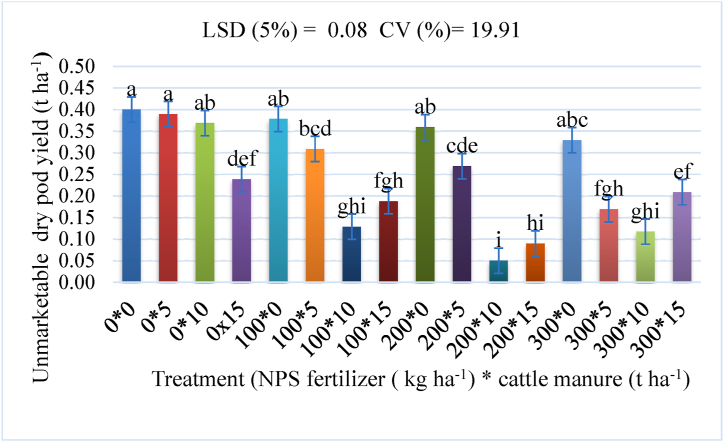
Hot pepper is one of the most important spice vegetable crops in Ethiopia and is widely cultivated for dry pod production. However, its productivity is low in Ethiopia due to degraded soil fertility and an unbalanced nutrient supply in the soil. An experiment was conducted to evaluate the effect of NPS fertilizer and cattle manure (CM) on soil chemical properties and hot pepper dry pod yield under irrigation in Jabi Tehnan. This experiment was arranged in factorial combinations of four NPS fertilizer (0, 100, 200, and 300 kg ha) and four CM (0, 5, 10, and 15 t ha) levels in a randomized complete block design with three replicates. Soil chemical properties, hot pepper phenology, growth, yield, and yield-related traits were recorded and analyzed using SAS software version 9.4. The main and interaction effects of NPS and CM fertilizers had a significant effect on soil chemical properties, hot pepper phenology, growth, yield, and yield-related traits. The combination of NPS fertilizer and CM significantly increased soil chemical properties and hot pepper traits. However, soil chemical properties and hot pepper yield traits showed a somewhat decreasing trend as the combination levels of two fertilizers further increased. The highest marketable (2.90 t ha) and total dry pod yield (2.99 t ha) were produced at the combination of 200 kg NPS ha and 15 t CM ha. However, the partial budget analysis showed that the combination of 200 kg NPS ha and 10 t CM ha had the highest net benefit with an acceptable MRR and can be recommended for profitable hot pepper dry pod production in the study area. However, the experiment was limited to a single location and variety; it should be repeated at multiple locations over the seasons to make a strong recommendation.
辣椒是埃塞俄比亚最重要的香料蔬菜作物之一,广泛种植用于干辣椒荚生产。然而,由于土壤肥力退化和土壤养分供应不均衡,埃塞俄比亚的辣椒产量较低。在贾比·泰南进行了一项试验,以评估氮磷硫复合肥(NPS)和牛粪(CM)对灌溉条件下土壤化学性质和辣椒干荚产量的影响。该试验采用随机完全区组设计,设置了四个NPS肥料水平(0、100、200和300千克/公顷)和四个CM水平(0、5、10和15吨/公顷)的析因组合,重复三次。使用SAS 9.4软件记录并分析了土壤化学性质、辣椒物候期、生长、产量及产量相关性状。NPS和CM肥料的主效应和交互效应显著影响土壤化学性质、辣椒物候期、生长、产量及产量相关性状。NPS肥料与CM的组合显著提高了土壤化学性质和辣椒性状。然而,随着两种肥料组合水平的进一步提高,土壤化学性质和辣椒产量性状呈现出一定的下降趋势。在200千克NPS/公顷和15吨CM/公顷的组合下,获得了最高的可售产量(2.90吨/公顷)和总干荚产量(2.99吨/公顷)。然而,部分预算分析表明,200千克NPS/公顷和10吨CM/公顷的组合具有最高的净利润,且边际收益率可接受,可推荐用于研究区域内有利可图的辣椒干荚生产。然而,该试验仅限于单一地点和品种;应在多个地点跨季节重复进行,以给出有力推荐。