Castellini Mirko, Bondì Cristina, Giglio Luisa, Iovino Massimo
Council for Agricultural Research and Economics-Research Center for Agriculture and Environment (CREA-AA), Via C. Ulpiani 5, 70125, Bari, Italy.
Department of Agricultural, Food and Forest Sciences, University of Palermo, 90128, Palermo, Italy.
Heliyon. 2024 Aug 3;10(15):e35699. doi: 10.1016/j.heliyon.2024.e35699. eCollection 2024 Aug 15.
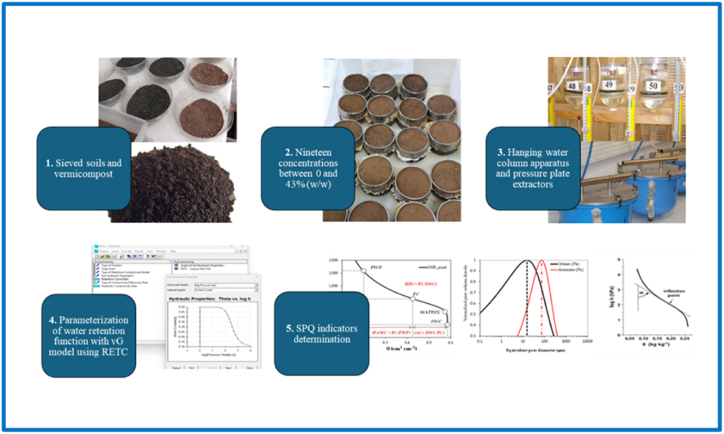
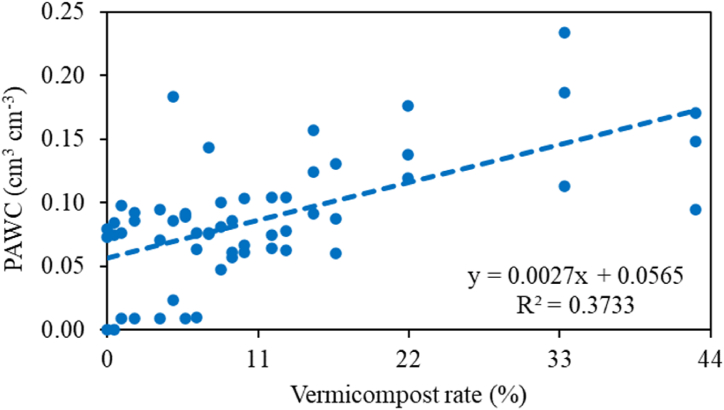
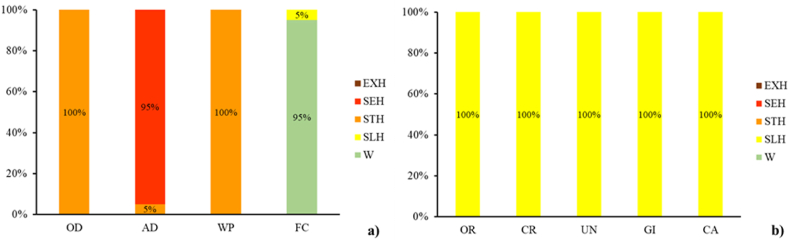
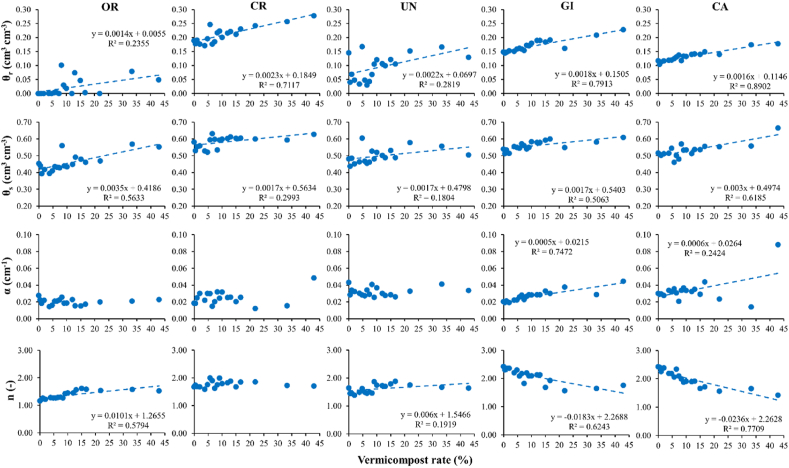
Vermicompost is an organic material that is abundant in humic acids and nutrients. It is obtained through the bio-oxidation and stabilization processes carried out by earthworms. It has been proven to bring several benefits to different soil properties, including bulk density, soil structure, and plant available water capacity (). This investigation was conducted to fill the knowledge gap in some critical factors related to vermicompost application, specifically the short-term influence of a single vermicompost application with increasing doses on soil wettability and physical quality of differently textured soils. Water repellency of vermicompost and soil/vermicompost mixtures was investigated at different moisture contents by the water drop penetration time test, whereas physical quality was assessed by 35 soil indicators related to bulk density, soil water retention curve, and pore size distribution function. Despite vermicompost showed from strong to severe hydrophobicity at moisture content lower than the field capacity, amended soils were at the most slightly water repellent thus indicating that, under field conditions, the hydrophobicity attributable to soil amendment with vermicompost could be considered negligible. Soil physical quality was effectively affected by vermicompost addiction with different outcomes depending on soil texture. Indicators linked to generally increased at increasing the vermicompost rate in the coarse soils whereas no significant effect was observed for intermediate and fine soils. For example, plant available water capacity of coarse-textured soils increased from an average initial value of 0.056 cm cm to an optimal value of 0.15 cm cm when a vermicompost addition dose of about one-third by volume (34 %) was applied. In the finest soil, drainable porosity significantly increased from an initial value of 0.09 cm cm to 0.23 cm cm when the maximum vermicompost dose (43 %) was applied thus indicating that amendment could be effective in enhancing water and air circulation.
蚯蚓堆肥是一种富含腐殖酸和养分的有机材料。它是通过蚯蚓进行的生物氧化和稳定化过程获得的。已证明它对不同的土壤性质有多种益处,包括容重、土壤结构和植物有效持水量()。本研究旨在填补与蚯蚓堆肥应用相关的一些关键因素方面的知识空白,特别是单次施用不同剂量蚯蚓堆肥对不同质地土壤的土壤润湿性和物理质量的短期影响。通过水滴渗透时间试验研究了蚯蚓堆肥以及土壤/蚯蚓堆肥混合物在不同水分含量下的拒水性,而通过与容重、土壤水分保持曲线和孔径分布函数相关的35项土壤指标评估了物理质量。尽管在水分含量低于田间持水量时蚯蚓堆肥表现出从强到严重的疏水性,但改良后的土壤最多只是略有拒水,这表明在田间条件下,蚯蚓堆肥对土壤改良引起的疏水性可忽略不计。蚯蚓堆肥添加有效地影响了土壤物理质量,不同质地的土壤有不同的结果。与一般相关的指标在粗质地土壤中随着蚯蚓堆肥施用量的增加而增加,而在中等质地和细质地土壤中未观察到显著影响。例如,当施用约三分之一体积(34%)的蚯蚓堆肥添加剂量时,粗质地土壤的植物有效持水量从平均初始值0.056 cm/cm增加到最佳值0.15 cm/cm。在最细的土壤中,当施用最大蚯蚓堆肥剂量(43%)时,排水孔隙度从初始值0.09 cm/cm显著增加到0.23 cm/cm,这表明改良可有效增强水分和空气循环。