Mizoguchi Yasuaki, Akasaka Kiyokazu, Suzuki Kenta, Kimura Fumihiko, Hall Toby, Ogihara Satoshi
Saitama Medical University Graduate School of Medicine Saitama Japan.
Department of Rehabilitation Kimura Orthopaedic Clinic Saitama Japan.
Health Sci Rep. 2024 Aug 20;7(8):e70005. doi: 10.1002/hsr2.70005. eCollection 2024 Aug.
Degenerative cervical myelopathy (DCM) is a debilitating condition characterized by compression of the cervical spinal cord, leading to neurological deficits. This study aimed to investigate the association between comorbidities like diabetes mellitus (DM) and obesity and quality of life (QOL) in preoperative patients with DCM, and to examine the distribution of pain and numbness.
A cross-sectional study with 86 preoperative patients with DCM was conducted. Patient-reported outcome measures (PROMs) including Core Outcome Measure Index for the neck (COMI-Neck), Neck Disability Index (NDI), EQ-5D-3L, SF-12v2 assessed QOL, and baseline characteristics were collected. Patients were categorized by diabetic and obesity status, resulting in 17 with and 69 without DM, and 27 obese, 59 nonobese patients. In the statistical analysis, we compared PROMs and baseline characteristics, and conducted MANCOVA to investigate the association of DM and obesity with PROMs.
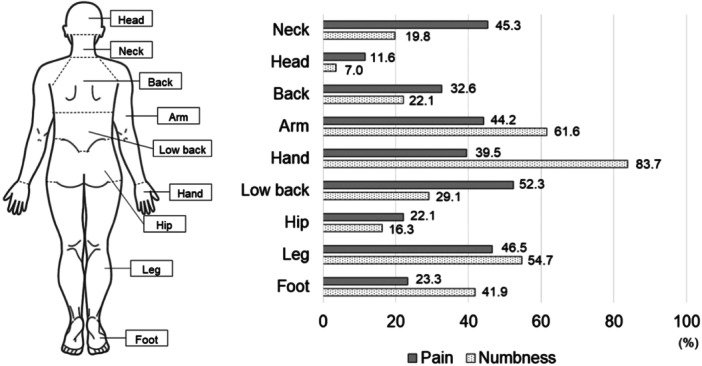
The study found no significant differences in preoperative QOL between patients with and without DM or obesity. Additionally, the results of MANCOVA indicated that neither DM nor obesity alone, nor their combination, had an association with the total scores of PROMs. In each group, the Symptom-specific well-being score on the COMI-Neck was notably high, implying distressing current symptoms (median: 10). On the NDI, the median score for pain intensity, lifting, work, and recreation subitems was 3. Pain was predominantly reported in the neck and lower back, while numbness was more prevalent in the peripheral regions of the upper and lower limbs.
Preoperative QOL was not significantly affected by the presence of DM and/or obesity. DCM-related symptoms may mask the associations with these comorbidities. Regardless of the preoperative condition, it is important to address the PROMs items that posed challenges before surgery.
退行性颈椎脊髓病(DCM)是一种使人衰弱的疾病,其特征为颈椎脊髓受压,导致神经功能缺损。本研究旨在调查糖尿病(DM)和肥胖等合并症与术前DCM患者生活质量(QOL)之间的关联,并研究疼痛和麻木的分布情况。
对86例术前DCM患者进行了一项横断面研究。收集了包括颈部核心结局测量指数(COMI-Neck)、颈部功能障碍指数(NDI)、EQ-5D-3L、SF-12v2在内的患者报告结局指标(PROMs)以评估生活质量,并收集了基线特征。患者按糖尿病和肥胖状况进行分类,结果为17例患有DM,69例未患DM,27例肥胖,59例非肥胖患者。在统计分析中,我们比较了PROMs和基线特征,并进行了多变量协方差分析以研究DM和肥胖与PROMs之间的关联。
研究发现,患有和未患有DM或肥胖的患者术前生活质量无显著差异。此外,多变量协方差分析结果表明,单独的DM或肥胖,以及它们的组合,均与PROMs总分无关联。在每组中,COMI-Neck上的症状特异性幸福感得分显著较高,这意味着当前症状令人痛苦(中位数:10)。在NDI上,疼痛强度、提起、工作和娱乐子项目的中位数得分均为3。疼痛主要集中在颈部和下背部,而麻木在上肢和下肢的周边区域更为普遍。
DM和/或肥胖的存在对术前生活质量没有显著影响。DCM相关症状可能掩盖了与这些合并症的关联。无论术前情况如何,解决术前带来挑战的PROMs项目都很重要。