Population Data Science, Faculty of Medicine, Health and Life Science, Swansea University, Swansea, United Kingdom.
School of Health and Life Sciences, Teesside University, Middlesbrough, United Kingdom.
JMIR Public Health Surveill. 2024 Aug 21;10:e43173. doi: 10.2196/43173.
The COVID-19 pandemic and the ensuing implementation of control measures caused widespread societal disruption. These disruptions may also have affected community transmission and seasonal circulation patterns of endemic respiratory viruses.
We aimed to investigate the impact of COVID-19-related disruption on influenza-related emergency hospital admissions and deaths in Wales in the first 2 years of the pandemic.
A descriptive analysis of influenza activity was conducted using anonymized pathology, hospitalization, and mortality data from the Secure Anonymised Information Linkage Databank in Wales. The annual incidence of emergency hospitalizations and deaths with influenza-specific diagnosis codes between January 1, 2015, and December 31, 2021, was estimated. Case definitions of emergency hospitalization and death required laboratory confirmation with a polymerase chain reaction test. Trends of admissions and deaths were analyzed monthly and yearly. We conducted 2 sensitivity analyses by extending case definitions to include acute respiratory illnesses with a positive influenza test and by limiting admissions to those with influenza as the primary diagnosis. We also examined yearly influenza testing trends to understand changes in testing behavior during the pandemic.
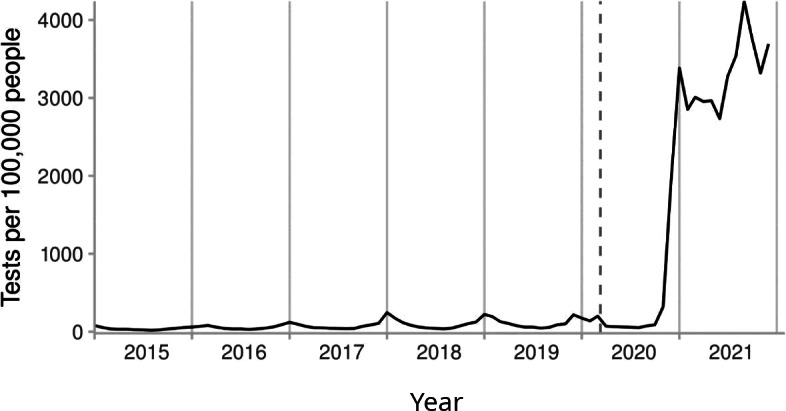
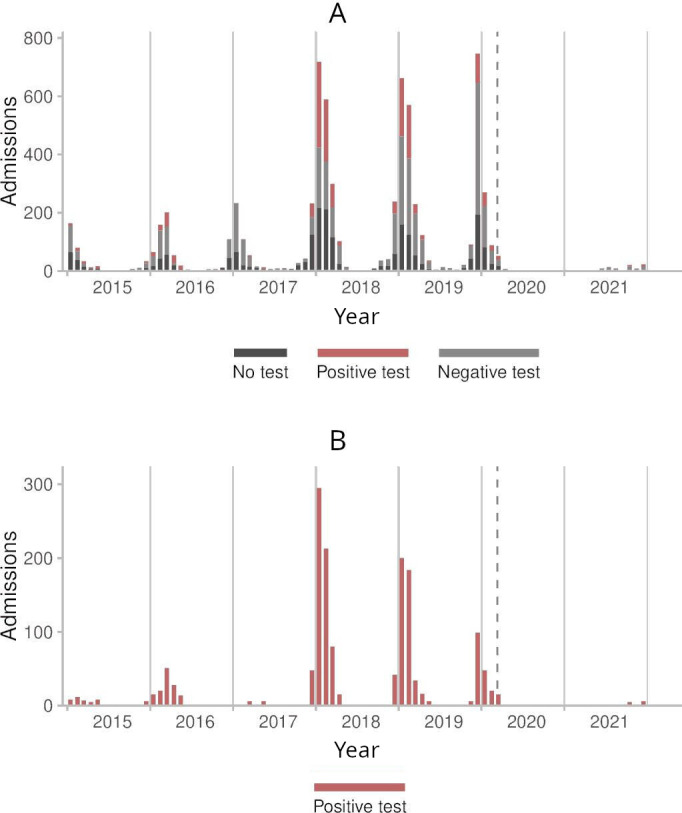
We studied a population of 3,235,883 Welsh residents in 2020 with a median age of 42.5 (IQR 22.9-61.0) years. Influenza testing in Wales increased notably in the last 2 months of 2020, and particularly in 2021 to 39,720 per 100,000 people, compared to the prepandemic levels (1343 in 2019). The percentage of influenza admissions matched to an influenza polymerase chain reaction test increased from 74.8% (1890/2526) in 2019 to 85.2% (98/115) in 2021. However, admissions with a positive test per 100,000 population decreased from 17.0 in 2019 to 2.7 and 0.6 in 2020 and 2021, respectively. Similarly, deaths due to influenza with a positive influenza test per 100,000 population decreased from 0.4 in 2019 to 0.0 in 2020 and 2021. Sensitivity analyses showed similar patterns of decreasing influenza admissions and deaths in the first 2 years of the COVID-19 pandemic.
Nonpharmaceutical interventions to control COVID-19 were associated with a substantial reduction in the transmission of the influenza virus, with associated substantial reductions in hospital cases and deaths observed. Beyond the pandemic context, consideration should be given to the role of nonpharmaceutical community-driven interventions to reduce the burden of influenza.
COVID-19 大流行及其随之而来的控制措施的实施导致了广泛的社会混乱。这些混乱也可能影响了地方性呼吸道病毒的社区传播和季节性循环模式。
我们旨在调查 COVID-19 相关干扰对威尔士大流行前 2 年流感相关急诊住院和死亡的影响。
使用威尔士安全匿名信息链接数据库中的匿名病理学、住院和死亡率数据,对流感活动进行描述性分析。估计了 2015 年 1 月 1 日至 2021 年 12 月 31 日期间,有流感特异性诊断代码的急诊住院和死亡的年度发病率。急诊住院和死亡的病例定义需要通过聚合酶链反应试验进行实验室确认。每月和每年分析入院和死亡趋势。我们通过将病例定义扩展到具有阳性流感检测的急性呼吸道疾病,以及将入院限制为流感为主要诊断的方式进行了 2 项敏感性分析。我们还检查了每年的流感检测趋势,以了解大流行期间检测行为的变化。
我们研究了 2020 年威尔士 3235883 名居民的人群,中位年龄为 42.5(IQR 22.9-61.0)岁。2020 年最后 2 个月,威尔士的流感检测明显增加,尤其是 2021 年达到 39720 人/10 万人,高于大流行前水平(2019 年为 1343 人)。与流感聚合酶链反应检测相匹配的流感入院人数百分比从 2019 年的 74.8%(1890/2526)增加到 2021 年的 85.2%(98/115)。然而,每 10 万人中因流感而入院的人数从 2019 年的 17.0 人减少到 2020 年的 2.7 人和 2021 年的 0.6 人。同样,每 10 万人中因流感阳性检测而死亡的人数从 2019 年的 0.4 人减少到 2020 年的 0.0 人和 2021 年的 0.0 人。敏感性分析显示,在 COVID-19 大流行的前 2 年,流感入院和死亡呈下降趋势。
控制 COVID-19 的非药物干预措施与流感病毒传播的大幅减少有关,观察到相关的住院和死亡人数大幅减少。在大流行背景之外,应考虑非药物性社区驱动干预措施在减轻流感负担方面的作用。