Usui Kentaro, Yamamoto Haruki, Mori Hitoshi, Fujita Yuichi
Graduate School of Bioagricultural Sciences, Nagoya University, Furo-cho, Chikusa-ku, Nagoya 464-8601, Japan.
Institute for Glyco-core Research, Nagoya University, Furo-cho, Chikusa-ku, Nagoya 464-8601, Japan.
Plant Cell Physiol. 2025 Feb 28;66(2):214-228. doi: 10.1093/pcp/pcae095.
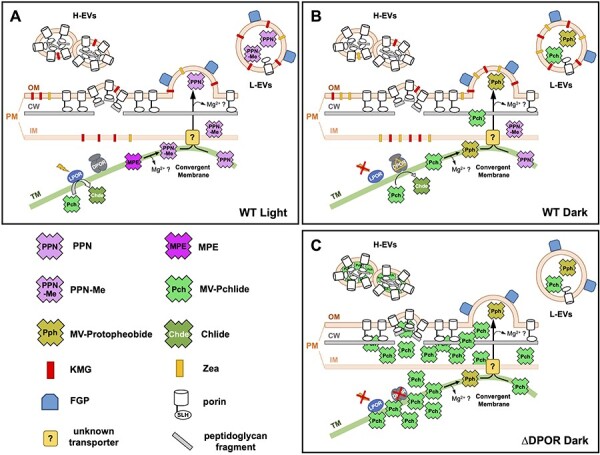
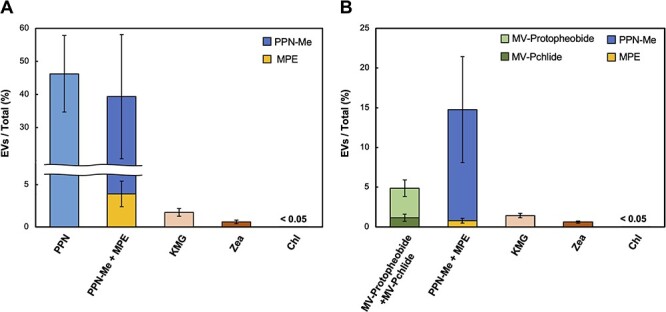
Extracellular vesicles (EVs) are derived from outer membranes (OMs) in Gram-negative bacteria and have diverse physiological functions. EV-mediated secretion of monovinyl protochlorophyllide (MV-Pchlide), the chlorophyll a (Chl) biosynthetic intermediate, was previously reported in a mutant lacking dark-operative Pchlide reductase in the cyanobacterium Leptolyngbya boryana. This study showed a detailed characterization of EVs from wild-type (WT) strain of L. boryana grown under photoautotrophic and dark heterotrophic conditions, focusing on the accumulation of Chl intermediates. WT L. boryana cells produce two types of EVs, low-density EVs (L-EVs) and high-density EVs (H-EVs), both under light and dark conditions. L-EVs and H-EVs showed distinct morphological features and protein compositions. L-EVs from cells grown under both light and dark conditions commonly contained carotenoids, ketomyxol glycoside and zeaxanthin as major pigments. Based on the protein compositions of EVs and other cellular membrane fractions, L-EVs and H-EVs are probably derived from low-density OMs and high-density OMs interacting with cell walls, respectively. Fluorescence detection of pigments was applied to EVs, and the two Chl intermediates, protoporphyrin IX and protoporphyrin IX monomethyl ester, were commonly detected in both L-EVs from light- and dark-grown cells, whereas L-EVs from dark-grown cells contained additional MV-Pchlide, MV-protopheophorbide and pheophorbide. The pigment ratios of L-EVs to the total culture medium of the Chl intermediates were much higher than those of carotenoids, suggesting an active transport of the Chl intermediates from the thylakoid membrane to L-EVs. Cyanobacterial EVs may play a novel role in alleviating the accumulation of Chl intermediates in cells.
细胞外囊泡(EVs)源自革兰氏阴性菌的外膜(OMs),具有多种生理功能。先前报道,在蓝细菌纤细席藻中,缺乏暗操作原叶绿素酸酯还原酶的突变体中存在EV介导的单乙烯基原叶绿素酸酯(MV-Pchlide)分泌,而MV-Pchlide是叶绿素a(Chl)生物合成的中间体。本研究详细表征了在光自养和暗异养条件下生长的纤细席藻野生型(WT)菌株的EVs,重点关注Chl中间体的积累。WT纤细席藻细胞在光照和黑暗条件下均产生两种类型的EVs,即低密度EVs(L-EVs)和高密度EVs(H-EVs)。L-EVs和H-EVs表现出不同的形态特征和蛋白质组成。在光照和黑暗条件下生长的细胞产生的L-EVs通常含有类胡萝卜素、酮粘醇糖苷和玉米黄质作为主要色素。基于EVs和其他细胞膜组分的蛋白质组成,L-EVs和H-EVs可能分别源自与细胞壁相互作用的低密度OMs和高密度OMs。对EVs进行了色素的荧光检测,在光照和黑暗条件下生长的细胞产生的L-EVs中均普遍检测到两种Chl中间体,即原卟啉IX和原卟啉IX单甲酯,而黑暗条件下生长的细胞产生的L-EVs还含有额外的MV-Pchlide、MV-原脱镁叶绿素和脱镁叶绿素。L-EVs中Chl中间体与总培养基的色素比率远高于类胡萝卜素,这表明Chl中间体从类囊体膜到L-EVs存在主动转运。蓝细菌EVs可能在减轻细胞中Chl中间体的积累方面发挥新作用。