Department of Civil and Environmental Engineering, Massachusetts Institute of Technology, Cambridge, MA, USA.
Department of Biological Sciences, Wellesley College, Wellesley, MA, USA.
Environ Microbiol. 2022 Jan;24(1):420-435. doi: 10.1111/1462-2920.15834. Epub 2021 Nov 12.
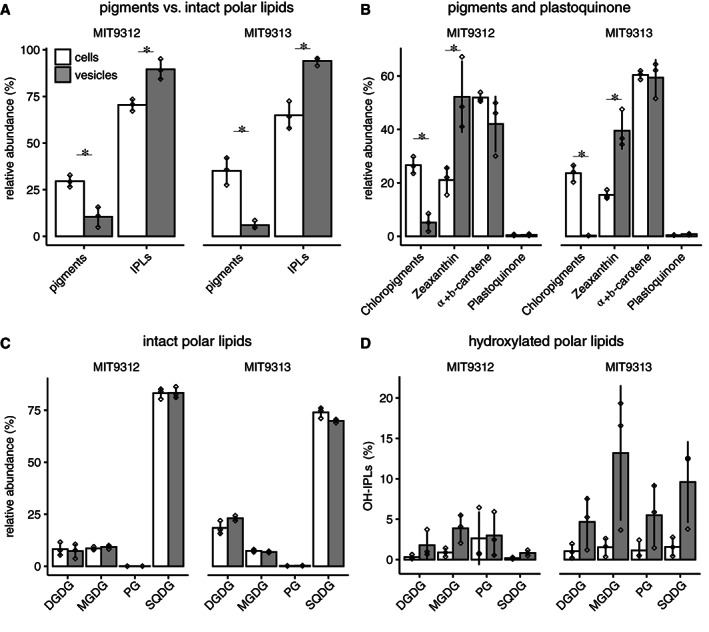
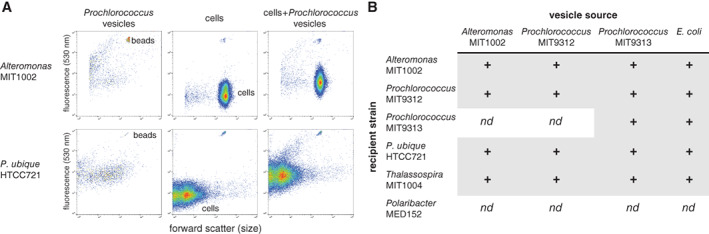
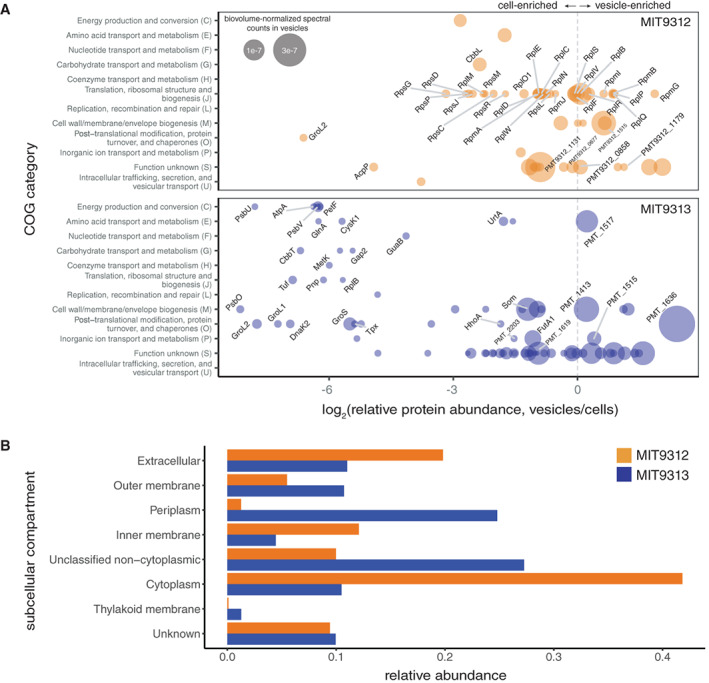
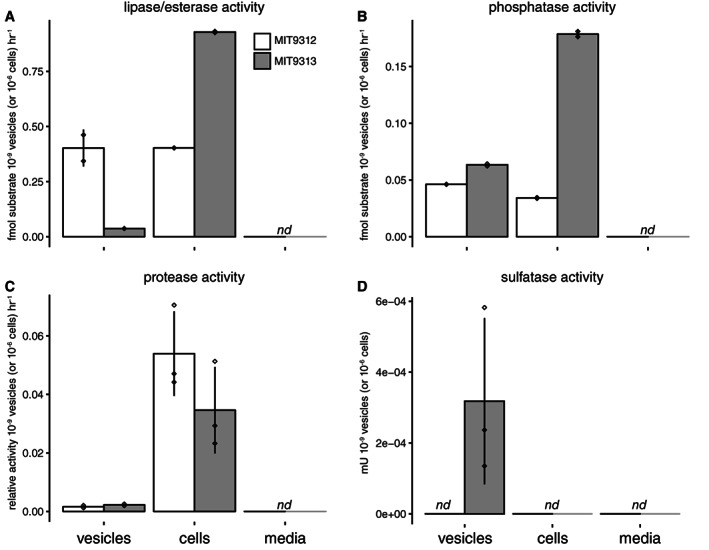
Extracellular vesicles are small (~50-200 nm diameter) membrane-bound structures released by cells from all domains of life. While vesicles are abundant in the oceans, their functions, both for cells themselves and the emergent ecosystem, remain a mystery. To better characterize these particles - a prerequisite for determining function - we analysed the lipid, protein, and metabolite content of vesicles produced by the marine cyanobacterium Prochlorococcus. We show that Prochlorococcus exports a diverse array of cellular compounds into the surrounding seawater enclosed within discrete vesicles. Vesicles produced by two different strains contain some materials in common, but also display numerous strain-specific differences, reflecting functional complexity within vesicle populations. The vesicles contain active enzymes, indicating that they can mediate extracellular biogeochemical reactions in the ocean. We further demonstrate that vesicles from Prochlorococcus and other bacteria associate with diverse microbes including the most abundant marine bacterium, Pelagibacter. Together, our data point toward hypotheses concerning the functional roles of vesicles in marine ecosystems including, but not limited to, possibly mediating energy and nutrient transfers, catalysing extracellular biochemical reactions, and mitigating toxicity of reactive oxygen species.
细胞外囊泡是由所有生命领域的细胞释放的小(~50-200nm 直径)膜结合结构。虽然囊泡在海洋中很丰富,但它们的功能,无论是对细胞本身还是新兴的生态系统,仍然是一个谜。为了更好地描述这些颗粒 - 确定功能的前提 - 我们分析了海洋蓝细菌聚球藻产生的囊泡的脂质、蛋白质和代谢物含量。我们表明,聚球藻将各种细胞化合物输出到周围海水中,这些化合物被封闭在离散的囊泡内。两种不同菌株产生的囊泡含有一些共同的物质,但也显示出许多菌株特异性差异,反映了囊泡群体内的功能复杂性。这些囊泡含有活性酶,表明它们可以在海洋中介导细胞外生物地球化学反应。我们进一步证明,来自聚球藻和其他细菌的囊泡与包括最丰富的海洋细菌 Pelagibacter 在内的各种微生物结合。总之,我们的数据指向关于囊泡在海洋生态系统中的功能作用的假设,包括但不限于可能介导能量和营养转移、催化细胞外生化反应以及减轻活性氧毒性。