Institute for NanoBioTechnology, Johns Hopkins University, Baltimore, MD 21218.
Department of Biomedical Engineering, Johns Hopkins University School of Medicine, Baltimore, MD 21205.
Proc Natl Acad Sci U S A. 2024 Aug 27;121(35):e2400194121. doi: 10.1073/pnas.2400194121. Epub 2024 Aug 22.
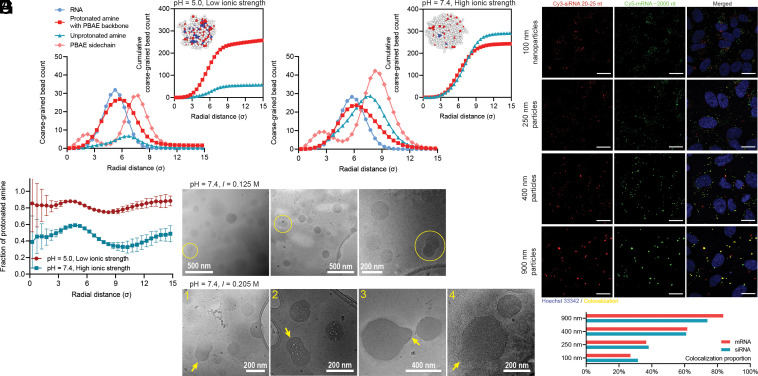
Size-dependent phagocytosis is a well-characterized phenomenon in monocytes and macrophages. However, this size effect for preferential gene delivery to these important cell targets has not been fully exploited because commonly adopted stabilization methods for electrostatically complexed nucleic acid nanoparticles, such as PEGylation and charge repulsion, typically arrest the vehicle size below 200 nm. Here, we bridge the technical gap in scalable synthesis of larger submicron gene delivery vehicles by electrostatic self-assembly of charged nanoparticles, facilitated by a polymer structurally designed to modulate internanoparticle Coulombic and van der Waals forces. Specifically, our strategy permits controlled assembly of small poly(β-amino ester)/messenger ribonucleic acid (mRNA) nanoparticles into particles with a size that is kinetically tunable between 200 and 1,000 nm with high colloidal stability in physiological media. We found that assembled particles with an average size of 400 nm safely and most efficiently transfect monocytes following intravenous administration and mediate their differentiation into macrophages in the periphery. When a CpG adjuvant is co-loaded into the particles with an antigen mRNA, the monocytes differentiate into inflammatory dendritic cells and prime adaptive anticancer immunity in the tumor-draining lymph node. This platform technology offers a unique ligand-independent, particle-size-mediated strategy for preferential mRNA delivery and enables therapeutic paradigms monocyte programming.
大小依赖吞噬作用是单核细胞和巨噬细胞中一种特征明显的现象。然而,这种大小效应对于将基因递送到这些重要细胞靶点的作用尚未得到充分利用,因为通常采用的静电复合核酸纳米颗粒的稳定化方法,如聚乙二醇化和电荷排斥,通常将载体大小限制在 200nm 以下。在这里,我们通过带电荷纳米颗粒的静电自组装来弥合可扩展合成较大亚微米级基因传递载体的技术差距,这得益于一种聚合物,其结构设计用于调节纳米颗粒间的库仑力和范德华力。具体而言,我们的策略允许将小的聚(β-氨基酯)/信使核糖核酸(mRNA)纳米颗粒受控组装成具有动力学可调大小的颗粒,在生理介质中具有高胶体稳定性,大小在 200nm 至 1000nm 之间。我们发现,静脉给药后,平均大小为 400nm 的组装颗粒能够安全有效地转染单核细胞,并使其在外周分化为巨噬细胞。当 CpG 佐剂与抗原 mRNA 共载入颗粒中时,单核细胞分化为炎症树突状细胞,并在肿瘤引流淋巴结中引发适应性抗癌免疫。该平台技术提供了一种独特的配体独立、基于颗粒大小的 mRNA 递呈策略,能够实现单核细胞编程的治疗范例。