Centre for Clinical Management of Dengue & Dengue Haemorrhagic Fever, Negombo General Hospital, Negombo, Sri Lanka.
Takeda Vaccines, Inc., Boston, Massachusetts, United States of America.
PLoS Negl Trop Dis. 2024 Aug 22;18(8):e0012376. doi: 10.1371/journal.pntd.0012376. eCollection 2024 Aug.
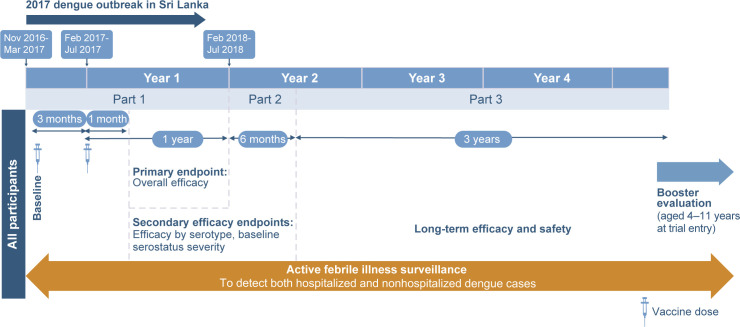
Outbreaks of dengue can overburden hospital systems, drastically reducing capacity for other care. The 2017 dengue serotype 2 (DENV-2) outbreak in Sri Lanka coincided with vaccination in an ongoing phase 3 efficacy trial of a tetravalent dengue vaccine, TAK-003 (NCT02747927). Here, we present data on the efficacy of TAK-003 following two doses of the vaccine administered 3 months apart in participants aged 4-16 years in Sri Lanka. In addition, we have used the 2017 outbreak dynamics to model the potential impact of TAK-003 on virologically confirmed dengue (VCD) cases and hospitalizations during an outbreak situation.
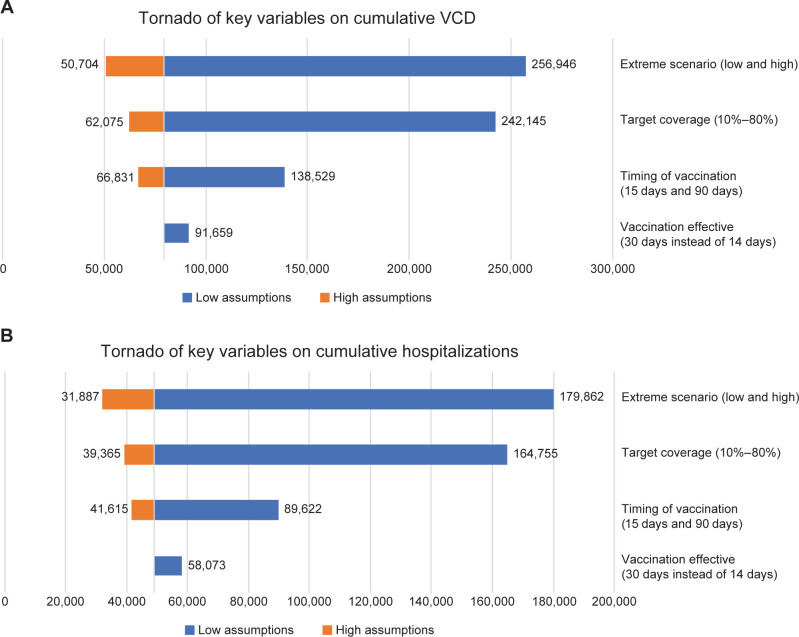
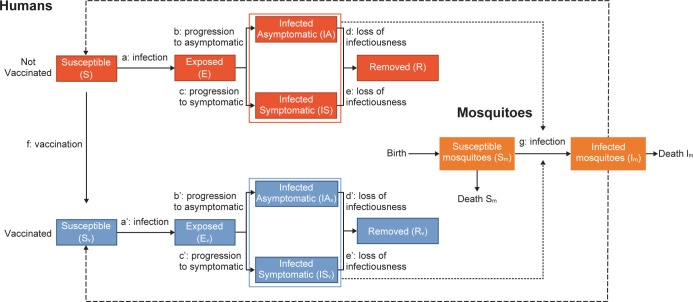
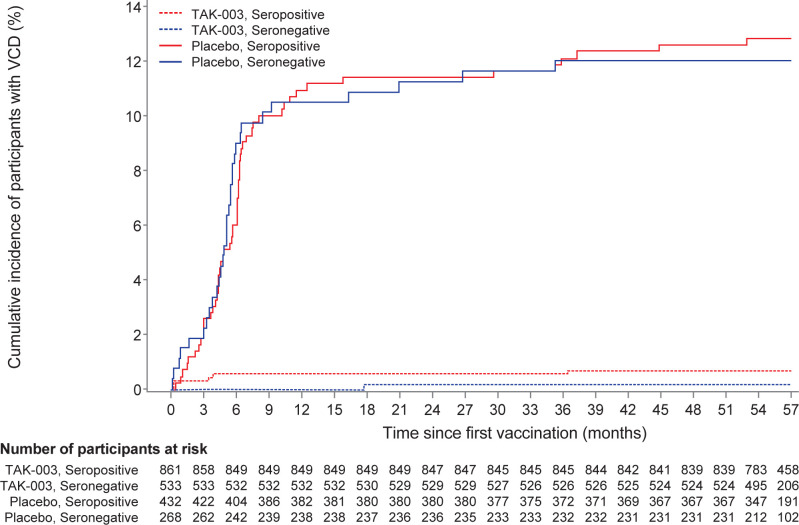
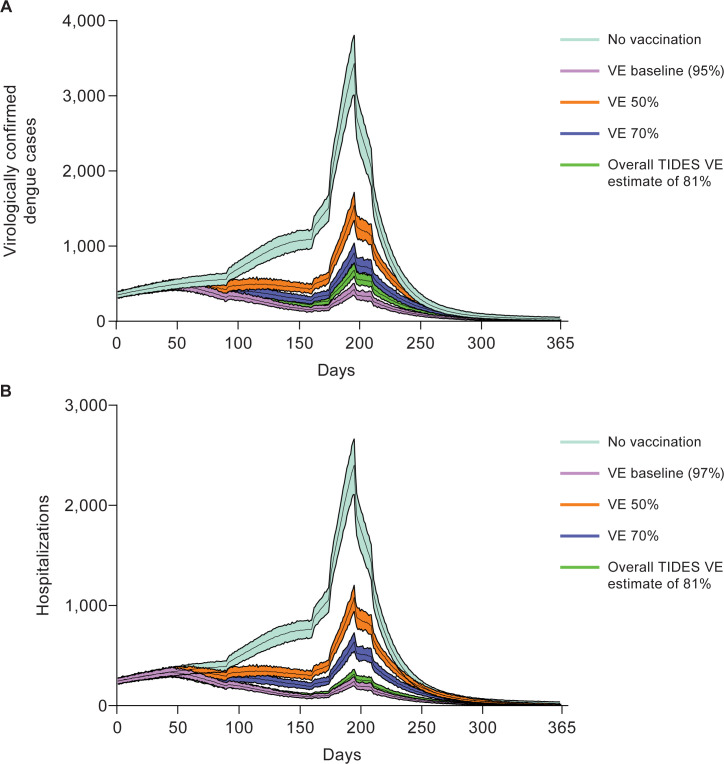
METHODOLOGY/PRINCIPAL FINDINGS: Modeling was performed using an age-structured, host-vector, spatial and stochastic transmission model, assuming 65% vaccine coverage and 30 days until initiation of vaccination. Efficacy of TAK-003 against VCD and hospitalized VCD cases was based on data against DENV-2 from the first year of the phase 3 trial. Vaccine efficacy and safety findings in Sri Lanka were in line with those of the overall trial population. The efficacy estimates in Sri Lanka up to the first 12 months after the second dose of TAK-003 were 94.7% and 95.7% against VCD and hospitalized VCD cases, respectively. Modeling of the trial data over an extended geographic area showed a substantial reduction in cases and a flattening of outbreak curves from TAK-003 use. The baseline vaccination scenario (initiation at 30 days, 65% target coverage, vaccine effective at 14 days, 70% hospitalization rate, VE of 95% for VCD and 97% for hospitalized VCD, and 47% for asymptomatic) resulted in a 69.1% reduction in VCD cases and 72.7% reduction in VCD hospitalizations compared with no vaccination. An extreme high scenario (vaccination initiated at Day 15, 80% coverage rate, baseline VE) resulted in 80.3% and 82.3% reduction in VCD and VCD hospitalizations, respectively. Vaccine performance, speed of vaccination campaign initiation, and vaccine coverage were key drivers in reducing VCD cases and hospitalizations.
CONCLUSIONS/SIGNIFICANCE: Overall, the study and modeling results indicate that TAK-003 has the potential of meaningful utility in dengue outbreaks in endemic areas.
登革热疫情可能会使医院系统不堪重负,大幅降低其他护理的能力。2017 年斯里兰卡登革热血清型 2(DENV-2)疫情与正在进行的四价登革热疫苗 TAK-003 (NCT02747927)三期疗效试验中的疫苗接种同时发生。在这里,我们报告了在斯里兰卡,4-16 岁参与者接种两剂 TAK-003 疫苗,每剂间隔 3 个月后,疫苗的疗效数据。此外,我们利用 2017 年的疫情动态,对 TAK-003 在疫情情况下对病毒确诊登革热(VCD)病例和住院治疗的潜在影响进行了建模。
方法/主要发现:使用年龄结构、宿主-媒介、空间和随机传播模型进行建模,假设疫苗覆盖率为 65%,疫苗接种开始前需 30 天。TAK-003 对 VCD 和住院 VCD 病例的疗效基于三期试验第一年针对 DENV-2 的数据。在斯里兰卡,疫苗的疗效和安全性发现与总体试验人群一致。在接种 TAK-003 后的头 12 个月内,TAK-003 对 VCD 和住院 VCD 病例的疗效估计分别为 94.7%和 95.7%。在更广泛的地理区域对试验数据进行建模显示,使用 TAK-003 可显著减少病例数,并使疫情曲线变平。基线接种方案(第 30 天开始,目标覆盖率为 65%,疫苗接种后 14 天有效,住院率为 70%,VCD 的疫苗有效率为 95%,住院 VCD 的疫苗有效率为 97%,无症状者为 47%)导致 VCD 病例减少 69.1%,VCD 住院人数减少 72.7%。高接种方案(第 15 天开始接种,覆盖率为 80%,基础 VE)分别导致 VCD 和 VCD 住院人数减少 80.3%和 82.3%。疫苗性能、疫苗接种运动启动速度和疫苗覆盖率是减少 VCD 病例和住院人数的关键驱动因素。
结论/意义:总的来说,研究和建模结果表明,TAK-003 有可能在流行地区的登革热疫情中发挥重要作用。