University of Liverpool Institute of Systems, Molecular and Integrative Biology, Liverpool, UK; Liverpool University Hospitals NHS Foundation Trust, Department of Gastroenterology, Liverpool, UK.
University of Liverpool Institute of Systems, Molecular and Integrative Biology, Liverpool, UK.
EBioMedicine. 2024 Sep;107:105282. doi: 10.1016/j.ebiom.2024.105282. Epub 2024 Aug 22.
Irritable bowel syndrome (IBS) is a common and debilitating disorder manifesting with abdominal pain and bowel dysfunction. A mainstay of treatment is dietary modification, including restriction of FODMAPs (fermentable oligosaccharides, disaccharides, monosaccharides and polyols). A greater response to a low FODMAP diet has been reported in those with a distinct IBS microbiome termed IBS-P. We investigated whether this is linked to specific changes in the metabolome in IBS-P.
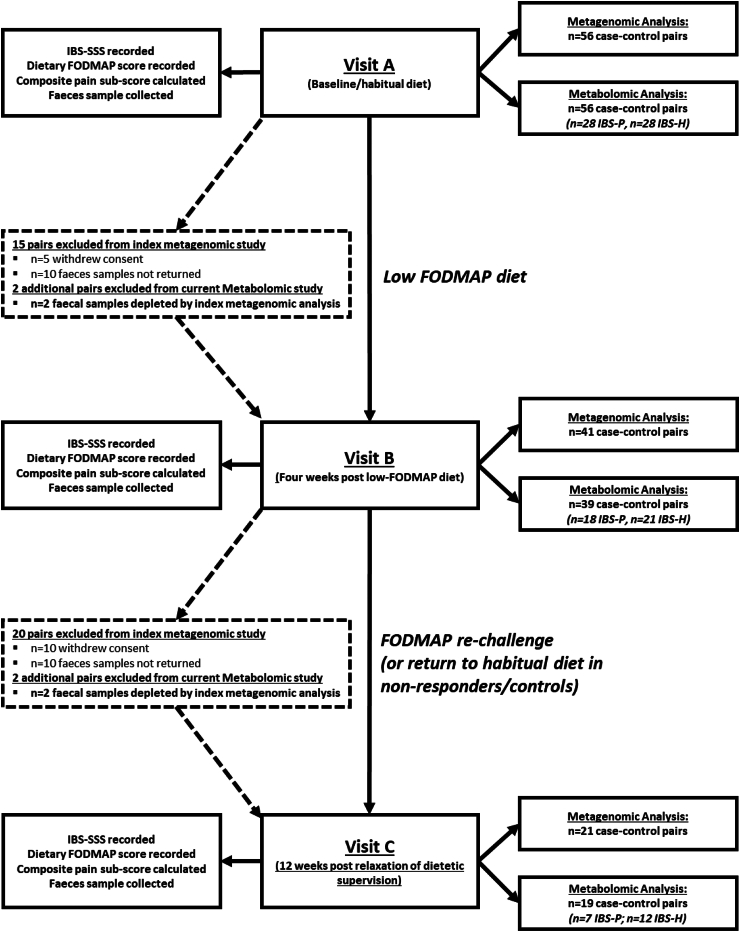
Solid phase microextraction gas chromatography-mass spectrometry was used to examine the faecal headspace of 56 IBS cases (each paired with a non-IBS household control) at baseline, and after four-weeks of a low FODMAP diet (39 pairs). 50% cases had the IBS-P microbial subtype, while the others had a microbiome that more resembled healthy controls (termed IBS-H). Clinical response to restriction of FODMAPs was measured with the IBS-symptom severity scale, from which a pain sub score was calculated.
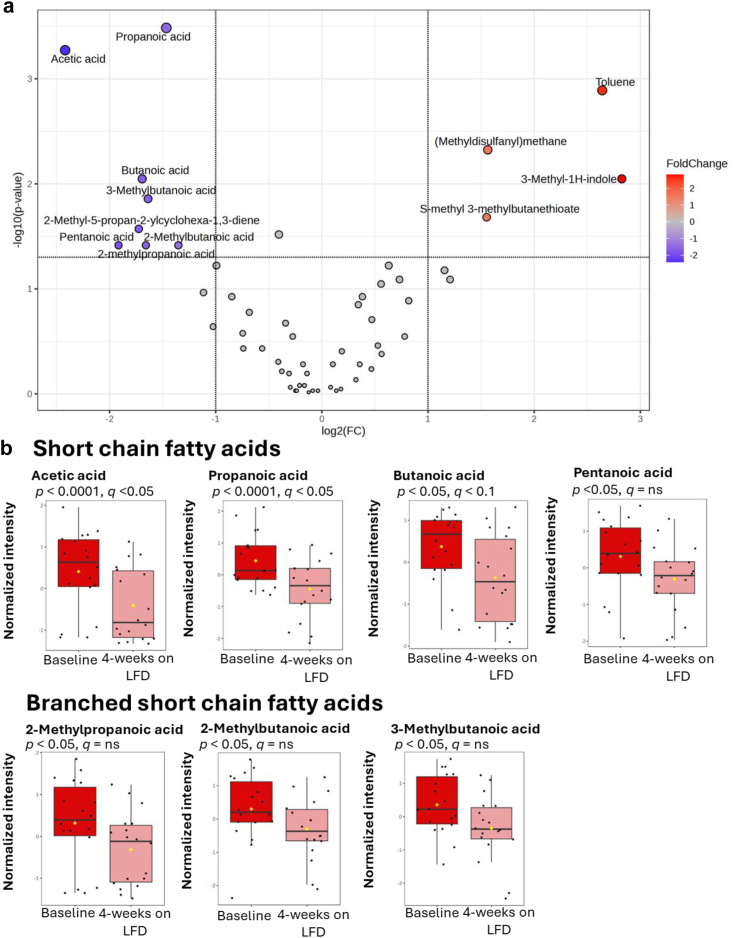
Two distinct metabotypes were identified and mapped onto the microbial subtypes. IBS-P was characterised by a fermentative metabolic profile rich in short chain fatty acids (SCFAs). After FODMAP restriction significant reductions in SCFAs were observed in IBS-P. SCFA levels did not change significantly in the IBS-H group. The magnitude of pain and overall symptom improvement were significantly greater in IBS-P compared to IBS-H (p = 0.016 and p = 0.026, respectively). Using just five metabolites, a biomarker model could predict microbial subtype with accuracy (AUROC 0.797, sensitivity 78.6% (95% CI: 0.78-0.94), specificity 71.4% (95% CI: 0.55-0.88).
A metabotype high in SCFAs can be manipulated by restricting fermentable carbohydrate, and is associated with an enhanced clinical response to this dietary restriction. This implies that SCFAs harbour pro-nociceptive potential when produced in a specific IBS niche. By ascertaining metabotype, microbial subtype can be predicted with accuracy. This could allow targeted FODMAP restriction in those seemingly primed to respond best.
This research was co-funded by Addenbrooke's Charitable Trust, Cambridge University Hospitals and the Wellcome Sanger Institute, and supported by the NIHR Cambridge Biomedical Research Centre (BRC-1215-20014).
肠易激综合征(IBS)是一种常见且使人虚弱的疾病,其特征为腹痛和肠道功能紊乱。治疗的主要方法是饮食调整,包括限制可发酵寡糖、二糖、单糖和多元醇(FODMAPs)。在具有特定 IBS 微生物组的患者中,低 FODMAP 饮食的反应更大,该微生物组被称为 IBS-P。我们研究了这是否与 IBS-P 中的代谢组特定变化有关。
采用固相微萃取气相色谱-质谱法检测 56 例 IBS 患者(每例均与非 IBS 家庭对照配对)的粪便顶空,基线时和低 FODMAP 饮食四周后(39 对)进行检测。50%的患者具有 IBS-P 微生物亚型,而其他患者的微生物组更类似于健康对照(称为 IBS-H)。使用 IBS 症状严重程度量表测量对 FODMAP 限制的临床反应,由此计算疼痛子评分。
确定了两种不同的代谢类型,并将其映射到微生物亚型上。IBS-P 的特点是富含短链脂肪酸(SCFAs)的发酵代谢特征。在限制 FODMAP 后,IBS-P 中 SCFAs 显著减少。IBS-H 组的 SCFA 水平没有显著变化。与 IBS-H 相比,IBS-P 的疼痛和整体症状改善幅度明显更大(p=0.016 和 p=0.026)。仅使用五种代谢物,生物标志物模型即可准确预测微生物亚型(AUROC 0.797,敏感性 78.6%(95%CI:0.78-0.94),特异性 71.4%(95%CI:0.55-0.88)。
富含 SCFAs 的代谢类型可以通过限制可发酵碳水化合物来调节,并且与对这种饮食限制的增强临床反应有关。这意味着当在特定的 IBS 生态位中产生时,SCFAs 具有潜在的致痛作用。通过确定代谢类型,可以准确预测微生物亚型。这可以使那些似乎最有可能做出最佳反应的人有针对性地限制 FODMAP。
这项研究由 Addenbrooke's Charitable Trust、剑桥大学医院和 Wellcome Sanger 研究所共同资助,并得到了 NIHR 剑桥生物医学研究中心(BRC-1215-20014)的支持。