Pollock Carol, Carrero Juan-Jesus, Kanda Eiichiro, Ofori-Asenso Richard, Palmer Ewelina, Niklasson Anna, Linder Andrew, Woodward Helen, Pentakota Surendra, Garcia Sanchez Juan Jose, Kashihara Naoki, Fishbane Steven, Pecoits-Filho Roberto, Wheeler David C
Kolling Institute, Royal North Shore Hospital, University of Sydney, Sydney, New South Wales, Australia.
Department of Medical Epidemiology and Biostatistics, Karolinska Institutet, Solna, Sweden.
Am J Nephrol. 2024;55(6):618-628. doi: 10.1159/000541064. Epub 2024 Aug 22.
Chronic kidney disease (CKD) can have a profound impact on patients' lives. However, multinational data on patients' lived experience with CKD are scarce.
Individuals from the prospective cohort of DISCOVER CKD (NCT04034992), an observational cohort study, were recruited to participate in one-to-one telephone interviews to explore their lived experience with CKD. A target of 100 participant interviews was planned across four countries (Japan, Spain, the UK, and the USA). These qualitative interviews, lasting ∼60-90 min, were conducted in the local language by trained interviewers with specific experience in CKD, between January and June 2023. Transcribed interviews were translated into English for coding and analysis. Data were coded using qualitative research software.
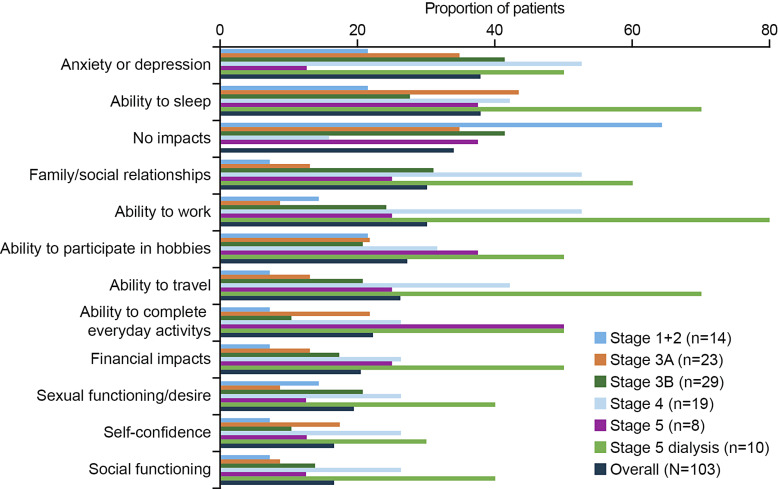
Of the 105 participants interviewed, 103 were included in the final analysis. The average time since CKD diagnosis was 9.5 years, and at least half (50.5%) of participants had CKD stage 3A or 3B. CKD diagnosis was an emotional experience, driven by worry (n = 29/103; 28.2%) and shock (n = 26/103; 25.2%), and participants often reported feeling inadequately informed. Additional information was frequently sought, either online or via other healthcare providers. The proportion of participants reporting no impacts of CKD on their lives was highest in those with CKD stage 1 and 2 (64.3%). Conversely, every participant in the CKD stage 5 on dialysis group reported some impact of CKD on their lives. Across all participants, the most reported impacts were anxiety or depression (37.9%) or ability to sleep (37.9%). The frequency of the reported impacts appeared to increase with disease severity, with the highest rates observed in the dialysis group. In that group, the most frequently reported impact was on the ability to work (80.0%).
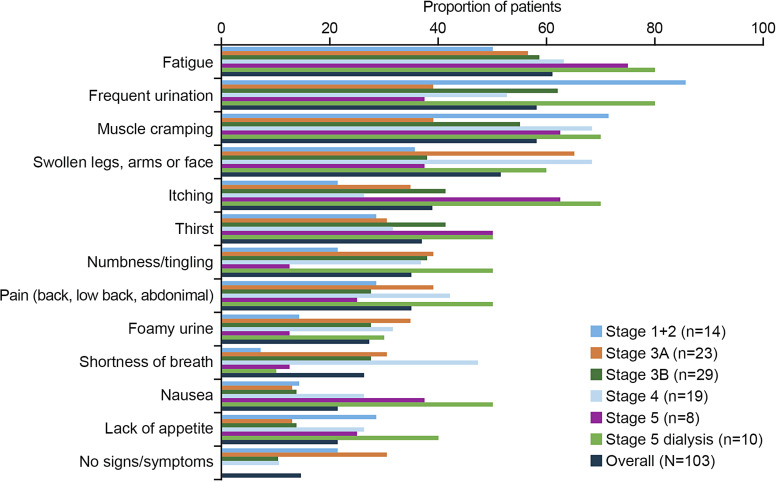
Findings from this multinational qualitative study suggest that patients may experience symptoms and signs of disease prior to diagnosis; however, these are often nonspecific and may not be directly associated with CKD. Once diagnosed, the burden of CKD can have a diverse, negative impact on various aspects of patients' lives. This highlights the need for early identification of at-risk individuals, and the importance of early CKD diagnosis and management with guideline-directed therapies to either prevent further deterioration of CKD or slow its progression, thus reducing symptom burden and improving quality of life.
慢性肾脏病(CKD)会对患者的生活产生深远影响。然而,关于CKD患者生活经历的跨国数据却很匮乏。
从DISCOVER CKD前瞻性队列研究(NCT04034992)中招募个体参与一对一电话访谈,以探究他们的CKD生活经历。计划在四个国家(日本、西班牙、英国和美国)对100名参与者进行访谈。这些定性访谈持续约60 - 90分钟,由具有CKD特定经验的经过培训的访谈者于2023年1月至6月以当地语言进行。转录后的访谈被翻译成英文进行编码和分析。数据使用定性研究软件进行编码。
在接受访谈的105名参与者中,103名被纳入最终分析。自CKD诊断以来的平均时间为9.5年,至少一半(50.5%)的参与者处于CKD 3A或3B期。CKD诊断是一种情感体验,由担忧(n = 29/103;28.2%)和震惊(n = 26/103;25.2%)驱动,参与者经常表示信息了解不足。他们经常通过网络或其他医疗服务提供者寻求更多信息。报告CKD对其生活无影响的参与者比例在CKD 1期和2期患者中最高(64.3%)。相反,CKD 5期透析组的每位参与者都报告CKD对其生活有一定影响。在所有参与者中,报告最多的影响是焦虑或抑郁(37.9%)以及睡眠能力(37.9%)。报告的影响频率似乎随疾病严重程度增加,在透析组中观察到的比例最高。在该组中,报告最频繁的影响是工作能力(80.0%)。
这项跨国定性研究的结果表明,患者在诊断前可能会出现疾病的症状和体征;然而,这些往往是非特异性的,可能与CKD没有直接关联。一旦确诊,CKD的负担会对患者生活的各个方面产生多样的负面影响。这凸显了早期识别高危个体的必要性,以及早期CKD诊断和采用指南指导疗法进行管理的重要性,以预防CKD进一步恶化或减缓其进展,从而减轻症状负担并提高生活质量。