Department of Management, Information and Production Engineering, University of Bergamo, Via Marconi 4, 24044, Dalmine, Bergamo, Italy.
Department of Movement, Human and Health Sciences, University of Rome "Foro Italico", Piazza Lauro de Bosis 15, 00135, Rome, Italy.
Sci Rep. 2024 Aug 22;14(1):19548. doi: 10.1038/s41598-024-69461-w.
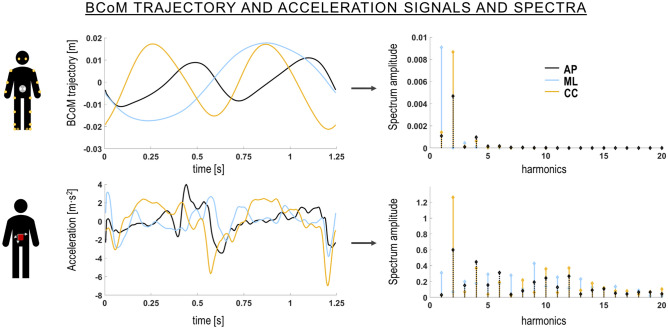
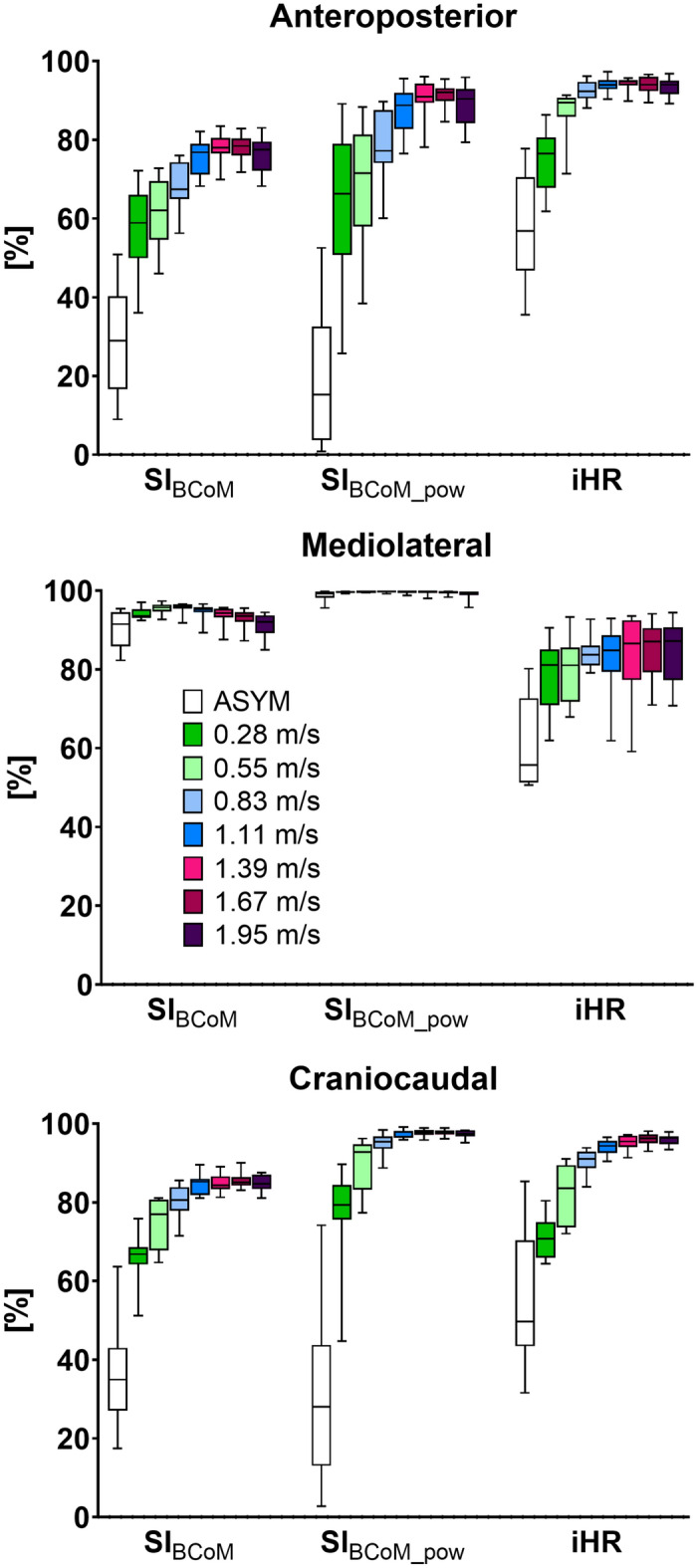
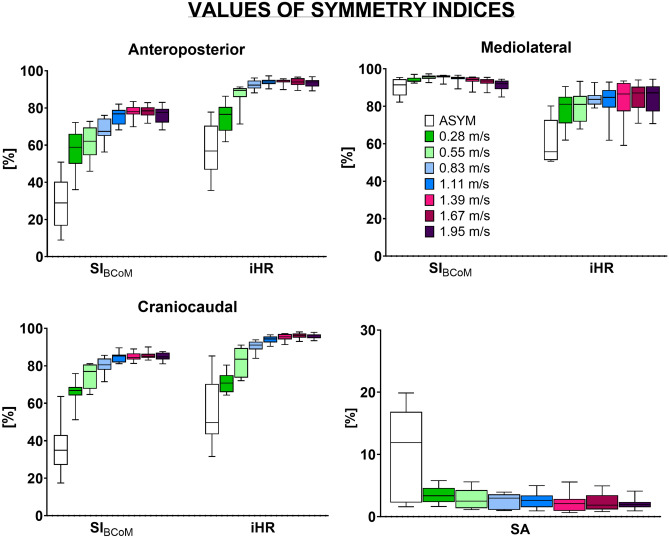
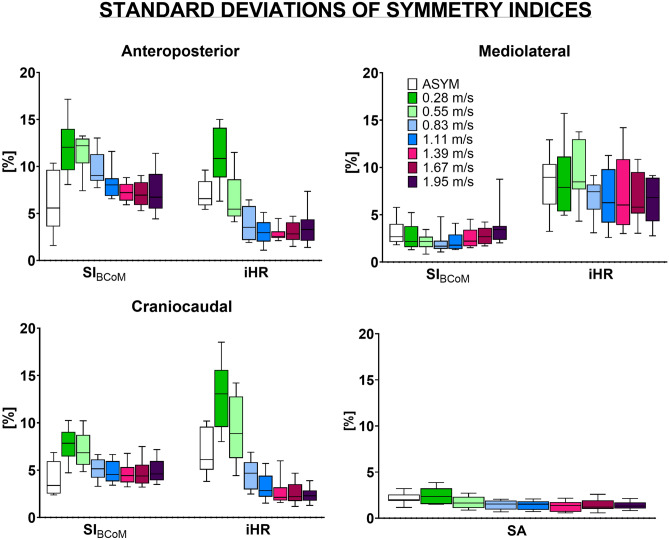
Gait symmetry is one of the most informative aspects describing the quality of gait. Many indices have been proposed to quantify gait symmetry. Among them, indices focusing on the comparison of the two body sides (e.g., Symmetry Angle, SA) and indices based on the analysis of the locomotor act as a whole, dealing with the body center of mass (e.g., Symmetry Index, SI) or lower trunk accelerometry (e.g., improved Harmonic Ratio, iHR) have been proposed. Remarkably, the relationship between these indices has received little attention so far, as well as the influence of gait speed on their values. The aim of this study is to investigate this relationship by comparing the SA, SI, and iHR, and to explore the effect of walking speed on these indices. Ten healthy adults walked for 60 s on a treadmill at seven different speeds (from 0.28 to 1.95 m s) and simulate an asymmetric gait (ASYM) at 0.83 m s. Marker-based trajectories were recorded, and the body center of mass 3D trajectory was obtained. Simultaneously, lower trunk 3D linear accelerations were collected using a triaxial accelerometer. SI, iHR, and SA were calculated for each stride, each anatomical direction, and each condition. Perfect symmetry was never displayed in any axes and any indices. Significant differences existed between SI, and iHR in all anatomical directions (p < 0.0001). The walking speed significantly affected SI and iHR values in anteroposterior and craniocaudal directions, but not in mediolateral. Conversely, no walking speed effect was found for SA (p = 0.28). All three indices significantly discriminated between ASYM and the corresponding walking condition (p < 0.05). Gait symmetry may differ significantly according to the data source, mathematical approach, and walking speed. Healthy individuals display an asymmetrical gait and acknowledging this aspect is crucial when establishing rehabilitation objectives and assessing the quality of gait in the clinical setting.
步态对称性是描述步态质量的最具信息量的方面之一。已经提出了许多指标来量化步态对称性。其中,一些指标侧重于比较身体两侧(例如,对称角度,SA),而另一些指标则基于对整个运动行为的分析,涉及身体质心(例如,对称指数,SI)或下躯干加速度计(例如,改进的谐波比,iHR)。值得注意的是,到目前为止,这些指标之间的关系以及步态速度对它们值的影响还没有得到太多关注。本研究的目的是通过比较 SA、SI 和 iHR 来研究这种关系,并探讨行走速度对这些指标的影响。十名健康成年人在跑步机上以七种不同速度(从 0.28 到 1.95 m/s)行走 60 秒,并在 0.83 m/s 时模拟不对称步态(ASYM)。记录基于标记的轨迹,并获得身体质心 3D 轨迹。同时,使用三轴加速度计收集下躯干 3D 线性加速度。为每个步和每个解剖方向以及每个条件计算 SI、iHR 和 SA。在任何轴和任何指标上都从未显示出完美的对称性。在所有解剖方向上,SI 和 iHR 之间存在显著差异(p < 0.0001)。行走速度显著影响前后和头尾方向的 SI 和 iHR 值,但在左右方向上没有影响。相反,SA 没有行走速度的影响(p = 0.28)。所有三个指标在 ASYM 和相应的行走条件之间均有显著差异(p < 0.05)。步态对称性可能根据数据源、数学方法和行走速度而有很大差异。健康个体表现出不对称步态,在临床环境中确定康复目标和评估步态质量时,了解这一方面至关重要。