School of Public Health, Kunming Medical University, Kunming, China.
The Second Affiliated Hospital of Soochow University, Suzhou, Jiangsu, China.
BMC Public Health. 2024 Aug 22;24(1):2279. doi: 10.1186/s12889-024-19743-9.
Zhiguo ethnic groups, commonly known as "the directly-entering-socialism ethnic groups", represent Chinese ethnic minorities who have undergone a unique social development trajectory by transforming directly from primitive societies to the socialist stage. In recent decades, significant lifestyle transformations have occurred among Zhiguo ethnic groups. Understanding their health lifestyles can play a strategic role in China's pursuit of universal health coverage. This study aims to examine patterns of health-related lifestyle among Zhiguo ethnic groups and explore whether sociodemographic features and specific indicators related to health status are associated with particular classes.
A cross-sectional study was conducted in Yunnan Province, China, from July to December 2022. Stratified random sampling method was employed to recruit residents belonging to six Zhiguo ethnic groups aged between 15 and 64. Latent class analysis was performed to identify clusters of health-related behaviors within each ethnic group. Logistic regression was utilized to determine the predictors of health lifestyles.
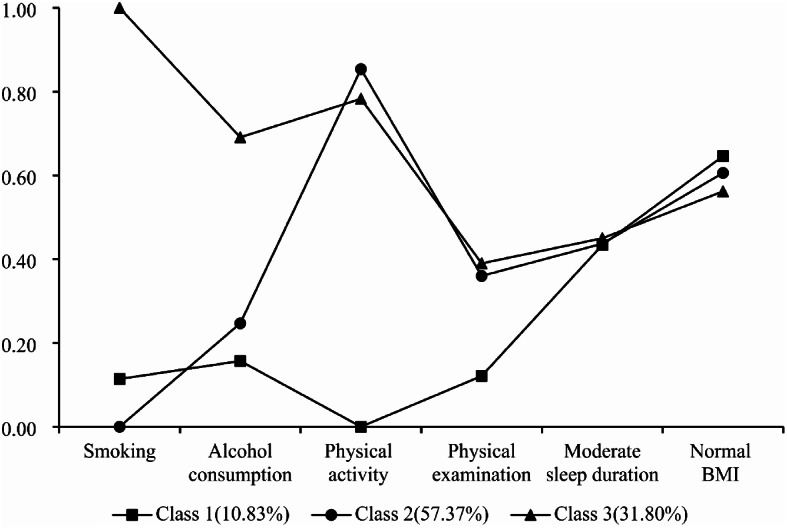
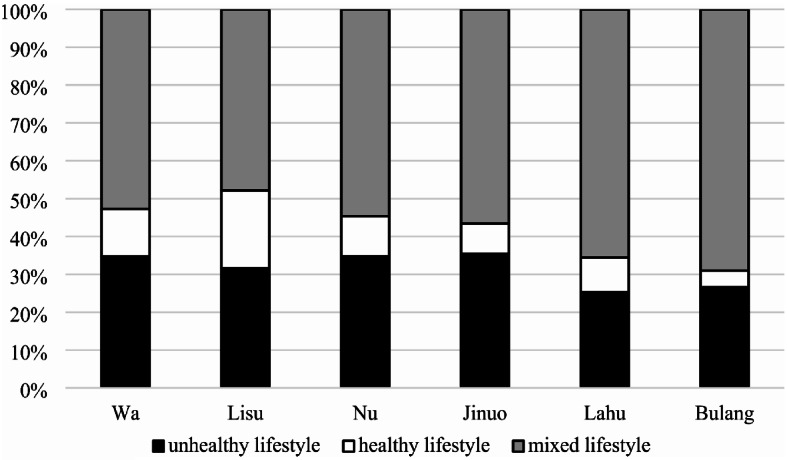
A total of 1,588 individuals from the Zhiguo ethnic groups participated in this study. Three latent classes representing prevalent health lifestyles among the Zhiguo ethnic groups were identified: "unhealthy lifestyle" (31.80%), "mixed lifestyle" (57.37%), and "healthy lifestyle" (10.83%). In the overall population, individuals belonging to the "healthy lifestyle" group exhibited a higher likelihood of being non-farmers (OR: 2.300, 95% CI: 1.347-3.927), women (OR: 21.459, 95% CI: 13.678-33.667), married individuals (OR: 1.897, 95% CI: 1.146-3.138), and those residing within a walking distance of less than 15 min from the nearest health facility (OR: 2.133, 95% CI: 1.415-3.215). Conversely, individuals in the age cohorts of 30-39 years (OR: 0.277, 95% CI: 0.137-0.558) and 40-49 years (OR: 0.471, 95% CI: 0.232-0.958) showed a decreased likelihood of adopting a healthy lifestyle.
A considerable proportion of the Zhiguo ethnic groups have not adopted healthy lifestyles. Targeted interventions aimed at improving health outcomes within these communities should prioritize addressing the clustering of unfavorable health behaviors, with particular emphasis on single male farmers aged 30-49, and expanding healthcare coverage for individuals residing more than 15 min away from accessible facilities.
直过民族,又称“直接过渡到社会主义的少数民族”,代表了中国少数民族中经历了独特社会发展轨迹的群体,他们直接从原始社会过渡到社会主义阶段。近几十年来,直过民族的生活方式发生了重大变化。了解他们的健康生活方式对于中国实现全民健康覆盖具有战略意义。本研究旨在探讨直过民族的健康相关生活方式模式,并探讨社会人口特征和与健康状况相关的具体指标是否与特定类别相关。
本研究于 2022 年 7 月至 12 月在云南省进行了一项横断面研究。采用分层随机抽样方法招募年龄在 15 至 64 岁之间的 6 个直过民族的居民。使用潜在类别分析来确定每个民族内健康相关行为的聚类。使用逻辑回归确定健康生活方式的预测因素。
共有 1588 名直过民族的人参加了这项研究。确定了代表直过民族中普遍存在的健康生活方式的三个潜在类别:“不健康生活方式”(31.80%)、“混合生活方式”(57.37%)和“健康生活方式”(10.83%)。在总人口中,属于“健康生活方式”组的个体更有可能是非农民(OR:2.300,95%CI:1.347-3.927)、女性(OR:21.459,95%CI:13.678-33.667)、已婚个体(OR:1.897,95%CI:1.146-3.138)和居住在离最近医疗机构步行距离不到 15 分钟的个体(OR:2.133,95%CI:1.415-3.215)。相比之下,30-39 岁(OR:0.277,95%CI:0.137-0.558)和 40-49 岁(OR:0.471,95%CI:0.232-0.958)年龄组的个体更不可能采用健康的生活方式。
相当一部分直过民族没有采用健康的生活方式。针对这些社区改善健康结果的有针对性的干预措施应优先解决不良健康行为的聚类问题,特别关注 30-49 岁的单身男性农民,并扩大对居住在离可及设施超过 15 分钟的个体的医疗保健覆盖范围。