College of Public Health, Zhengzhou University, No.100 Science Avenue, Zhengzhou, 450001, Henan, People's Republic of China.
BMC Public Health. 2023 Jul 3;23(1):1279. doi: 10.1186/s12889-023-16197-3.
Unhealthy lifestyles are risk factors for non-communicable diseases (NCDs) and tend to be clustered, with a trajectory that extends from adolescence to adulthood. This study investigated the association of diets, tobacco, alcohol, physical activity (PA), screen time (ST) and sleep duration (SD) in a total of six lifestyles, separately and as cumulative lifestyle scores, with sociodemographic characteristics among school-aged adolescents in the Chinese city of Zhengzhou.
In the aggregate, 3,637 adolescents aged 11-23 years were included in the study. The questionnaire collected data on socio-demographic characteristics and lifestyles. Healthy and unhealthy lifestyles were identified and scored, depending on the individual score (0 and 1 for healthy and unhealthy lifestyles respectively), with a total score between 0 and 6. Based on the sum of the dichotomous scores, the number of unhealthy lifestyles was calculated and divided into three clusters (0-1, 2-3, 4-6). Chi-square test was used to analyze the group difference of lifestyles and demographic characteristics, and multivariate logistic regression was used to explore the associations between demographic characteristics and the clustering status of unhealthy lifestyles.
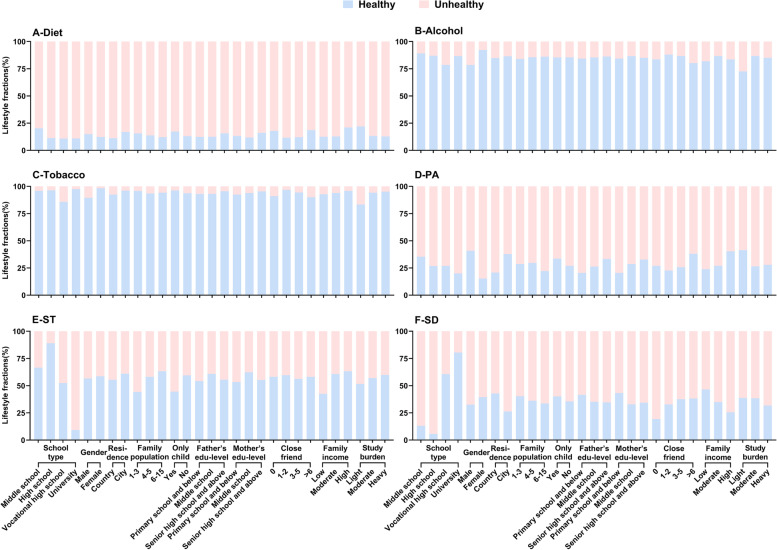
Among all participants, the prevalence of unhealthy lifestyles was: 86.4% for diet, 14.5% for alcohol, 6.0% for tobacco, 72.2% for PA, 42.3% for ST and 63.9% for SD. Students who were in university, female, lived in country (OR = 1.725, 95% CI: 1.241-2.398), had low number of close friends (1-2: OR = 2.110, 95% CI: 1.428-3.117; 3-5: OR = 1.601, 95% CI: 1.168-2.195), and had moderate family income (OR = 1.771, 95% CI: 1.208-2.596) were more likely to develop unhealthy lifestyles. In total, unhealthy lifestyles remain highly prevalent among Chinese adolescents.
In the future, the establishment of an effective public health policy may improve the lifestyle profile of adolescents. Based on the lifestyle characteristics of different populations reported in our findings, lifestyle optimization can be more efficiently integrated into the daily lives of adolescents. Moreover, it is essential to conduct well-designed prospective studies on adolescents.
不健康的生活方式是非传染性疾病(NCD)的危险因素,且往往集中出现,其轨迹从青春期延伸至成年期。本研究调查了郑州市学龄青少年的六种生活方式(饮食、烟草、酒精、体力活动、屏幕时间和睡眠持续时间)分别以及作为累积生活方式评分,与社会人口统计学特征之间的关联。
本研究共纳入 3637 名 11-23 岁的青少年。问卷收集了社会人口统计学特征和生活方式的数据。根据个人得分(健康生活方式为 0,不健康生活方式为 1)确定并评分健康和不健康的生活方式,总分为 0-6 分。根据二分制得分的总和,计算了不健康生活方式的数量,并分为三组(0-1、2-3、4-6)。卡方检验用于分析生活方式和人口统计学特征的组间差异,多因素逻辑回归用于探索人口统计学特征与不健康生活方式聚类状态之间的关联。
在所有参与者中,不健康生活方式的流行率为:饮食 86.4%、酒精 14.5%、烟草 6.0%、体力活动 72.2%、屏幕时间 42.3%、睡眠持续时间 63.9%。在大学就读的学生、女性、居住在农村(OR=1.725,95%CI:1.241-2.398)、朋友较少(1-2:OR=2.110,95%CI:1.428-3.117;3-5:OR=1.601,95%CI:1.168-2.195)和中等家庭收入(OR=1.771,95%CI:1.208-2.596)更有可能形成不健康的生活方式。总的来说,不健康的生活方式在中国青少年中仍然非常普遍。
未来,建立有效的公共卫生政策可能会改善青少年的生活方式。根据我们研究结果中报告的不同人群的生活方式特征,可以更有效地将生活方式优化融入青少年的日常生活中。此外,对青少年进行精心设计的前瞻性研究至关重要。