Department of Adult Health, School of Nursing and Midwifery, College of Health and Allied Sciences, University of Cape Coast, Cape Coast, Ghana.
Department of Maternal and Child Health, School of Nursing and Midwifery, College of Health and Allied Sciences, University of Cape Coast, Cape Coast, Ghana.
BMC Pregnancy Childbirth. 2024 Aug 22;24(1):549. doi: 10.1186/s12884-024-06764-w.
Gestational diabetes (GD) can threaten the health of both the mother and the foetus if it is not effectively managed. While there exists a growing body of research on self-management interventions for GD, there is a lack of reviewed studies regarding the various self-management interventions in Africa. The purpose of this review is to map the evidence of self-management interventions for GD in Africa.
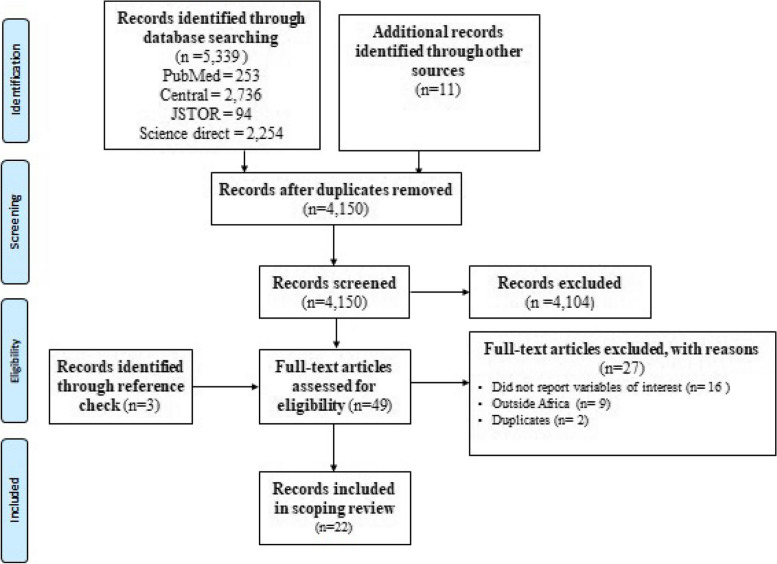
Searches for records were conducted in four major databases, including PubMed, PubMed Central, Science Direct and Journal Storage. Additional documents from Google and Google Scholar were also added. The guidelines for conducting scoping reviews by Arksey and O'Malley were followed.
The results revealed that intermittent fasting, education on diet, insulin injection, blood glucose monitoring, physical activities, lifestyle modification and foot care were the available self-management interventions for GD in Africa. Most of the reviewed studies reported intermittent fasting and patient education as effective self-management interventions for GD in Africa. The barriers identified in the reviewed studies were either patient-related or facility-related. Patient-related barriers included lack of awareness, and negative attitude, while facility-related barriers included lack of access to education on GD, especially, face-to-face educational interventions.
It is crucial to consider the cultural and personal needs, as well as the educational level of women with gestational diabetes when creating an effective self-management intervention. Optimal results can be achieved for self-management of gestational diabetes by integrating multidisciplinary approaches.
如果不能有效管理,妊娠糖尿病(gestational diabetes,GD)会威胁到母婴健康。虽然有越来越多的研究关注 GD 的自我管理干预措施,但在非洲,缺乏对各种自我管理干预措施的综述研究。本综述旨在绘制非洲 GD 自我管理干预措施的证据图谱。
在包括 PubMed、PubMed Central、Science Direct 和 Journal Storage 在内的四个主要数据库中进行了记录搜索,并在 Google 和 Google Scholar 上添加了额外的文档。遵循 Arksey 和 O'Malley 进行 scoping 综述的指南。
结果显示,在非洲,间歇性禁食、饮食教育、胰岛素注射、血糖监测、体育活动、生活方式改变和足部护理是 GD 的可用自我管理干预措施。大多数综述研究报告间歇性禁食和患者教育是非洲 GD 的有效自我管理干预措施。综述研究中确定的障碍要么是患者相关的,要么是设施相关的。患者相关的障碍包括缺乏意识和负面态度,而设施相关的障碍包括缺乏 GD 教育的机会,特别是缺乏面对面的教育干预。
在制定有效的自我管理干预措施时,必须考虑到有妊娠糖尿病的妇女的文化和个人需求以及教育水平。通过整合多学科方法,可以实现妊娠糖尿病自我管理的最佳效果。