Pediatric Hematology Laboratory, Division of Hematology/Oncology, Department of Pediatrics, The Seventh Affiliated Hospital of Sun Yat-Sen University, Shenzhen, Guangdong, 518107, China.
Edmond H. Fischer Translational Medical Research Laboratory, Scientific Research Center, The Seventh Affiliated Hospital, Sun Yat-sen University, Shenzhen, Guangdong, 518107, China.
BMC Pediatr. 2024 Aug 22;24(1):540. doi: 10.1186/s12887-024-05015-3.
Precursor B-cell acute lymphoblastic leukemia (B-ALL) is the most common cancers in children. Failure of induction chemotherapy is a major factor leading to relapse and death in children with B-ALL. Given the importance of altered metabolites in the carcinogenesis of pediatric B-ALL, studying the metabolic profile of children with B-ALL during induction chemotherapy and in different minimal residual disease (MRD) status may contribute to the management of pediatric B-ALL.
We collected paired peripheral blood plasma samples from children with B-ALL at pre- and post-induction chemotherapy and analyzed the metabolomic profiling of these samples by ultra-high performance liquid chromatography-mass spectrometry (UHPLC-MS). Healthy children were included as controls. We selected metabolites that were depleted in pediatric B-ALL and analyzed the concentrations in pediatric B-ALL samples. In vitro, we study the effects of the selected metabolites on the viability of ALL cell lines and the sensitivity to conventional chemotherapeutic agents in ALL cell lines.
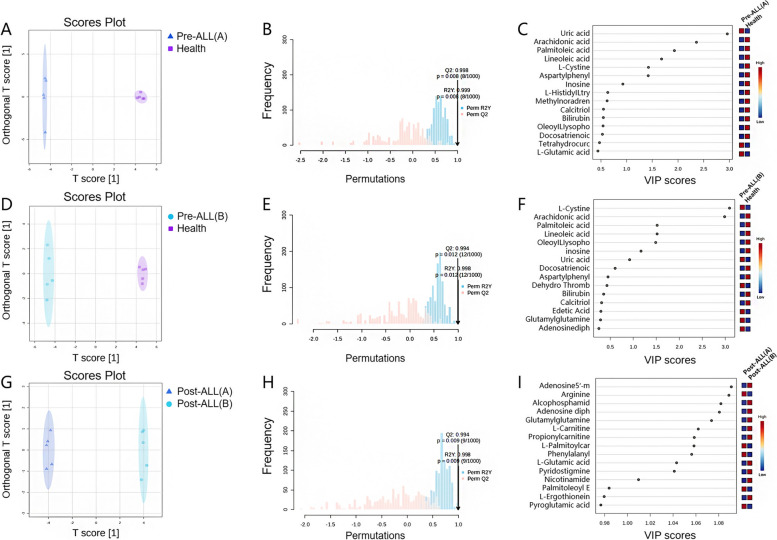
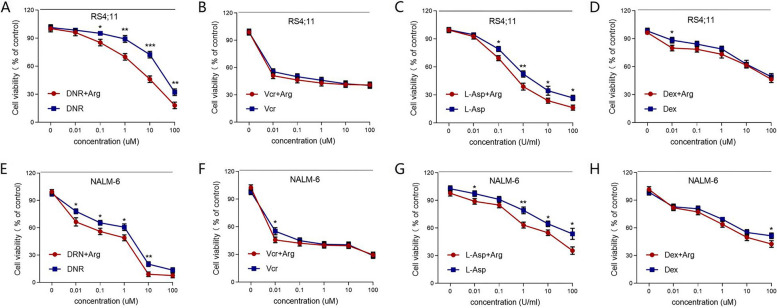
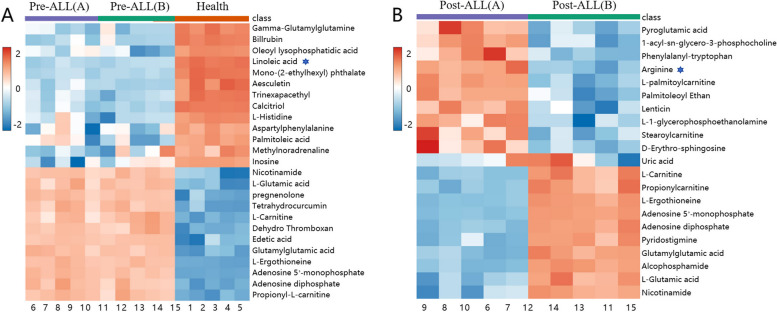
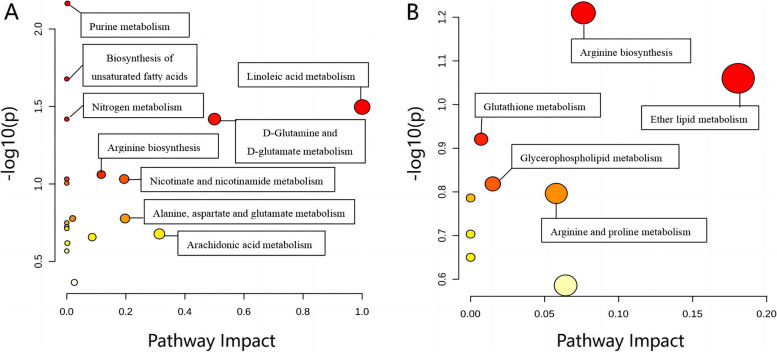
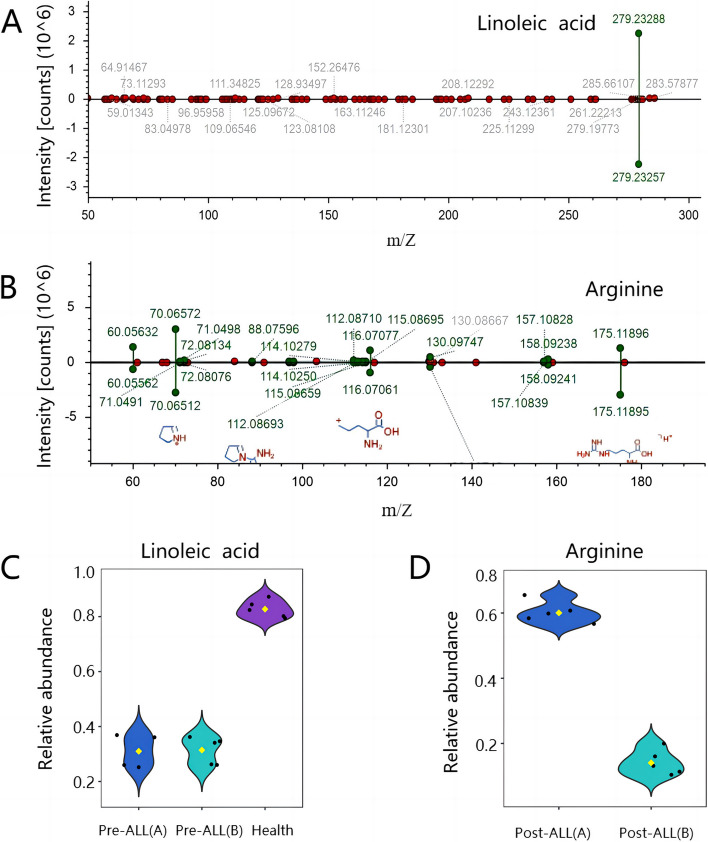
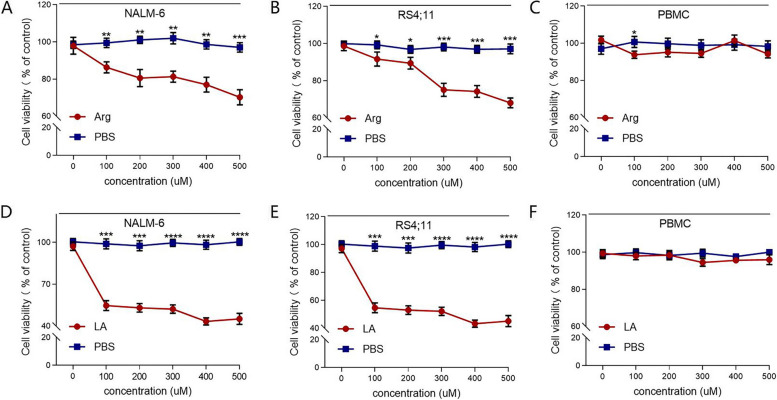
Forty-four metabolites were identified with different levels between groups. KEGG pathway enrichment analyses revealed that dysregulated linoleic acid (LA) metabolism and arginine (Arg) biosynthesis were closely associated with pediatric B-ALL. We confirmed that LA and Arg were decreased in pediatric B-ALL samples. The treatment of LA and Arg inhibited the viability of NALM-6 and RS4;11 cells in a dose-dependent manner, respectively. Moreover, Arg increased the sensitivity of B-ALL cells to L-asparaginase and daunorubicin.
Arginine increases the sensitivity of B-ALL cells to the conventional chemotherapeutic drugs L-asparaginase and daunorubicin. This may represent a promising therapeutic approach.
前体 B 细胞急性淋巴细胞白血病(B-ALL)是儿童中最常见的癌症。诱导化疗失败是导致儿童 B-ALL 复发和死亡的主要因素。鉴于代谢物改变在儿童 B-ALL 发生中的重要性,研究诱导化疗期间和不同微小残留病(MRD)状态下儿童 B-ALL 的代谢谱可能有助于儿童 B-ALL 的管理。
我们收集了诱导化疗前后儿童 B-ALL 的配对外周血血浆样本,并通过超高效液相色谱-质谱联用(UHPLC-MS)分析这些样本的代谢组学特征。健康儿童作为对照组。我们选择在儿童 B-ALL 中耗竭的代谢物,并分析儿童 B-ALL 样本中的浓度。在体外,我们研究了所选代谢物对 ALL 细胞系活力和 ALL 细胞系对常规化疗药物敏感性的影响。
鉴定出 44 种代谢物在组间水平不同。KEGG 通路富集分析显示,失调的亚油酸(LA)代谢和精氨酸(Arg)生物合成与儿童 B-ALL 密切相关。我们证实,LA 和 Arg 在儿童 B-ALL 样本中减少。LA 和 Arg 的处理分别以剂量依赖性方式抑制 NALM-6 和 RS4;11 细胞的活力。此外,Arg 增加了 B-ALL 细胞对 L-天冬酰胺酶和柔红霉素的敏感性。
精氨酸增加了 B-ALL 细胞对常规化疗药物 L-天冬酰胺酶和柔红霉素的敏感性。这可能代表一种有前途的治疗方法。