Department of Veterinary Medicine and Animals Productions, University of Naples Federico II, Via F. Delpino n. 1, Naples, 80137, Italy.
BMC Vet Res. 2024 Aug 22;20(1):374. doi: 10.1186/s12917-024-04227-0.
Feline Herpesvirus type-1 (FHV-1) is a worldwide spread pathogen responsible for viral rhinotracheitis and conjunctivitis in cats that, in the most severe cases, can lead to death. Despite the availability of a variety of antiviral medications to treat this illness, mainly characterized by virostatic drugs that alter DNA replication, their use is often debated. Phytotherapeutic treatments are a little-explored field for FHV-1 infections and reactivations. In this scenario, natural compounds could provide several advantages, such as reduced side effects, less resistance and low toxicity. The purpose of this study was to explore the potential inhibitory effects of the green tea extract (GTE), consisting of 50% of polyphenols, on FHV-1 infection and reactive oxygen species (ROS) production.
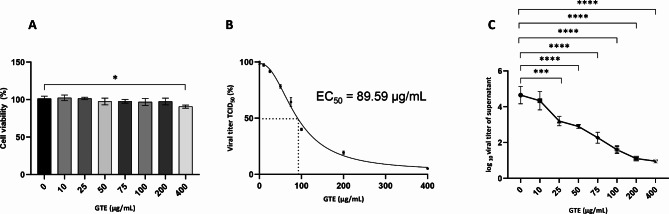
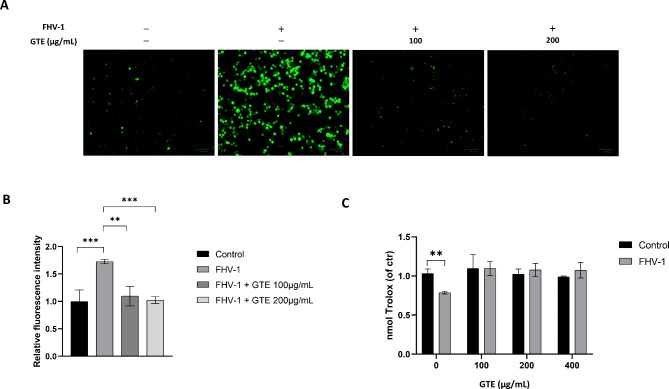
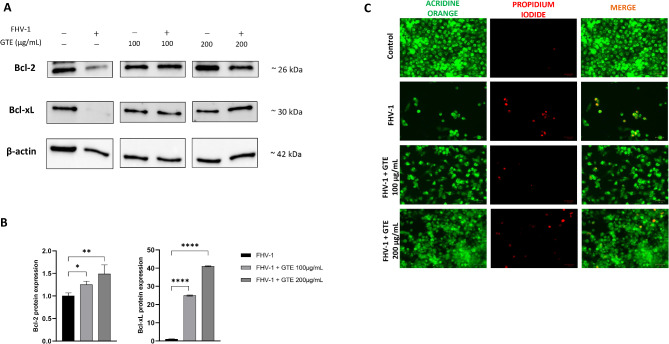
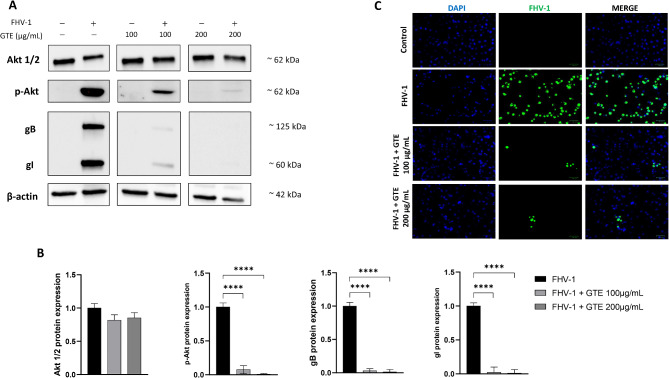
Crandell-Reese feline kidney (CRFK) cells were treated with different doses of GTE (10-400 µg/mL) during the viral adsorption and throughout the following 24 h. The MTT and TCID assays were performed to determine the cytotoxicity and the EC of the extract, determining the amounts of GTE used for the subsequent investigations. The western blot assay showed a drastic reduction in the expression of viral glycoproteins (i.e., gB and gI) after GTE treatment. GTE induced not only a suppression in viral proliferation but also in the phosphorylation of Akt protein, generally involved in viral entry. Moreover, the increase in cell proliferation observed in infected cells upon GTE addition was supported by enhanced expression of Bcl-2 and Bcl-xL anti-apoptotic proteins. Finally, GTE antioxidant activity was evaluated by dichloro-dihydro-fluorescein diacetate (DCFH-DA) and total antioxidant capacity (TAC) assays. The ROS burst observed during FHV-1 infection was mitigated after GTE treatment, leading to a reduction in the oxidative imbalance.
Although further clinical trials are necessary, this study demonstrated that the GTE could potentially serve as natural inhibitor of FHV-1 proliferation, by reducing viral entry. Moreover, it is plausible that the extract could inhibit apoptosis by modulating the intrinsic pathway, thus affecting ROS production.
猫疱疹病毒 1 型(FHV-1)是一种在全球范围内传播的病原体,可导致猫病毒性鼻炎和结膜炎,在最严重的情况下可导致死亡。尽管有多种抗病毒药物可用于治疗这种疾病,主要是通过改变 DNA 复制的病毒静态药物,但它们的使用经常存在争议。植物疗法治疗是 FHV-1 感染和再激活的一个探索较少的领域。在这种情况下,天然化合物可能具有多种优势,例如减少副作用、降低耐药性和低毒性。本研究旨在探讨绿茶提取物(GTE)对 FHV-1 感染和活性氧(ROS)产生的潜在抑制作用,GTE 由 50%的多酚组成。
用不同剂量的 GTE(10-400μg/mL)处理猫肾细胞(CRFK)细胞,在病毒吸附期间和随后的 24 小时内进行处理。进行 MTT 和 TCID 测定以确定提取物的细胞毒性和 EC,确定用于后续研究的 GTE 量。Western blot 分析表明,GTE 处理后病毒糖蛋白(即 gB 和 gI)的表达明显减少。GTE 不仅诱导病毒增殖的抑制,而且还诱导参与病毒进入的 Akt 蛋白的磷酸化。此外,在 GTE 加入感染细胞后观察到的细胞增殖增加得到了抗凋亡蛋白 Bcl-2 和 Bcl-xL 表达增强的支持。最后,通过二氯二氢荧光素二乙酸酯(DCFH-DA)和总抗氧化能力(TAC)测定评估 GTE 的抗氧化活性。在用 GTE 处理后,减轻了 FHV-1 感染期间观察到的 ROS 爆发,从而减轻了氧化失衡。
尽管需要进一步的临床试验,但本研究表明,GTE 可能通过减少病毒进入来作为 FHV-1 增殖的天然抑制剂。此外,提取物通过调节内在途径抑制细胞凋亡,从而影响 ROS 产生,这是合理的。