Amini Mohammad Amin, Karimi Jamshid, Talebi Seyed Saman, Piri Hosein
Department of Clinical Biochemistry, School of Medicine, Hamadan University of Medical Sciences, Hamadan, Iran.
Department of Internal Medicine, School of Medicine, Hamadan University of Medical Sciences, Hamadan, Iran.
Chonnam Med J. 2022 Jan;58(1):1-5. doi: 10.4068/cmj.2022.58.1.1. Epub 2022 Jan 25.
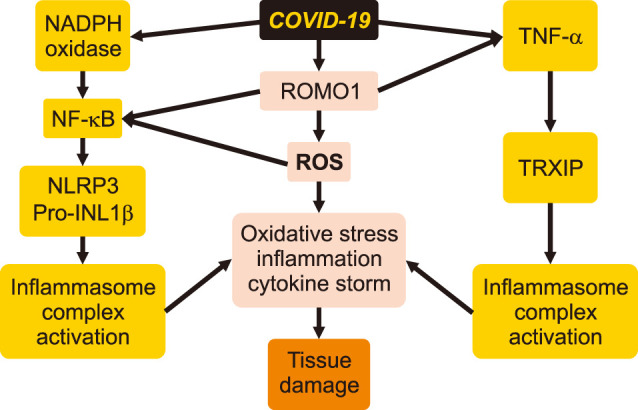
There is no denying that the massive spread of COVID-19 around the world has worried everyone. The virus can cause mild to severe symptoms in various organs, especially the lungs. The virus affects oxidative stress in the cells. Reactive Oxygen Species modulator 1 (ROMO1) is one of the most important mitochondrial proteins that plays a critical regulatory role in the production of Reactive Oxygen Species (ROS). According to the studies, COVID-19 can promote oxidative stress through some important pathways, for instance, TNF-α and NF-κB routes. Furthermore, ROMO1 is closely related to these pathways and its dysfunction may affect these routes, then promote oxidative stress, and ultimately cause tissue damage, especially in the lungs. Another factor to consider is that the TNF-α and NF-κB pathways are associated with ROMO1, COVID-19, and oxidative stress. To summarize, it is hypothesized that COVID-19 may increase oxidative stress by affecting ROMO1. Understanding the exact molecular mechanisms of ROMO1 in the pathogenesis of COVID-19 can pave the way to find better therapeutic strategies.
不可否认,新冠病毒在全球的大规模传播令每个人都忧心忡忡。该病毒可在各个器官引发从轻症到重症的症状,尤其是肺部。这种病毒会影响细胞中的氧化应激。活性氧调节剂1(ROMO1)是最重要的线粒体蛋白之一,在活性氧(ROS)的产生中起关键调节作用。根据研究,新冠病毒可通过一些重要途径促进氧化应激,例如肿瘤坏死因子-α(TNF-α)和核因子-κB(NF-κB)途径。此外,ROMO1与这些途径密切相关,其功能障碍可能会影响这些途径,进而促进氧化应激,并最终导致组织损伤,尤其是肺部。另一个需要考虑的因素是,TNF-α和NF-κB途径与ROMO1、新冠病毒和氧化应激有关。总而言之,据推测新冠病毒可能通过影响ROMO1来增加氧化应激。了解ROMO1在新冠病毒发病机制中的确切分子机制可为寻找更好的治疗策略铺平道路。