de Camargo Nícholas F, de Oliveira Hernani F M, Ribeiro Juliana F, de Camargo Amabílio J A, Vieira Emerson M
Laboratório de Ecologia de Vertebrados, Departamento de Ecologia, Instituto de Ciências Biológicas, Universidade de Brasília, CP 04457, Brasília, DF, 70910-900, Brazil.
Departamento de Zoologia, Setor de Ciências Biológicas, Universidade Federal do Paraná, Avenida Coronel Francisco Heráclito dos Santos100, Curitiba, PR, 81531980, Brazil.
Curr Zool. 2023 Jun 20;70(4):453-464. doi: 10.1093/cz/zoad023. eCollection 2024 Aug.
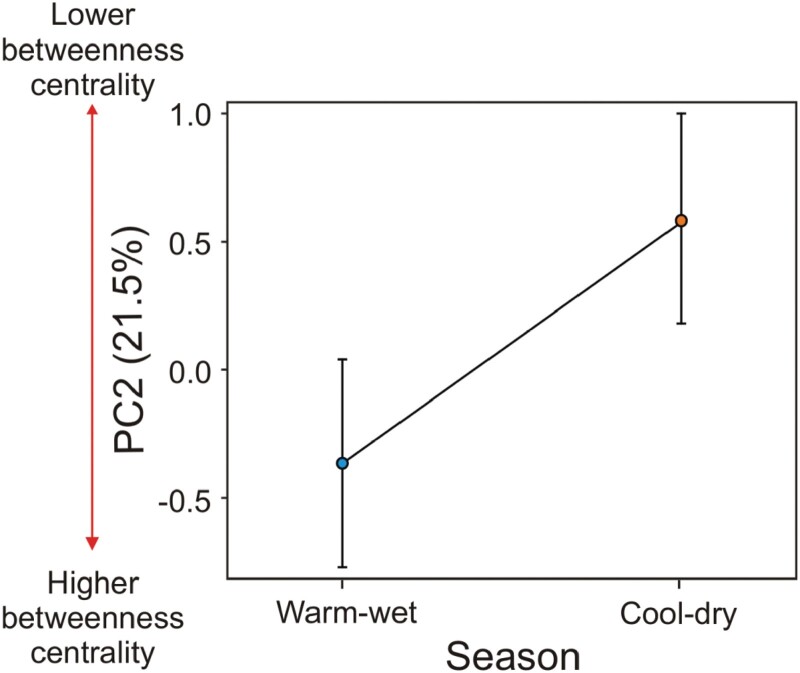
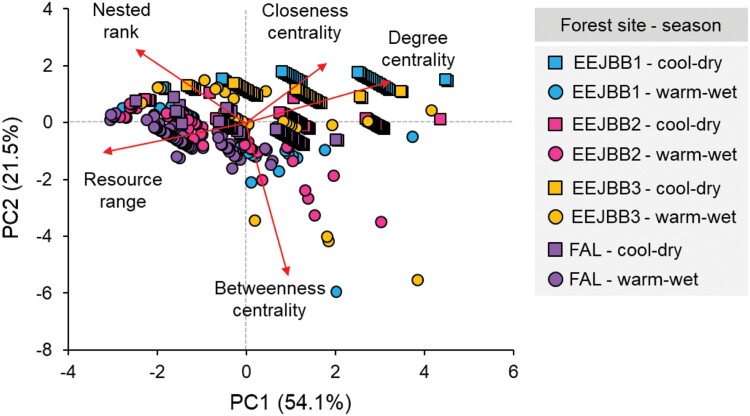
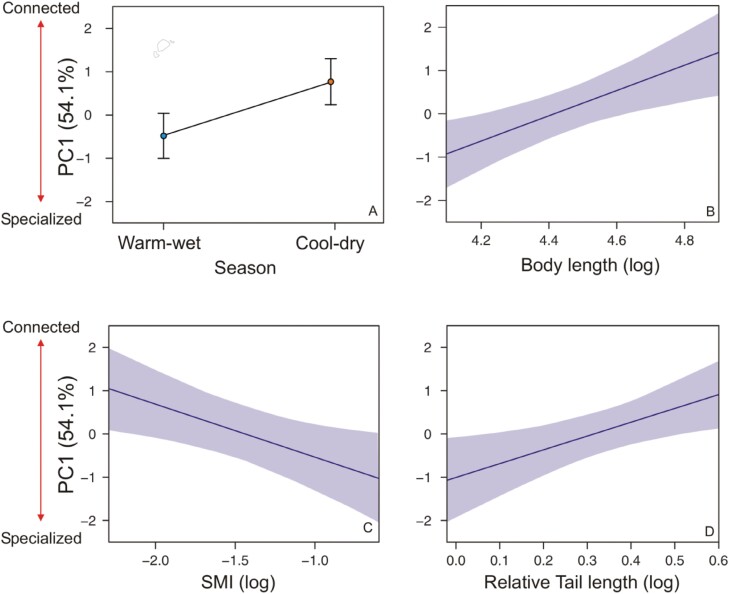
Knowledge regarding the influence of individual traits on interaction patterns in nature can help understand the topological role of individuals within a network of intrapopulation interactions. We tested hypotheses on the relationships between individuals' positions within networks (specialization and centrality) of 4 populations of the mouse opossum and their traits (i.e., body length, body condition, tail length relative to body length, sex, reproductive condition, and botfly parasitism) and also seasonal effects in the Brazilian savanna. Individuals with lower body length, better body condition, and relatively shorter tail were more specialized (i.e., less connected within the network). Individuals were also more specialized and less connected during the warm-wet season. The relationship between individuals' position in the network and body traits, however, was independent of season. We propose that specialization may arise not only as a result of preferred feeding strategies by more capable individuals (i.e., those with better body condition and potentially prone to defend and access high-quality food resources) but also because of morphological constraints. Smaller/younger individuals (consequently with less experience in foraging) and short-tailed individuals (less skilled to explore the vertical strata of the vegetation) would feed only on a subset of the available food resources and consequently become more specialized. Moreover, individuals are more specialized during the warm-wet season because of high competition (population-dense period) and higher ecological opportunities (resource-rich period). Therefore, our study reveals the relevance of individual traits in shaping interaction patterns and specialization in populations.
了解个体特征对自然界中相互作用模式的影响,有助于理解个体在种群内相互作用网络中的拓扑作用。我们检验了关于小鼠负鼠4个种群的个体在网络中的位置(专业化程度和中心性)与其特征(即体长、身体状况、相对于体长的尾长、性别、繁殖状况和马蝇寄生情况)之间关系的假设,以及巴西稀树草原中的季节效应。体长较短、身体状况较好且尾巴相对较短的个体更为专业化(即,在网络中的连接较少)。在温暖湿润季节,个体也更为专业化且连接较少。然而,个体在网络中的位置与身体特征之间的关系不受季节影响。我们提出,专业化的出现可能不仅是由于能力更强的个体(即身体状况更好且可能易于捍卫和获取优质食物资源的个体)偏好的觅食策略,还可能是由于形态学限制。体型较小/年龄较小的个体(因此觅食经验较少)和尾巴较短的个体(探索植被垂直层次的技能较低)只会取食可用食物资源的一个子集,因此会变得更加专业化。此外,由于竞争激烈(种群密集期)和生态机会更多(资源丰富期),个体在温暖湿润季节更为专业化。因此,我们的研究揭示了个体特征在塑造种群内相互作用模式和专业化方面的重要性。