Centre for Prevention, Lifestyle and Health, Department Behaviour & Health, National Institute for Public Health and the Environment (RIVM), Bilthoven, the Netherlands.
Erasmus University, Erasmus School of Health Policy and Management, Rotterdam, the Netherlands.
Euro Surveill. 2024 Aug;29(34). doi: 10.2807/1560-7917.ES.2024.29.34.2300503.
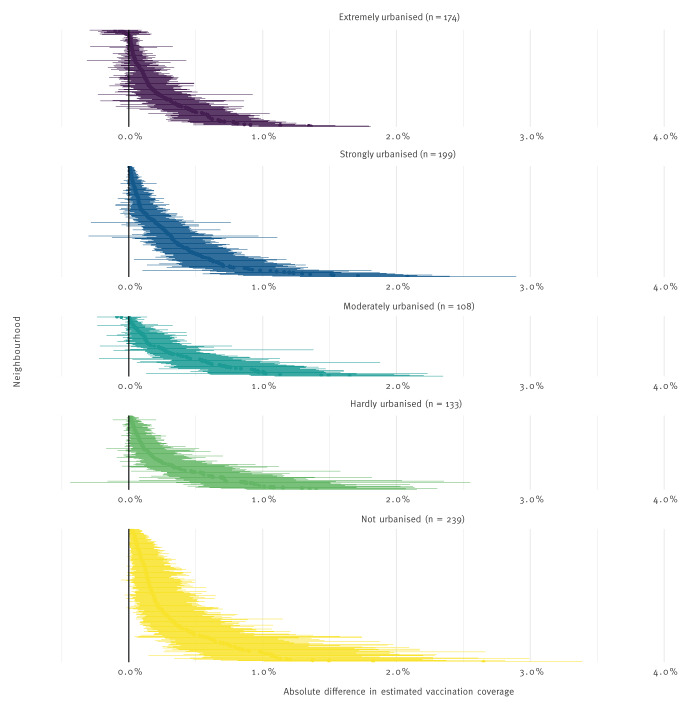
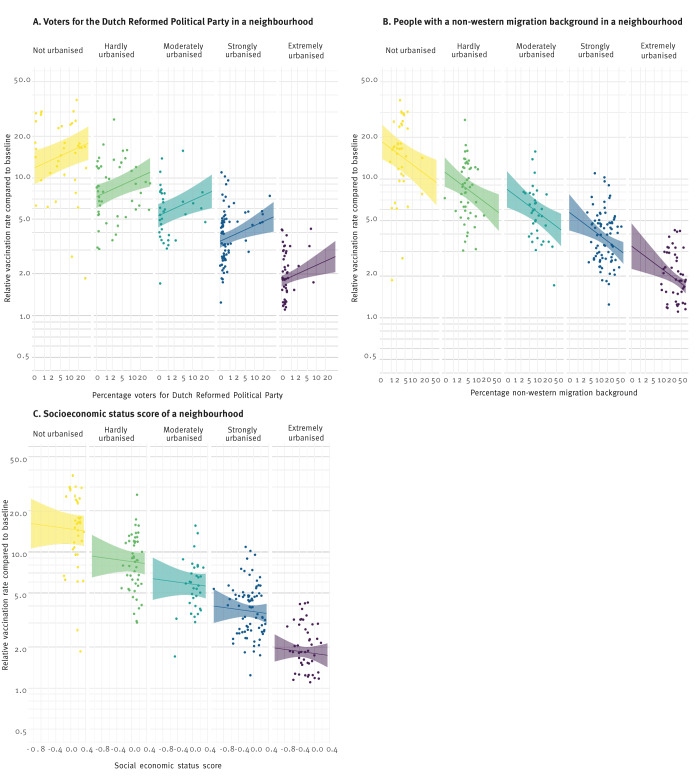
BackgroundVaccine uptake differs between social groups. Mobile vaccination units (MV-units) were deployed in the Netherlands by municipal health services in neighbourhoods with low uptake of COVID-19 vaccines.AimWe aimed to evaluate the impact of MV-units on vaccine uptake in neighbourhoods with low vaccine uptake.MethodsWe used the Dutch national-level registry of COVID-19 vaccinations (CIMS) and MV-unit deployment registrations containing observations in 253 neighbourhoods where MV-units were deployed and 890 contiguous neighbourhoods (total observations: 88,543 neighbourhood-days). A negative binomial regression with neighbourhood-specific temporal effects using splines was used to study the effect.ResultsDuring deployment, the increase in daily vaccination rate in targeted neighbourhoods ranged from a factor 2.0 (95% confidence interval (CI): 1.8-2.2) in urbanised neighbourhoods to 14.5 (95% CI: 11.6-18.0) in rural neighbourhoods. The effects were larger in neighbourhoods with more voters for the Dutch conservative Reformed Christian party but smaller in neighbourhoods with a higher proportion of people with non-western migration backgrounds. The absolute increase in uptake over the complete intervention period ranged from 0.22 percentage points (95% CI: 0.18-0.26) in the most urbanised neighbourhoods to 0.33 percentage point (95% CI: 0.28-0.37) in rural neighbourhoods.ConclusionDeployment of MV-units increased daily vaccination rate, particularly in rural neighbourhoods, with longer travel distance to permanent vaccination locations. This public health intervention shows promise to reduce geographic and social health inequalities, but more proactive and long-term deployment is required to identify its potential to substantially contribute to overall vaccination rates at country level.
背景
疫苗接种在不同社会群体之间存在差异。荷兰各市政府在 COVID-19 疫苗接种率较低的社区部署了移动疫苗接种单元 (MV-Unit)。
目的
我们旨在评估 MV-Unit 在疫苗接种率较低的社区中对疫苗接种的影响。
方法
我们使用了荷兰全国 COVID-19 疫苗接种登记系统 (CIMS) 和 MV-Unit 部署登记系统,其中包含了在 253 个部署了 MV-Unit 的社区和 890 个相邻社区(总观察数:88543 个社区日)中的观察结果。使用带局部时间效应的样条负二项回归来研究效果。
结果
在部署期间,目标社区的每日接种率增加幅度从城市社区的 2.0 倍(95%置信区间[CI]:1.8-2.2)到农村社区的 14.5 倍(95% CI:11.6-18.0)。在荷兰保守的改革宗教党选票较多的社区效果更大,但在具有非西方移民背景的人群比例较高的社区效果较小。在整个干预期间,接种率的绝对增加幅度从最城市化社区的 0.22 个百分点(95% CI:0.18-0.26)到农村社区的 0.33 个百分点(95% CI:0.28-0.37)。
结论
部署 MV-Unit 提高了每日接种率,特别是在农村社区,这些社区到常设疫苗接种点的出行距离较长。这种公共卫生干预措施有望减少地理和社会健康不平等,但需要更积极和长期的部署,以确定其在国家层面上对整体疫苗接种率做出重大贡献的潜力。