Root Deep Insight, Boston, MA, USA.
Department of Human Genetics, University of Chicago, Chicago, IL, USA.
BMC Med. 2024 Aug 26;22(1):337. doi: 10.1186/s12916-024-03539-0.
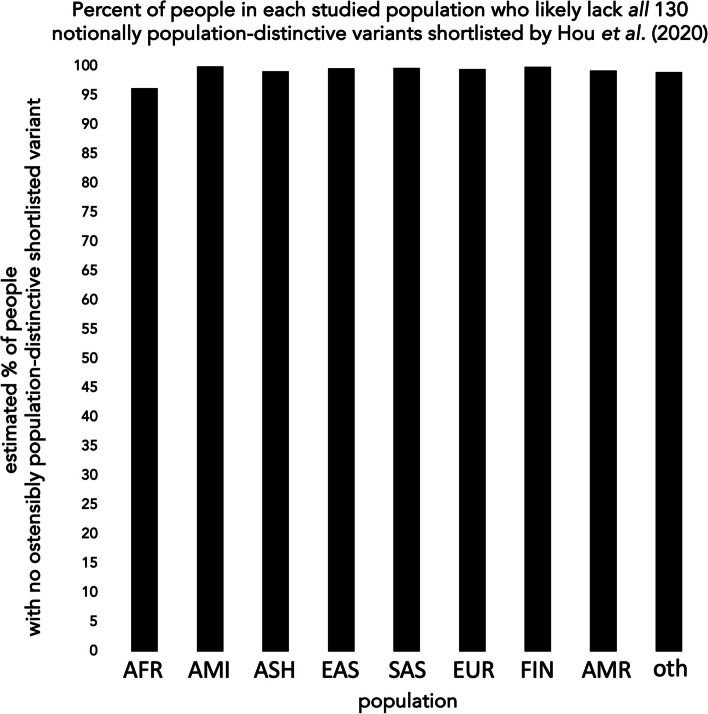
Early in the SARS-CoV2 pandemic, in this journal, Hou et al. (BMC Med 18:216, 2020) interpreted public genotype data, run through functional prediction tools, as suggesting that members of particular human populations carry potentially COVID-risk-increasing variants in genes ACE2 and TMPRSS2 far more often than do members of other populations. Beyond resting on predictions rather than clinical outcomes, and focusing on variants too rare to typify population members even jointly, their claim mistook a well known artifact (that large samples reveal more of a population's variants than do small samples) as if showing real and congruent population differences for the two genes, rather than lopsided population sampling in their shared source data. We explain that artifact, and contrast it with empirical findings, now ample, that other loci shape personal COVID risks far more significantly than do ACE2 and TMPRSS2-and that variation in ACE2 and TMPRSS2 per se unlikely exacerbates any net population disparity in the effects of such more risk-informative loci.
在 SARS-CoV2 大流行早期,Hou 等人在本刊(BMC Med 18:216, 2020)中解释了公众基因型数据,通过功能预测工具运行这些数据,表明特定人群的成员携带 ACE2 和 TMPRSS2 基因中潜在增加 COVID 风险的变异体的频率远高于其他人群的成员。除了依赖预测而不是临床结果,以及关注即使联合起来也太罕见而无法代表人群成员的变异体之外,他们的说法错误地将一个众所周知的假象(即大样本比小样本揭示更多的人群变异体)视为在这两个基因中显示出真实且一致的人群差异,而不是它们共享数据源中偏向性的人群抽样。我们解释了这种假象,并将其与现在大量的经验发现进行了对比,这些发现表明,其他基因座对个人 COVID 风险的影响要大得多,而 ACE2 和 TMPRSS2 本身不太可能加剧这些更具风险信息的基因座对任何净人群差异的影响。