Nasr E, Wimbush S C, Noonan P, Harris P, Gowland R, Petrov A
United Kingdom Atomic Energy Authority, Culham Campus, Abingdon, Oxfordshire OX14 3DB, UK.
Philos Trans A Math Phys Eng Sci. 2024 Oct 9;382(2280):20230407. doi: 10.1098/rsta.2023.0407. Epub 2024 Aug 26.
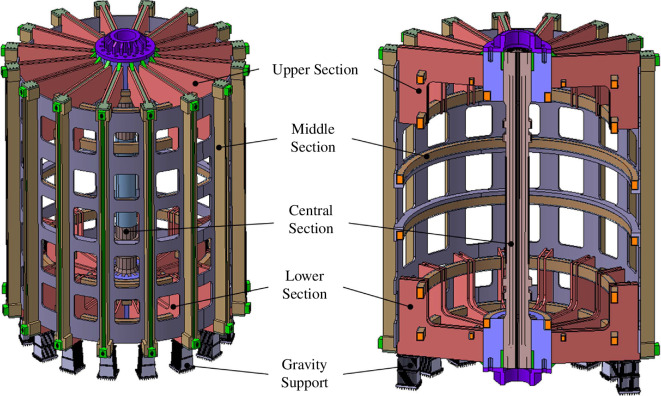
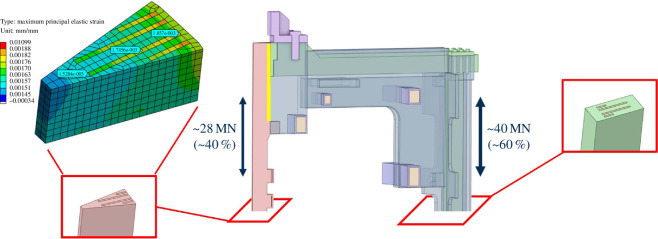
The Spherical Tokamak for Energy Production (STEP) requires high-field magnet designs and has therefore adopted the REBCO-based high-temperature superconductor (HTS) as its current carrier. The HTS enables the toroidal field (TF) coils to be remountable, which unlocks STEP's vertical maintenance approach; however, remountable joints, approximately 18 GJ of stored energy and limited space down the centre of a spherical tokamak, make the TF coils the most challenging. STEP has pursued a passive approach to TF coil quench protection in order to limit coil terminal voltage. Initial results suggest that a solution may rely on tuning internal coil resistance coupled with actively powered heaters. The pre-conceptual inter-coil structure demonstrates acceptable stresses and deflections under steady-state operating conditions and preliminary fault scenarios, and loads are distributed to limit the tensile force on the TF centre rod. Finally, the HTS must operate reliably in a high radiation environment and endure high neutron fluences, ensuring commercially relevant magnet lifetimes. Initial experiments indicate that instantaneous gamma irradiation of HTS has no negative impact on current carrying capacity. Experimental programmes are underway to cold irradiate HTS to fusion-relevant fluences and to develop a method of assuring tape irradiation tolerance using oxygen ions as an analogue for neutrons.This article is part of the theme issue 'Delivering Fusion Energy - The Spherical Tokamak for Energy Production (STEP)'.
用于能源生产的球形托卡马克(STEP)需要高场磁体设计,因此采用了基于稀土钡铜氧(REBCO)的高温超导体(HTS)作为其载流子。这种高温超导体使环形场(TF)线圈能够重新安装,这开启了STEP的垂直维护方式;然而,可重新安装的接头、约18吉焦的储能以及球形托卡马克中心有限的空间,使得TF线圈成为最具挑战性的部分。STEP采用了一种被动方法来进行TF线圈失超保护,以限制线圈端电压。初步结果表明,解决方案可能依赖于调整内部线圈电阻并结合主动供电的加热器。概念设计阶段的线圈间结构在稳态运行条件和初步故障情况下展示出了可接受的应力和挠度,并且载荷分布能够限制作用在TF中心杆上的拉力。最后,高温超导体必须在高辐射环境中可靠运行并承受高中子注量,以确保具有商业相关性的磁体寿命。初步实验表明,高温超导体的瞬时伽马辐照对其载流能力没有负面影响。正在开展实验项目,对高温超导体进行与聚变相关注量的冷辐照,并开发一种使用氧离子作为中子模拟物来确保带材辐照耐受性的方法。本文是主题为“实现聚变能源——用于能源生产的球形托卡马克(STEP)”的一部分。