Tsuda Yuzo, Yoshikawa Ryo, Matsuda Atsuko, Fujii Yasumitsu, Kobayashi Yoshimichi, Harada Risa, Saji Yoshiaki, Sakai Yoshitada
Department of Rehabilitation Medicine, Ishikawa Hospital, Himeji, JPN.
Department of Physical Medicine and Rehabilitation, Kobe University Hospital, Kobe, JPN.
Cureus. 2024 Jul 24;16(7):e65304. doi: 10.7759/cureus.65304. eCollection 2024 Jul.
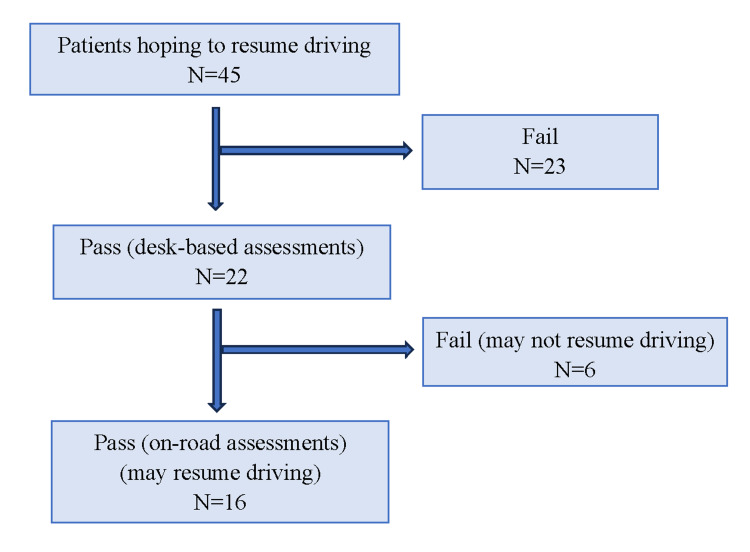
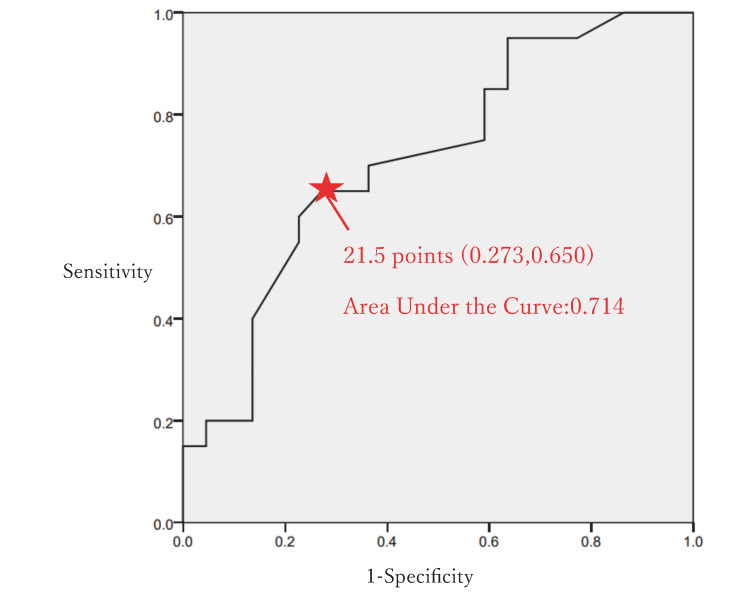
Objectives For patients with brain disorders, regaining the ability to drive is crucial to their reintegration into society. Despite the existence of numerous assessment methods for determining the ability to resume driving, the most effective approach remains unclear. This study evaluated patients with brain disorders who had received support for driving resumption. We examined the factors influencing the acquisition of driving ability in this specific population. Methods This retrospective observational study was conducted from July 2019 to March 2022. Initially, a desk-based assessment was conducted using neuropsychological tests. Successful candidates subsequently underwent an on-road assessment at an affiliated driving school. Patients who passed both assessments were granted permission to resume driving. The participants were categorized into pass and fail groups based on their assessments, and a comparative analysis was conducted. Age, sex, type of brain disorder, functional independence measures (FIMs), assessments of higher cognitive skills, and physical function test results were evaluated. Results Forty-five patients (average age: 62±13 years) underwent evaluation. Logistic regression analysis for the desk-based assessment identified the Rey-Osterrieth complex figure test (ROCFT) (three-minute delayed recall) as the most influential factor (cutoff value: 21.5 points; sensitivity: 65%; specificity, 72.7%). In the on-road assessment, the 10-m walking test was significantly faster in the passing group than in the failing group (p<0.005). Conclusions We demonstrated that the ROCFT (three-minute delayed recall) was the most effective neuropsychological assessment tool for evaluating driving resumption. The assessment of walking speed may also be able to predict the resumption of driving in patients with brain disorders.
目的 对于患有脑部疾病的患者而言,恢复驾驶能力对于他们重新融入社会至关重要。尽管存在众多用于确定恢复驾驶能力的评估方法,但最有效的方法仍不明确。本研究对接受恢复驾驶支持的脑部疾病患者进行了评估。我们考察了影响这一特定人群获得驾驶能力的因素。
方法 这项回顾性观察研究于2019年7月至2022年3月进行。首先,使用神经心理学测试进行案头评估。成功的候选人随后在附属驾驶学校进行上路评估。两项评估均通过的患者被获准恢复驾驶。根据评估结果将参与者分为通过组和未通过组,并进行比较分析。对年龄、性别、脑部疾病类型、功能独立性测量(FIM)、高级认知技能评估和身体功能测试结果进行了评估。
结果 45名患者(平均年龄:62±13岁)接受了评估。案头评估的逻辑回归分析确定雷-奥斯特里思复杂图形测试(ROCFT)(三分钟延迟回忆)为最具影响力的因素(临界值:21.5分;敏感性:65%;特异性:72.7%)。在上路评估中,通过组的10米步行测试明显快于未通过组(p<0.005)。
结论 我们证明,ROCFT(三分钟延迟回忆)是评估恢复驾驶最有效的神经心理学评估工具。步行速度评估也可能能够预测脑部疾病患者恢复驾驶的情况。