Kim Yunkyung, Kim Hongwon, Cho Byounggook, An Saemin, Kang Soi, Kim Sumin, Kim Jongpil
Department of Chemistry, Dongguk University, Seoul, Republic of Korea.
Department of Chemistry and Chemical Biology, Rutgers, The State University of New Jersey, Piscataway, NJ, United States.
Front Aging Neurosci. 2024 Aug 9;16:1435445. doi: 10.3389/fnagi.2024.1435445. eCollection 2024.
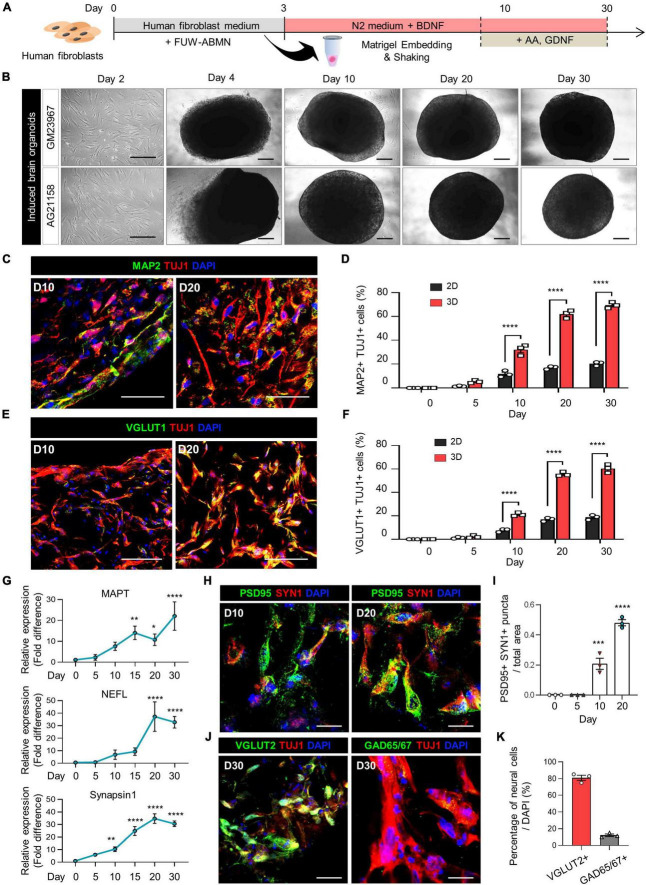
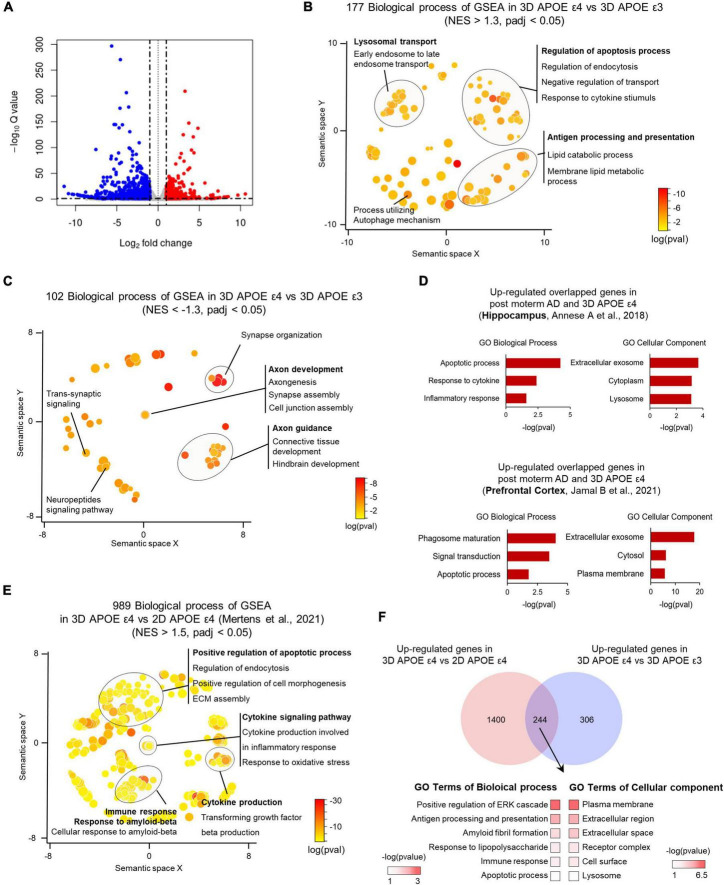
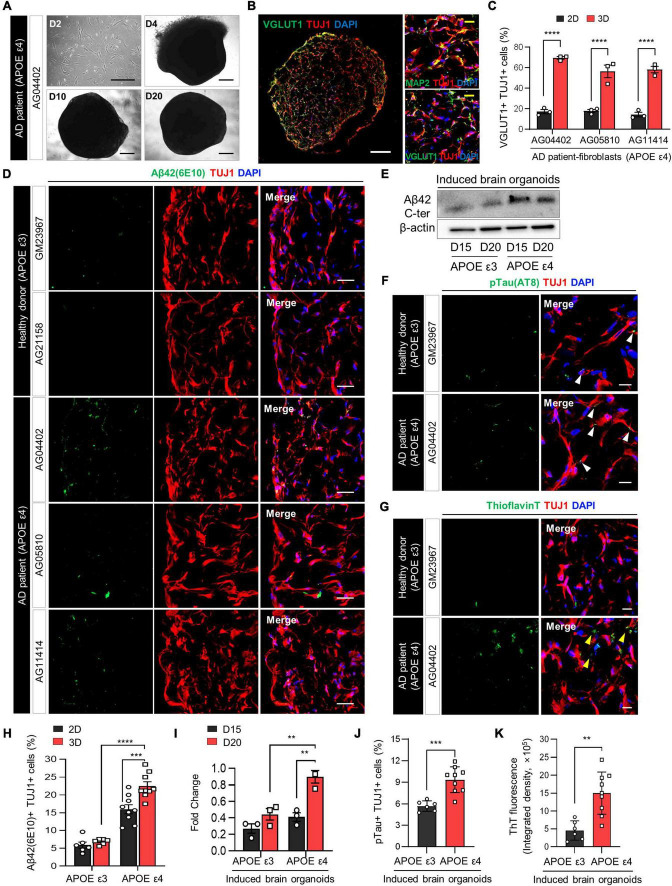
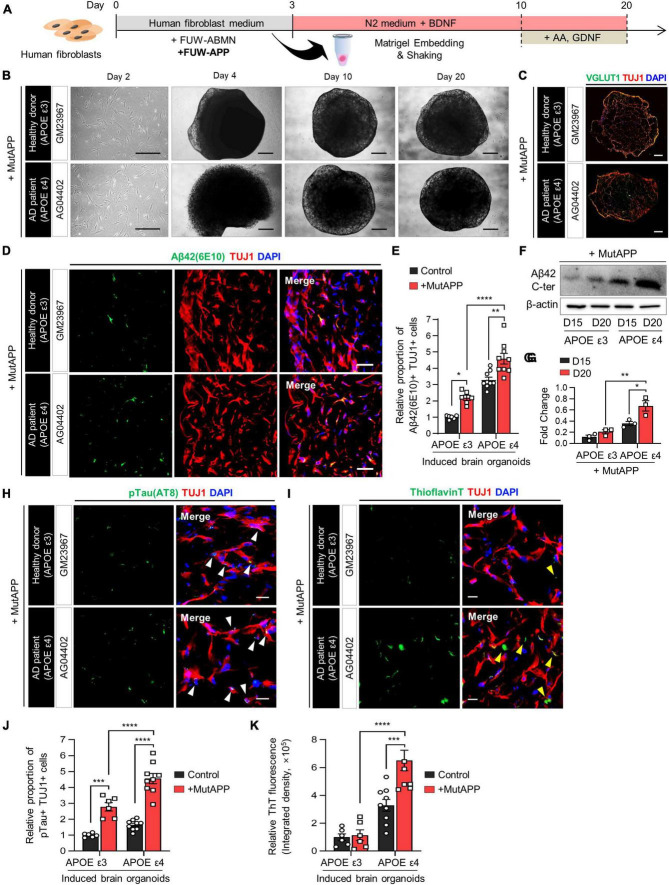
Brain organoids have become a valuable tool for studying human brain development, disease modeling, and drug testing. However, generating brain organoids with mature neurons is time-intensive and often incomplete, limiting their utility in studying age-related neurodegenerative diseases such as Alzheimer's disease (AD). Here, we report the generation of 3D brain organoids from human fibroblasts through direct reprogramming, with simplicity, efficiency, and reduced variability. We also demonstrate that induced brain organoids from APOE ε4 AD patient fibroblasts capture some disease-specific features and pathologies associated with APOE ε4 AD. Moreover, APOE ε4-induced brain organoids with mutant APP overexpression faithfully recapitulate the acceleration of AD-related pathologies, providing a more physiologically relevant and patient-specific model of familial AD. Importantly, transcriptome analysis reveals that gene sets specific to APOE ε4 patient-induced brain organoids are highly similar to those of APOE ε4 post-mortem AD brains. Overall, induced brain organoids from direct reprogramming offer a promising approach for more efficient and controlled studies of neurodegenerative disease modeling.
脑类器官已成为研究人类大脑发育、疾病建模和药物测试的重要工具。然而,生成含有成熟神经元的脑类器官耗时且往往不完整,限制了它们在研究如阿尔茨海默病(AD)等与年龄相关的神经退行性疾病中的应用。在此,我们报告了通过直接重编程从人成纤维细胞生成三维脑类器官的方法,该方法简单、高效且变异性降低。我们还证明,由APOE ε4 AD患者成纤维细胞诱导生成的脑类器官捕获了一些与APOE ε4 AD相关的疾病特异性特征和病理变化。此外,过表达突变APP的APOE ε4诱导脑类器官忠实地重现了AD相关病理变化的加速,提供了一个更具生理相关性且针对患者的家族性AD模型。重要的是,转录组分析表明,APOE ε4患者诱导脑类器官特有的基因集与APOE ε4死后AD大脑的基因集高度相似。总体而言,直接重编程诱导的脑类器官为更高效、可控地研究神经退行性疾病建模提供了一种有前景的方法。