Headache Science & Neurorehabilitation Unit, IRCCS Mondino Foundation, Via Mondino 2, Pavia, 27100, Italy.
Department of Brain and Behavioral Sciences, University of Pavia, Pavia, Italy.
J Headache Pain. 2024 Aug 27;25(1):138. doi: 10.1186/s10194-024-01842-y.
miR-155 is involved in the generation and maintenance of inflammation and pain, endothelial function and immune system homeostasis, all functions that are relevant for migraine. The present study aims to assess the levels of miR-155 in migraine subtypes (episodic and chronic) in comparison to age- and sex-matched healthy controls.
This is a cross-sectional, controlled, study involving three study groups: I) episodic migraine (n = 52, EM), II) chronic migraine with medication overuse (n = 44, CM-MO), and III) healthy controls (n = 32, HCs). We assessed the interictal gene expression levels of miR-155, IL-1β, TNF-α, and IL-10 in peripheral blood monocytes using rtPCR. The monocytic differentiation toward the M1 (pro-inflammatory) or M2 (anti-inflammatory) phenotypes was assessed in circulating monocytes with flow cytometry analysis and cell sorting.
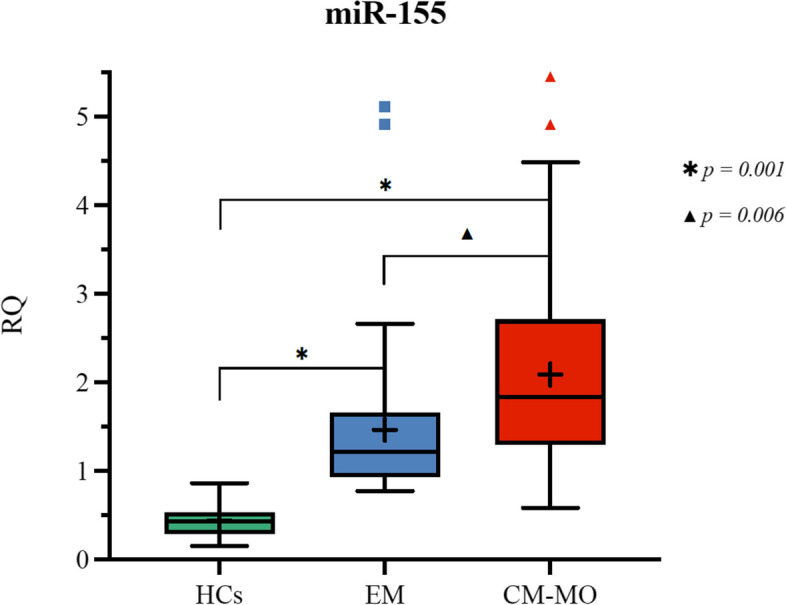
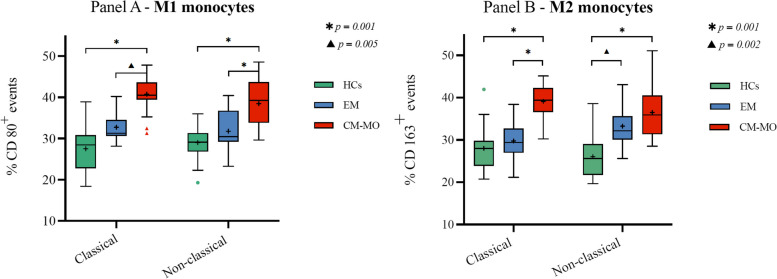
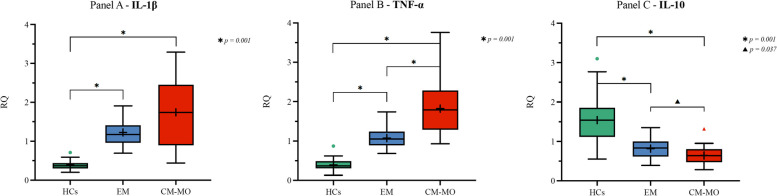
miR-155 gene expression was higher in CM-MO group (2.68 ± 2.47 Relative Quantification - RQ) when compared to EM group (1.46 ± 0.85 RQ, p = 0.006) and HCs (0.44 ± 0.18 RQ, p = 0.001). In addition, miR-155 gene expression was higher in EM group when compared to HCs (p = 0.001). A multivariate analysis confirmed the difference between EM and CM-MO groups after correction for age, sex, smoking habit, preventive treatment, aura, presence of psychiatric or other pain conditions. We found higher gene expression of IL-1β, TNF-α, and lower gene expression of IL-10 in migraine participants when compared to HCs (p = 0.001 for all comparisons). TNF-α and IL-10 genes alterations were more prominent in CM-MO when compared to EM participants (p = 0.001). miR-155 positively correlated with IL-1β (p = 0.001) and TNF-α (p = 0.001) expression levels. Finally, in people with CM-MO, we described an up-regulated percentage of events in both M1 and M2 monocytic profiles.
Our study shows for the first time a specific profile of activation of miR-155 gene expression levels in monocytes of selected migraine subpopulations, more pronounced in subjects with CM-MO. Interestingly, mir-155 expression correlated with markers of activation of the inflammatory and immune systems. The CM-MO subpopulation showed a peculiar increase of both pro-inflammatory and anti-inflammatory monocytes which worths further investigation.
www.
gov . (NCT05891808).
miR-155 参与炎症和疼痛的产生和维持、内皮功能和免疫系统稳态,所有这些功能都与偏头痛有关。本研究旨在评估偏头痛亚型(发作性和慢性)患者外周血单核细胞中 miR-155 的水平,并与年龄和性别匹配的健康对照组进行比较。
这是一项横断面、对照研究,包括三个研究组:I)发作性偏头痛(n=52,EM),II)慢性偏头痛伴药物过度使用(n=44,CM-MO)和 III)健康对照组(n=32,HCs)。我们使用 rtPCR 评估了外周血单核细胞中 miR-155、IL-1β、TNF-α 和 IL-10 的基因表达水平。通过流式细胞术分析和细胞分选评估循环单核细胞向 M1(促炎)或 M2(抗炎)表型的分化。
与 EM 组(1.46±0.85 RQ,p=0.006)和 HCs(0.44±0.18 RQ,p=0.001)相比,CM-MO 组的 miR-155 基因表达更高(2.68±2.47 RQ)。此外,与 HCs 相比,EM 组的 miR-155 基因表达也更高(p=0.001)。多变量分析证实,在年龄、性别、吸烟习惯、预防治疗、先兆、是否存在精神疾病或其他疼痛状况等因素校正后,EM 组和 CM-MO 组之间存在差异。与 HCs 相比,偏头痛患者的 IL-1β、TNF-α 基因表达更高,而 IL-10 基因表达更低(所有比较均 p=0.001)。与 EM 患者相比,CM-MO 患者的 TNF-α 和 IL-10 基因改变更为明显(p=0.001)。miR-155 与 IL-1β(p=0.001)和 TNF-α(p=0.001)的表达水平呈正相关。最后,在 CM-MO 人群中,我们描述了 M1 和 M2 单核细胞谱中事件百分比的上调。
本研究首次在选定的偏头痛亚群的单核细胞中显示了 miR-155 基因表达水平的特定激活谱,在 CM-MO 患者中更为明显。有趣的是,mir-155 的表达与炎症和免疫系统激活的标志物相关。CM-MO 亚群显示出促炎和抗炎单核细胞的独特增加,值得进一步研究。
www.(NCT05891808)。
gov.