College of Landscape Architecture, Sichuan Agricultural University, Chengdu, 611130, China.
Triticeae Research Institute of Sichuan Agricultural University, Chengdu, Sichuan, 611130, China.
BMC Plant Biol. 2024 Aug 27;24(1):807. doi: 10.1186/s12870-024-05526-2.
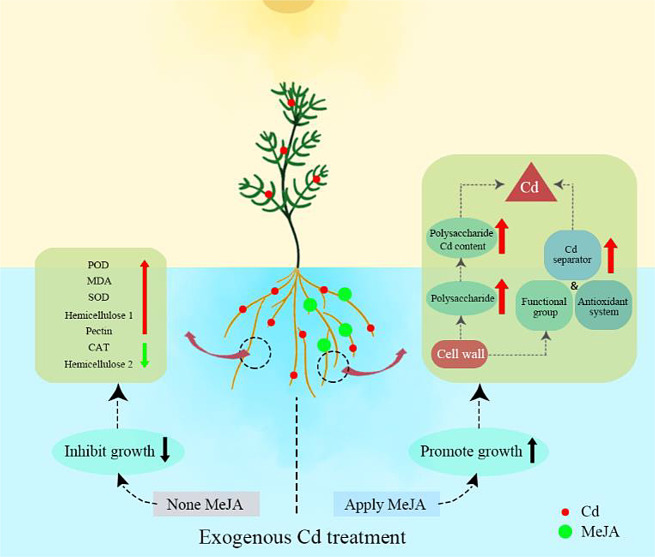
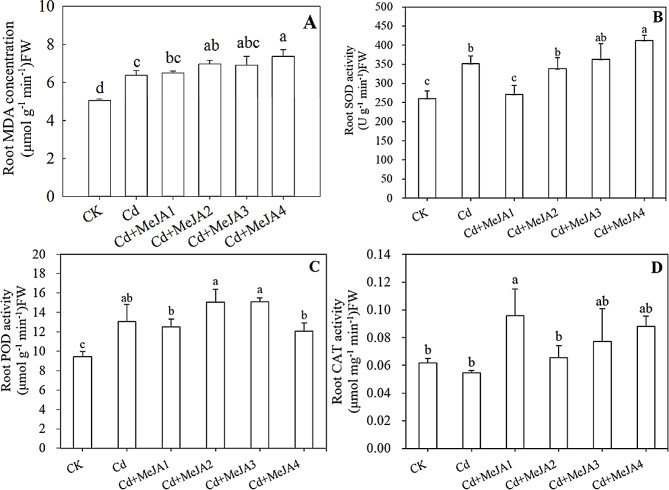
Cadmium (Cd) is a biologically non-essential heavy metal, a major soil pollutant, and extremely harmful to plants. The phytohormone methyl jasmonate (MeJA) plays an important role in plant heavy-metal resistance. However, the understanding of the effects of MeJA supply level on alleviating Cd toxicity in plants is limited. Here, we investigated how MeJA regulated the development of physiological processes and cell wall modification in Cosmos bipinnatus. We found that low concentrations of MeJA increased the dry weight of seedlings under 120 µM Cd stress by reducing the transport of Cd from roots to shoots. Moreover, a threshold concentration of exogenous MeJA increased the activities of superoxide dismutase (SOD), peroxidase (POD), and catalase (CAT) in plant roots, the concentration of Cd in the root cell wall, and the contents of pectin and hemicellulose 1 polysaccharides, through converting Cd into pectin-bound forms. These results suggested that MeJA mitigated Cd toxicity by modulating root cell wall polysaccharide and functional group composition, especially through pectin polysaccharides binding to Cd, with effects on Cd transport capacity, specific chemical forms of Cd, and homeostatic antioxidant systems in C. bipinnatus.
镉(Cd)是一种生物上非必需的重金属,是主要的土壤污染物,对植物有极大的危害。植物激素茉莉酸甲酯(MeJA)在植物耐重金属方面起着重要作用。然而,人们对 MeJA 供应水平对缓解植物 Cd 毒性的影响的理解是有限的。在这里,我们研究了 MeJA 如何调节天人菊生理过程的发展和细胞壁的修饰。我们发现,低浓度的 MeJA 通过减少 Cd 从根部向地上部的运输,在 120µM Cd 胁迫下增加了幼苗的干重。此外,外源性 MeJA 的阈值浓度通过将 Cd 转化为果胶结合形式,增加了植物根部的超氧化物歧化酶(SOD)、过氧化物酶(POD)和过氧化氢酶(CAT)的活性、根细胞壁中 Cd 的浓度、果胶和半纤维素 1 多糖的含量。这些结果表明,MeJA 通过调节根细胞壁多糖和功能基团组成减轻 Cd 毒性,特别是通过果胶多糖与 Cd 的结合,影响 Cd 的运输能力、Cd 的特定化学形式和 C. bipinnatus 的内稳态抗氧化系统。