Beetham Eye Institute, Joslin Diabetes Center, Boston, MA, 02115, USA.
Department of Medicine, Harvard Medical School, Boston, MA, 02115, USA.
Alzheimers Res Ther. 2024 Aug 26;16(1):192. doi: 10.1186/s13195-024-01556-y.
Protein biomarkers have been broadly investigated in cerebrospinal fluid and blood for the detection of neurodegenerative diseases, yet a clinically useful diagnostic test to detect early, pre-symptomatic Alzheimer's disease (AD) remains elusive. We conducted this study to quantify Aβ40, Aβ42, total Tau (t-Tau), hyperphosphorylated Tau (ptau181), glial fibrillary acidic protein (GFAP) and neurofilament light chain (NfL) in eye fluids relative to blood.
In this cross-sectional study we collected vitreous humor, aqueous humor, tear fluid and plasma in patients undergoing surgery for eye disease. All six biomarkers were quantitatively measured by digital immunoassay. Spearman and Bland-Altman correlation analyses were performed to assess the agreement of levels between ocular fluids and plasma.
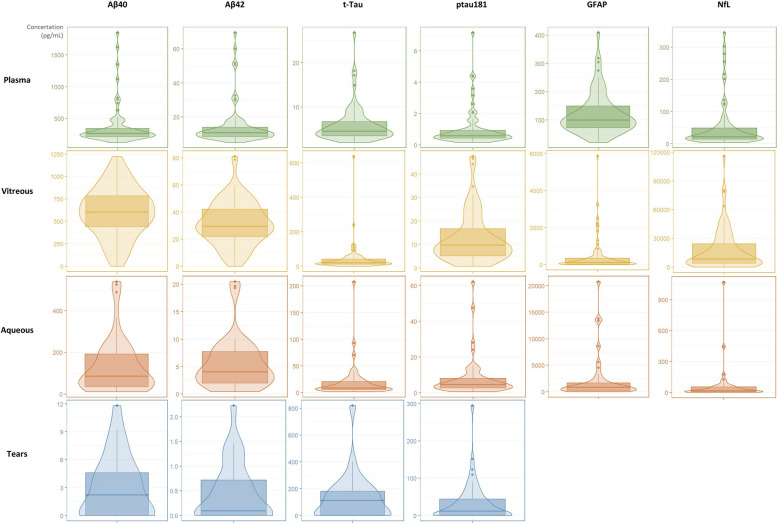
Seventy-nine adults underwent pars-plana vitrectomy in at least one eye. Of the 79, there were 77 vitreous, 67 blood, 56 tear fluid, and 51 aqueous samples. All six biomarkers were quantified in each bio-sample, except GFAP and NfL in tear fluid due to low sample volume. All six biomarkers were elevated in vitreous humor compared to plasma samples. T-Tau, ptau181, GFAP and NfL were higher in aqueous than in plasma, and t-Tau and ptau181 concentrations were higher in tear fluid than in plasma. Significant correlations were found between Aβ40 in plasma and tears (r = 0.5; p = 0.019), t-Tau in plasma and vitreous (r = 0.4; p = 0.004), NfL in plasma and vitreous (r = 0.3; p = 0.006) and plasma and aqueous (r = 0.5; p = 0.004). No significant associations were found for Aβ42, ptau181 and GFAP among ocular fluids relative to plasma. Bland-Altman analysis showed aqueous humor had the closest agreement to plasma across all biomarkers. Biomarker levels in ocular fluids revealed statistically significant associations between vitreous and aqueous for t-Tau (r = 0.5; p = 0.001), GFAP (r = 0.6; p < 0.001) and NfL (r = 0.7; p < 0.001).
AD biomarkers are detectable in greater quantities in eye fluids than in plasma and show correlations with levels in plasma. Future studies are needed to assess the utility of ocular fluid biomarkers as diagnostic and prognostic markers for AD, especially in those at risk with eye disease.
蛋白质生物标志物已在脑脊液和血液中广泛研究,用于检测神经退行性疾病,但仍难以找到一种临床有用的诊断测试来检测早期、无症状的阿尔茨海默病(AD)。我们进行了这项研究,以定量检测眼液中 Aβ40、Aβ42、总 Tau(t-Tau)、磷酸化 Tau(ptau181)、神经胶质纤维酸性蛋白(GFAP)和神经丝轻链(NfL)与血液相比的水平。
在这项横断面研究中,我们收集了接受眼部疾病手术的患者的玻璃体、房水、泪液和血浆。所有六种生物标志物均通过数字免疫测定法进行定量测量。进行 Spearman 和 Bland-Altman 相关性分析,以评估眼液与血浆之间水平的一致性。
79 名成年人在至少一只眼睛中进行了平面内玻璃体切除术。在这 79 名患者中,有 77 份玻璃体、67 份血液、56 份泪液和 51 份房水样本。除了由于样本量低而无法在泪液中检测 GFAP 和 NfL 之外,每个生物样本都检测到了所有六种生物标志物。与血浆样本相比,所有六种生物标志物在玻璃体中均升高。与血浆相比,t-Tau、ptau181、GFAP 和 NfL 在房水中更高,t-Tau 和 ptau181 浓度在泪液中高于血浆。在血浆和眼泪中的 Aβ40 之间(r=0.5;p=0.019)、血浆和玻璃体中的 t-Tau(r=0.4;p=0.004)、血浆和玻璃体中的 NfL(r=0.3;p=0.006)以及血浆和房水中(r=0.5;p=0.004)均发现显著相关性。在眼液与血浆之间,Aβ42、ptau181 和 GFAP 之间未发现显著相关性。Bland-Altman 分析表明,在所有生物标志物中,房水与血浆的一致性最高。眼液中的生物标志物水平显示,在 t-Tau(r=0.5;p=0.001)、GFAP(r=0.6;p<0.001)和 NfL(r=0.7;p<0.001)方面,玻璃体与房水之间存在统计学显著相关性。
与血浆相比,AD 生物标志物在眼液中可检测到更高的量,并与血浆中的水平相关。需要进一步研究来评估眼液生物标志物作为 AD 的诊断和预后标志物的效用,特别是在那些患有眼部疾病风险的人群中。