Sinenko S A
Institute of Cytology Russian Academy of Sciences, St. Petersburg, 194064 Russian Federation.
Acta Naturae. 2024 Apr-Jun;16(2):4-21. doi: 10.32607/actanaturae.27410.
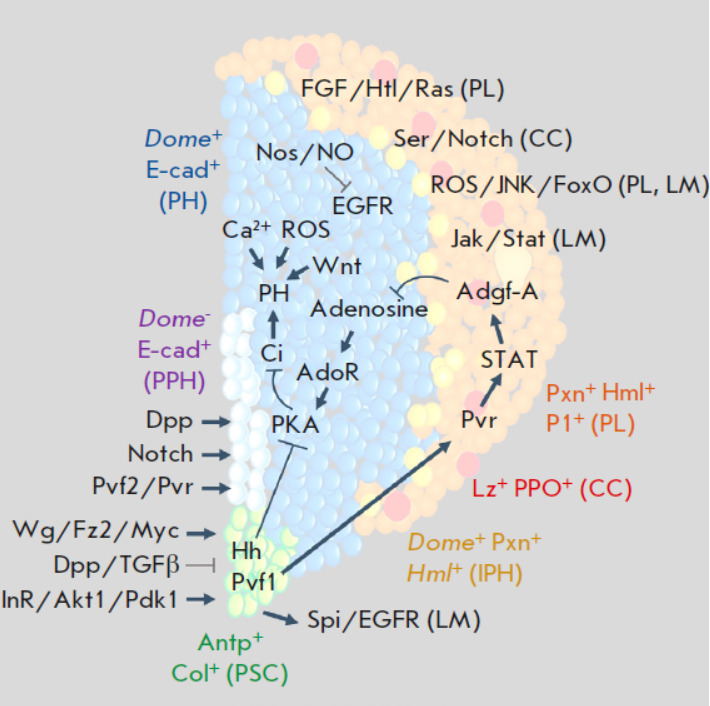
As a model organism, the fruit fly () has assumed a leading position in modern biological research. The genetic system has a number of advantages making it a key model in investigating the molecular mechanisms of metazoan developmental processes. Over the past two decades, significant progress has been made in understanding the molecular mechanisms regulating hematopoiesis. This review discusses the major advances in investigating the molecular mechanisms involved in maintaining the population of multipotent progenitor cells and their differentiation into mature hemocytes in the hematopoietic organ of the larva. The use of the hematopoietic organ as a model system for hematopoiesis has allowed to characterize the complex interactions between signaling pathways and transcription factors in regulating the maintenance and differentiation of progenitor cells through the signals from the hematopoietic niche, autocrine and paracrine signals, and the signals emanated by differentiated cells.
作为一种模式生物,果蝇在现代生物学研究中占据了主导地位。果蝇的遗传系统具有诸多优势,使其成为研究后生动物发育过程分子机制的关键模型。在过去二十年里,我们在理解调节造血作用的分子机制方面取得了重大进展。本综述讨论了在研究果蝇幼虫造血器官中维持多能祖细胞群体及其分化为成熟血细胞的分子机制方面的主要进展。将果蝇造血器官用作造血模型系统,有助于通过造血微环境信号、自分泌和旁分泌信号以及分化细胞发出的信号,来描述信号通路和转录因子在调节祖细胞维持和分化过程中的复杂相互作用。