Albahli Odai M, Ali Saqib, Alblaihi Fahad, Aljaman Abdulaziz A
Family Medicine, Kingdom of Saudi Arabia Ministry of Health, Riyadh, SAU.
Endocrinology and Diabetes, King Salman Hospital, Riyadh, SAU.
Cureus. 2024 Jul 27;16(7):e65521. doi: 10.7759/cureus.65521. eCollection 2024 Jul.
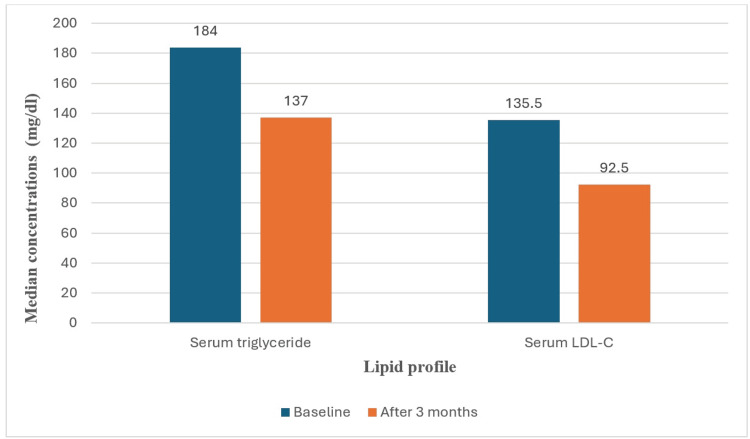
Background Dyslipidemia is a common complication of type 2 diabetes mellitus (T2DM), which is the leading cause of morbidity and mortality in developed countries, including Saudi Arabia. Injectable glucagon-like peptide-1 receptor agonists (GLP-1RA) are recent therapies found to be effective in treating dyslipidemia in diabetic patients by acting similarly to the body's internal glucagon peptide hormone, regulating blood sugar levels and reducing triglycerides and low-density lipoprotein (LDL) levels. Aim of the study This retrospective cohort study aimed to investigate the effect of GLP-1RA on the lipid profile of dyslipidemia diabetic patients who were not controlled using statins. Methods Data were collected from the medical records of male and female diabetic patients with dyslipidemia (uncontrolled by statins) who were administered to the diabetic center of King Salman Bin Abdulaziz Hospital in Riyadh, Saudi Arabia, and received GLP-1RA (dulaglutide) from June 2023 to August 2023. The primary endpoint was the change in triglycerides and LDL-C levels after three months of using dulaglutide, and the secondary endpoints included the change in body weight, BMI, and HbA1c%. Descriptive analysis was conducted to present numerical and categorical data. The Wilcoxon signed-rank test was used to compare numerical data before and after using dulaglutide. Ethical considerations were taken into account by ensuring anonymous data collection and obtaining IRB approval before data collection. Results The study included 102 patients with a median (interquartile range (IQR)) age of 59 (14) years. Females constituted 55.2% of the population. Obesity (96.1%), hypertension (71.6%), and retinopathy (13.7%) were the most commonly reported comorbidities. The study showed a significant reduction in body weight, BMI, HbA1c, hemoglobin, mean corpuscular volume (MCV), serum LDL-C, and triglyceride concentrations after three months of using dulaglutide (p<0.001). Conclusion Our study results confirm the positive effect of the GLP-1RA (dulaglutide) on the lipid profile of diabetic patients with dyslipidemia uncontrolled by statins.
血脂异常是2型糖尿病(T2DM)的常见并发症,在包括沙特阿拉伯在内的发达国家,它是发病和死亡的主要原因。注射用胰高血糖素样肽-1受体激动剂(GLP-1RA)是最近发现的一种治疗方法,通过与人体内部的胰高血糖素肽激素起类似作用,调节血糖水平,降低甘油三酯和低密度脂蛋白(LDL)水平,从而有效治疗糖尿病患者的血脂异常。
这项回顾性队列研究旨在调查GLP-1RA对未使用他汀类药物控制的血脂异常糖尿病患者血脂谱的影响。
从沙特阿拉伯利雅得国王萨勒曼·本·阿卜杜勒阿齐兹医院糖尿病中心收治的血脂异常(未用他汀类药物控制)的糖尿病男性和女性患者的病历中收集数据,这些患者在2023年6月至2023年8月期间接受了GLP-1RA(度拉糖肽)治疗。主要终点是使用度拉糖肽三个月后甘油三酯和LDL-C水平的变化,次要终点包括体重、BMI和糖化血红蛋白(HbA1c)%的变化。进行描述性分析以呈现数值和分类数据。使用Wilcoxon符号秩检验比较使用度拉糖肽前后的数值数据。通过确保匿名数据收集并在数据收集前获得机构审查委员会(IRB)批准来考虑伦理因素。
该研究纳入了102名患者,年龄中位数(四分位间距(IQR))为59(14)岁。女性占总人口的55.2%。最常报告的合并症是肥胖(96.1%)、高血压(71.6%)和视网膜病变(13.7%)。研究表明,使用度拉糖肽三个月后,体重、BMI、HbA1c、血红蛋白、平均红细胞体积(MCV)、血清LDL-C和甘油三酯浓度显著降低(p<0.001)。
我们的研究结果证实了GLP-1RA(度拉糖肽)对未使用他汀类药物控制的血脂异常糖尿病患者血脂谱的积极影响。