Vuerich Marta, Nguyen Du Hanh, Ferrari Davide, Longhi Maria Serena
Biomedical Research, Novartis Pharma AG, Basel, Switzerland.
Department of Anesthesia, Critical Care & Pain Medicine, Beth Israel Deaconess Medical Center and Harvard Medical School, Boston, MA, United States.
Front Cell Dev Biol. 2024 Aug 12;12:1429736. doi: 10.3389/fcell.2024.1429736. eCollection 2024.
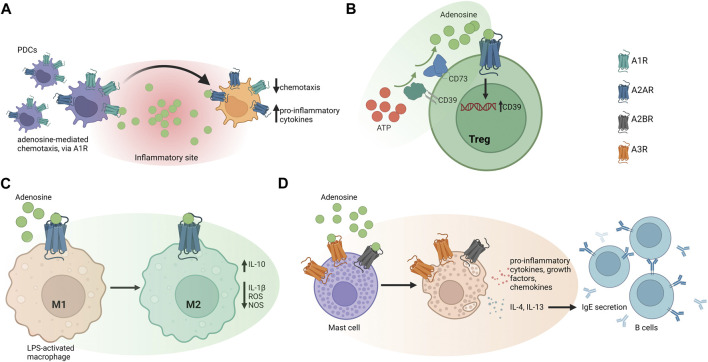
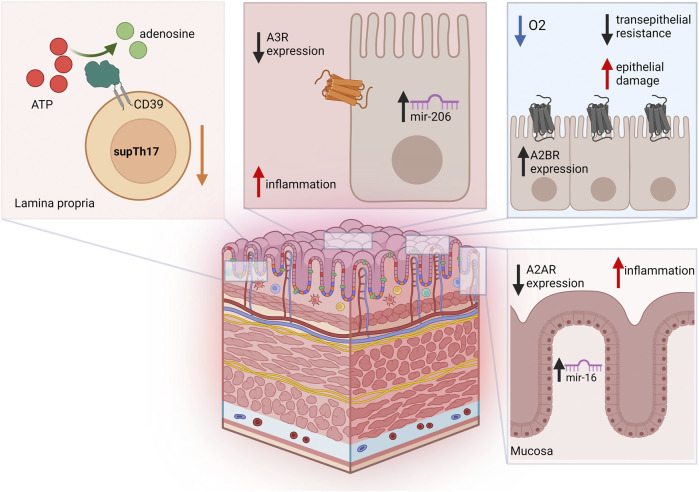
Extracellular ATP and its derivates mediate a signaling pathway that might be pharmacologically targeted to treat inflammatory conditions. Extracellular adenosine, the product of ATP hydrolysis by ectonucleotidase enzymes, plays a key role in halting inflammation while promoting immune tolerance. The rate-limiting ectoenzyme ENTPD1/CD39 and the ecto-5'-nucleotidase/CD73 are the prototype members of the ectonucleotidase family, being responsible for ATP degradation into immunosuppressive adenosine. The biological effects of adenosine are mediated via adenosine receptors, a family of G protein-coupled receptors largely expressed on immune cells where they modulate innate and adaptive immune responses. Inflammatory bowel disease (IBD) is a serious inflammatory condition of the gastrointestinal tract, associated with substantial morbidity and often refractory to currently available medications. IBD is linked to altered interactions between the gut microbiota and the immune system in genetically predisposed individuals. A wealth of studies conducted in patients and animal models highlighted the role of various adenosine receptors in the modulation of chronic inflammatory diseases like IBD. In this review, we will discuss the most recent findings on adenosine-mediated immune responses in different cell types, with a focus on IBD and its most common manifestations, Crohn's disease and ulcerative colitis.
细胞外ATP及其衍生物介导了一条信号通路,该通路可能成为治疗炎症性疾病的药理学靶点。细胞外腺苷是胞外核苷酸酶催化ATP水解的产物,在抑制炎症并促进免疫耐受方面发挥关键作用。限速胞外酶ENTPD1/CD39和胞外5'-核苷酸酶/CD73是胞外核苷酸酶家族的典型成员,负责将ATP降解为具有免疫抑制作用的腺苷。腺苷的生物学效应通过腺苷受体介导,腺苷受体是一类G蛋白偶联受体,在免疫细胞上大量表达,可调节先天性和适应性免疫反应。炎症性肠病(IBD)是一种严重的胃肠道炎症性疾病,发病率高,且通常对现有药物难治。IBD与遗传易感性个体中肠道微生物群和免疫系统之间的相互作用改变有关。在患者和动物模型中进行的大量研究突出了各种腺苷受体在调节如IBD等慢性炎症性疾病中的作用。在本综述中,我们将讨论不同细胞类型中腺苷介导的免疫反应的最新发现,重点关注IBD及其最常见的表现形式,即克罗恩病和溃疡性结肠炎。