Department of Gastroenterology, Hainan General Hospital, Affiliated Hainan Hospital, Hainan Medical University, Haikou 570311, Hainan Province, China.
Doheny Eye Institute, Department of Ophthalmology, David Geffen School of Medicine, University of California Los Angeles, Los Angeles, CA 90033, United States.
World J Gastroenterol. 2022 Jul 7;28(25):2955-2967. doi: 10.3748/wjg.v28.i25.2955.
Post-infectious irritable bowel syndrome (PI-IBS) is generally regarded as a functional disease. Several recent studies have reported the involvement of low-grade inflammation and immunological dysfunction in PI-IBS. T helper 17 (Th17) polarization occurs in IBS. Adenosine and its receptors participate in intestinal inflammation and immune regulation.
To investigate the role of Th17 polarization of CD4+ T cells regulated by adenosine 2A receptor (A2AR) in PI-IBS.
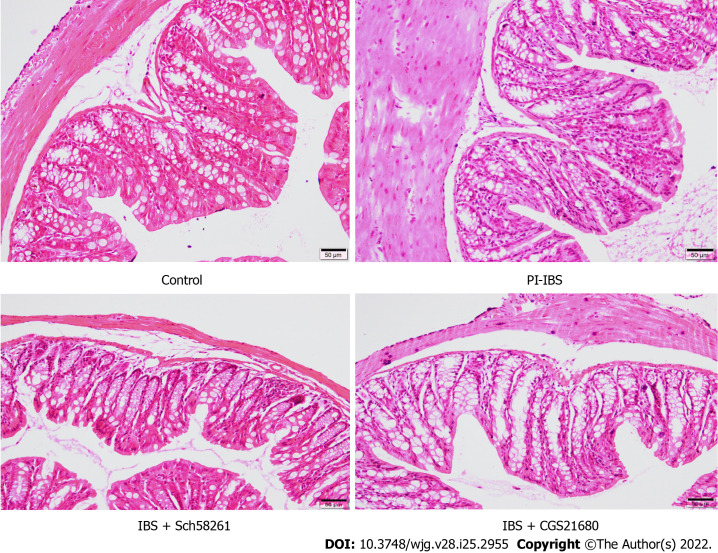
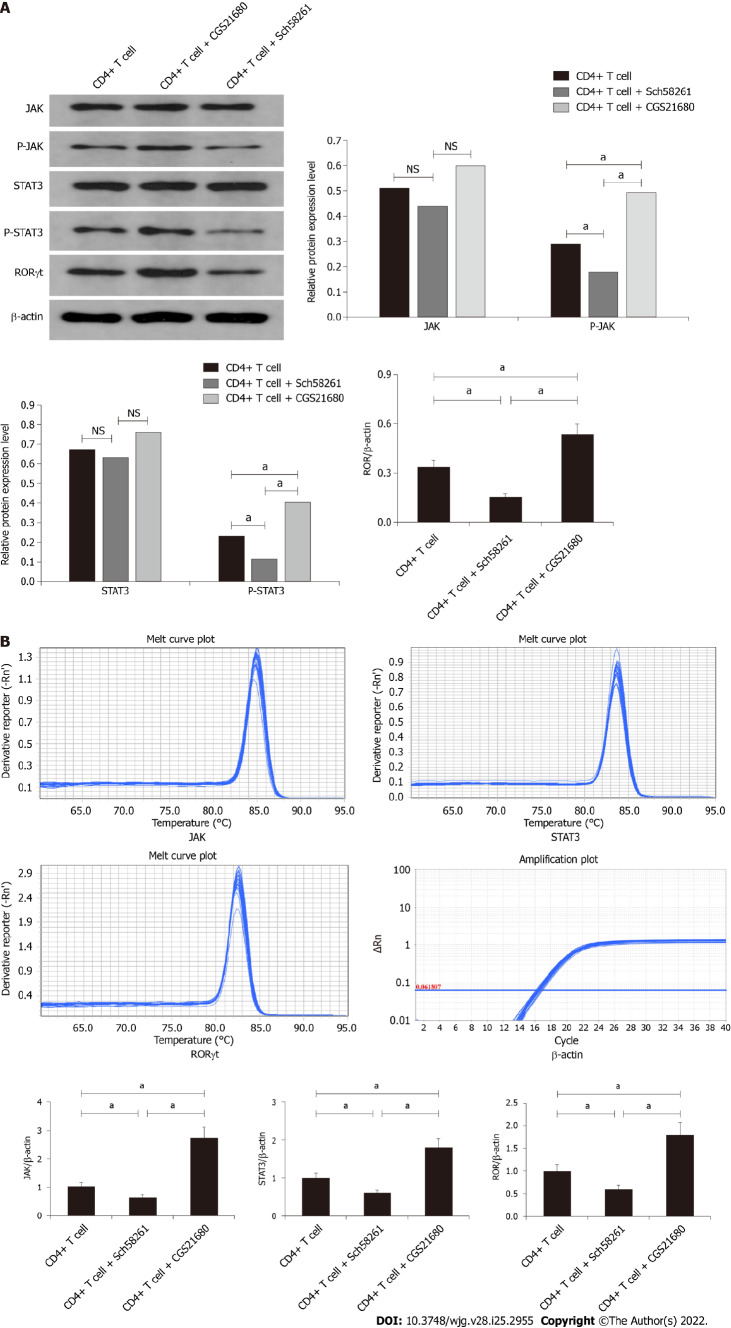
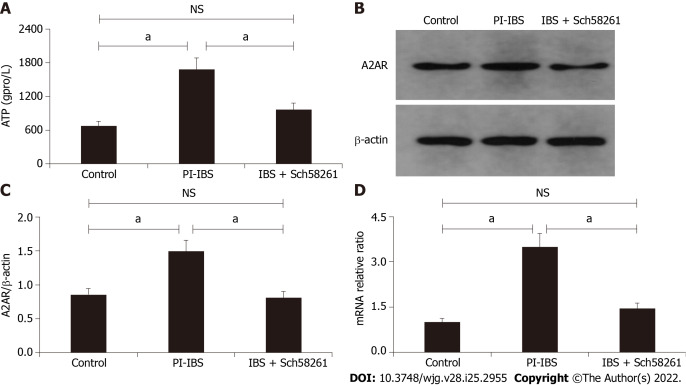
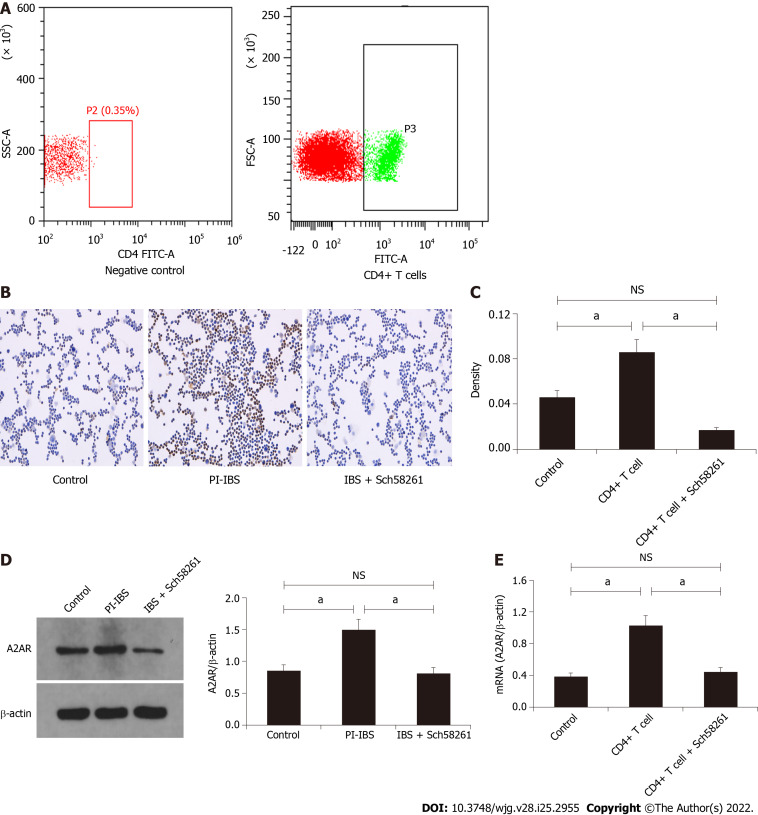
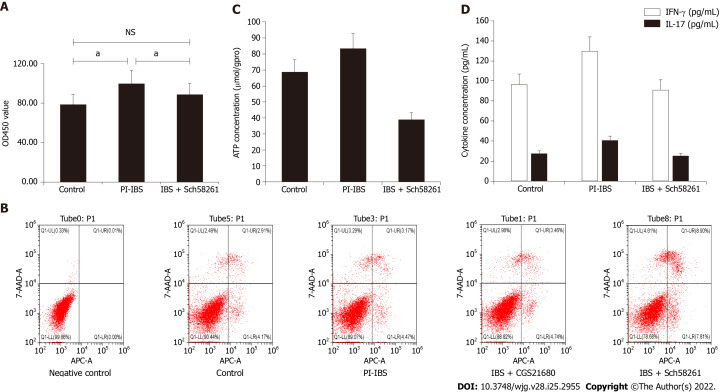
A PI-IBS model was established by infecting mice with . The intestinal A2AR and CD4+ T lymphocytes were detected by immunohistochemistry, and the inflammatory cytokines were detected by enzyme-linked immunoassay. CD4+ T lymphocytes present in the animal's spleen were separated and cultured with or without A2AR agonist and antagonist. Western blotting and real-time quantitative polymerase chain reaction were performed to determine the effect of A2AR on the cells and intestinal tissue. Cytokine production was determined. The protein and mRNA levels of A2AR associated signaling pathway molecules were also evaluated. Furthermore, A2AR agonist and antagonist were injected into the mouse model and the clinical features were observed.
The PI-IBS mouse model showed increased expression of ATP and A2AR ( < 0.05), and inhibition of A2AR improved the clinical features in PI-IBS, including the abdominal withdrawal reflex and colon transportation test ( < 0.05). The number of intestinal CD4+ T cells and interleukin-17 (IL-17) protein levels increased during PI-IBS, which was reversed by administration of the A2AR antagonist ( < 0.05). CD4+ T cells expressed A2AR and produced IL-17 , which was regulated by the A2AR agonist and antagonist. The A2AR antagonist increased the production of IL-17 by CD4+ T cells the Janus kinase-signal transducer and activator of transcription-receptor-related orphan receptor γ signaling pathway.
The results of the present study suggested that the upregulation of A2AR increases PI-IBS by promoting the Th17 polarization of CD4+ T cells.
感染后肠易激综合征(PI-IBS)通常被认为是一种功能性疾病。最近的几项研究报告称,PI-IBS 存在低度炎症和免疫功能障碍。IBS 中发生 Th17 极化。腺苷及其受体参与肠道炎症和免疫调节。
探讨腺苷 2A 受体(A2AR)调节的 CD4+T 细胞 Th17 极化在 PI-IBS 中的作用。
通过感染小鼠建立 PI-IBS 模型。通过免疫组织化学检测肠道 A2AR 和 CD4+T 淋巴细胞,通过酶联免疫吸附试验检测炎症细胞因子。分离并培养动物脾脏中的 CD4+T 淋巴细胞,用或不用 A2AR 激动剂和拮抗剂。进行 Western blot 和实时定量聚合酶链反应,以确定 A2AR 对细胞和肠道组织的影响。测定细胞因子的产生。还评估了与 A2AR 相关信号通路分子的蛋白和 mRNA 水平。此外,向小鼠模型中注射 A2AR 激动剂和拮抗剂,并观察临床特征。
PI-IBS 小鼠模型中 ATP 和 A2AR 的表达增加(<0.05),抑制 A2AR 可改善 PI-IBS 的临床特征,包括腹壁退缩反射和结肠转运试验(<0.05)。PI-IBS 时肠道 CD4+T 细胞数量和白细胞介素-17(IL-17)蛋白水平增加,A2AR 拮抗剂给药后逆转(<0.05)。CD4+T 细胞表达 A2AR 并产生 IL-17,这受 A2AR 激动剂和拮抗剂的调节。A2AR 拮抗剂通过增加 JAK-STAT-转录激活因子相关孤儿受体 γ 信号通路增加 CD4+T 细胞产生 IL-17。
本研究结果表明,A2AR 的上调通过促进 CD4+T 细胞的 Th17 极化增加 PI-IBS。