Li Wenzhe, Fu Yiting, Jiang Yanqing, Hu Jindong, Wei Yanli, Li Hongmei, Li Jishun, Yang Hetong, Wu Yuanzheng
School of Bioengineering, Qilu University of Technology, Shandong Academy of Sciences, Jinan 250353, China.
Shandong Provincial Key Laboratory of Applied Microbiology, Ecology Institute, Qilu University of Technology, Shandong Academy of Sciences, Jinan 250103, China.
J Fungi (Basel). 2024 Aug 5;10(8):551. doi: 10.3390/jof10080551.
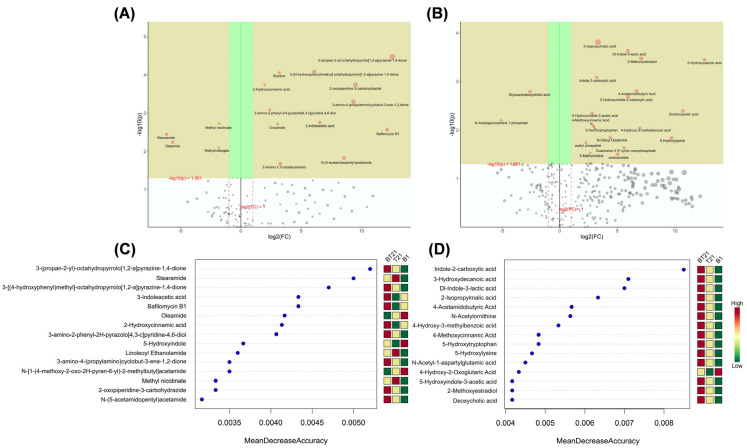
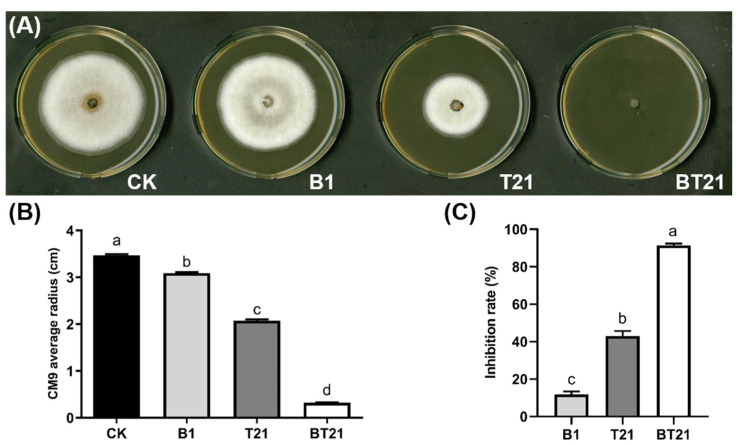
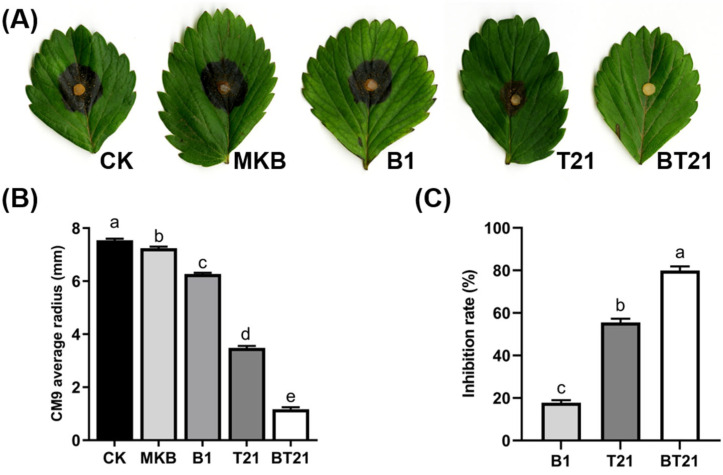
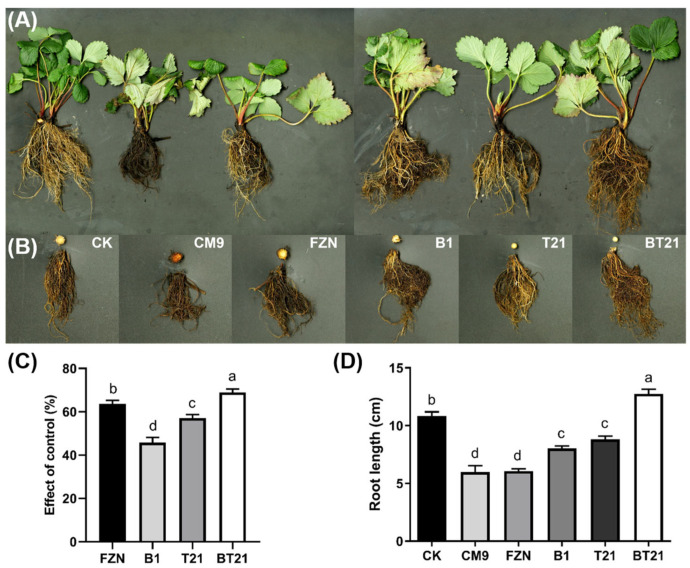
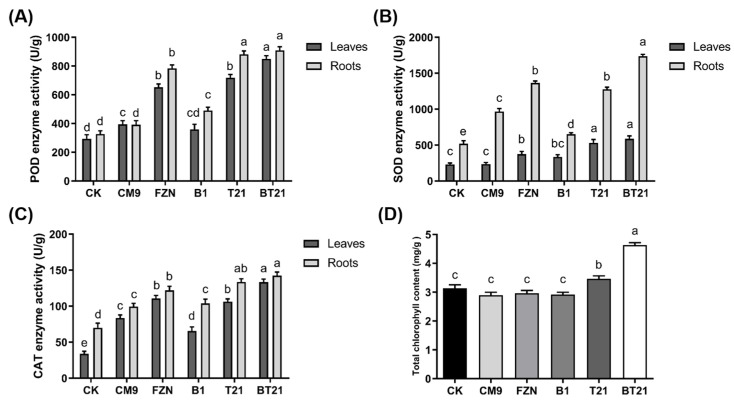
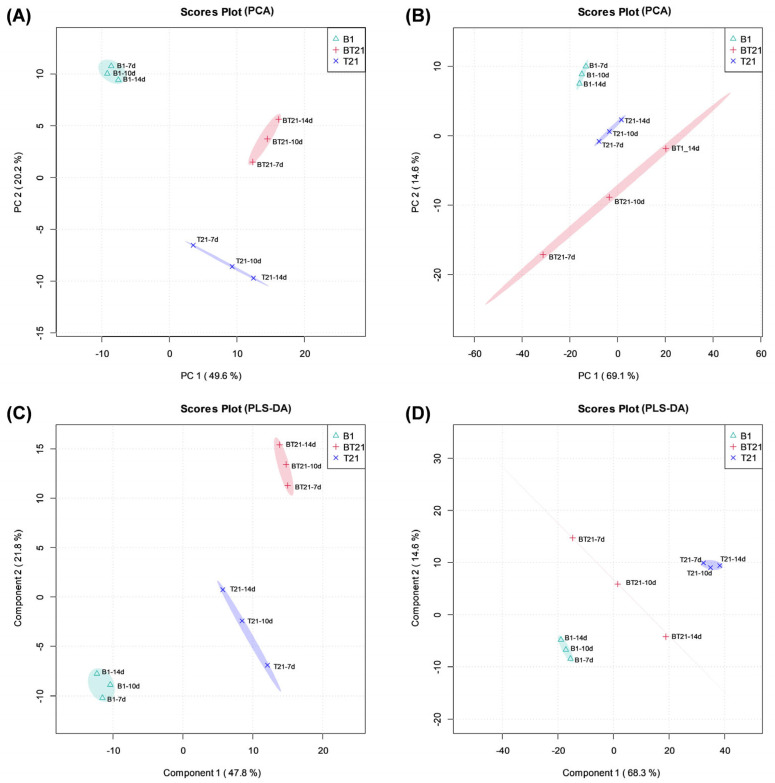
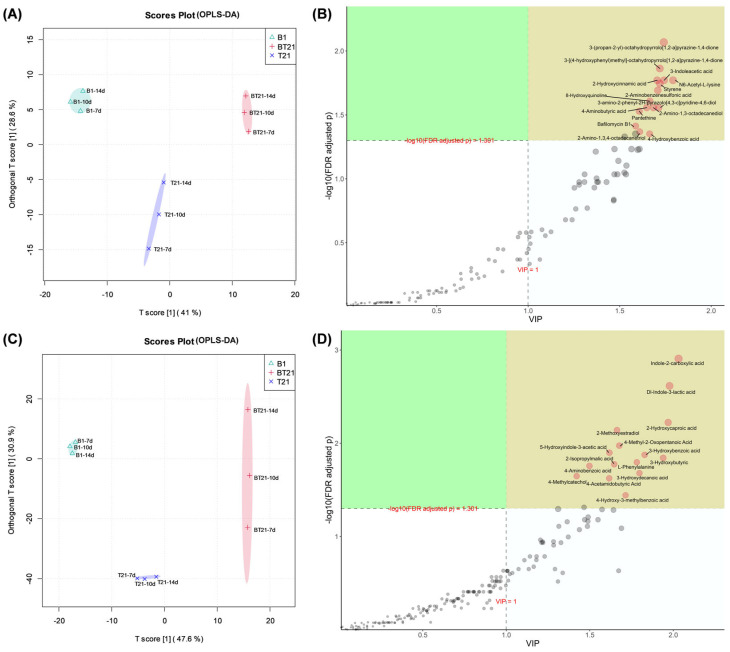
This study aimed to investigate the efficiency of the secondary metabolites (SMs) produced by a co-culture of TW21990 and B418 in the control of CM9. A fermentation filtrate of B418 + TW21990 co-culture (BT21) produced a notable increase in the inhibition rate of CM9 compared to those of TW21990 and B418 monocultures, which reached 91.40% and 80.46% on PDA plates and strawberry leaves, respectively. The BT21 fermentation broth exhibited high control efficiency on strawberry root rot of 68.95% in a pot experiment, which was higher than that in the monocultures and fluazinam treatment. In addition, BT21 treatment promoted strawberry root development, improved antioxidative enzyme activities in the leaves and roots, and enhanced the total chlorophyll content of the strawberry leaves. UHPLC-MS/MS analysis of fermentation filtrates was performed to elucidate SM variations, revealing 478 and 795 metabolites in BT21 co-culture in positive and negative ion modes, respectively. The metabolomic profiles suggested abundant SMs with antagonistic capabilities and growth-promoting effects: 3-(propan-2-yl)-octahydropyrrolo [1,2-a]pyrazine-1,4-dione (cyclo(L-Pro-L-Val)), 3-[(4-hydroxyphenyl)methyl]-octahydropyrrolo[1,2-a]pyrazine-1,4-dione (cyclo(L-Pro-L-Tyr)), 3-indoleacetic acid (IAA), 2-hydroxycinnamic acid, 4-aminobutyric acid (GABA), bafilomycin B1, and DL-indole-3-lactic acid (ILA) were significantly enhanced in the co-culture. Overall, this study demonstrates that a co-culture strategy is efficient for inducing bioactive SMs in and which could be exploited as a novel approach for developing biocontrol consortia.
本研究旨在探究TW21990和B418共培养产生的次生代谢产物(SMs)对CM9的防控效果。与TW21990和B418单培养相比,B418 + TW21990共培养(BT21)的发酵滤液使CM9的抑制率显著提高,在PDA平板和草莓叶片上分别达到91.40%和80.46%。在盆栽试验中,BT21发酵液对草莓根腐病的防控效果高达68.95%,高于单培养和咯菌腈处理。此外,BT21处理促进了草莓根系发育,提高了叶片和根系中的抗氧化酶活性,并增加了草莓叶片的总叶绿素含量。对发酵滤液进行UHPLC-MS/MS分析以阐明SMs的变化,结果显示在正离子和负离子模式下,BT21共培养物中分别有478种和795种代谢产物。代谢组学图谱表明存在大量具有拮抗能力和促生长作用的SMs:3-(异丙基)-八氢吡咯并[1,2-a]吡嗪-1,4-二酮(环(L-脯氨酸-L-缬氨酸))、3-[(4-羟基苯基)甲基]-八氢吡咯并[1,2-a]吡嗪-1,4-二酮(环(L-脯氨酸-L-酪氨酸))、3-吲哚乙酸(IAA)、2-羟基肉桂酸、4-氨基丁酸(GABA)、巴弗洛霉素B1和DL-吲哚-3-乳酸(ILA)在共培养物中显著增加。总体而言,本研究表明共培养策略可有效诱导生物活性SMs,可作为开发生物防治联合体的新方法。