Department of Medical Biotechnology, Faculty of Allied Medical Sciences, Iran University of Medical Sciences, Tehran, Iran.
PLoS One. 2024 Aug 28;19(8):e0309289. doi: 10.1371/journal.pone.0309289. eCollection 2024.
Patients with breast cancer, especially triple-negative breast cancer, have a poor prognosis. There is still no effective treatment for this disease. Due to resistance to traditional treatments such as chemotherapy and radiation therapy, there is a need to discover novel treatment strategies to treat this disease. Ribociclib is a selective CDK4/6 inhibitor. Approximately 20% of patients with HR+ breast cancer developed primary resistance to CDK4/6 inhibitors, and more than 30% experienced secondary resistance. Since most patients experience resistance during CDK4/6 inhibitor treatment, managing this disease is becoming more challenging. Many malignant tumors abnormally express microRNA (miR)-141, which participates in several cellular processes, including drug resistance, proliferation, epithelial-mesenchymal transition, migration, and invasion.
In the present study, we cultured MDA-MB-231 and MCF-7 cells in DMEM-F12 medium. By performing MTT assay we determined the cytotoxic effects of ribociclib on breast cancer cells, as well as determining the IC50 of it. Then, we treated the cells with ribociclib at two time points: 24 h and 72 h. After that, RNA was isolated and reverse transcribed to cDNA. Finally, we performed qRT‒PCR to evaluate how ribociclib affects the expression level of desired genes.
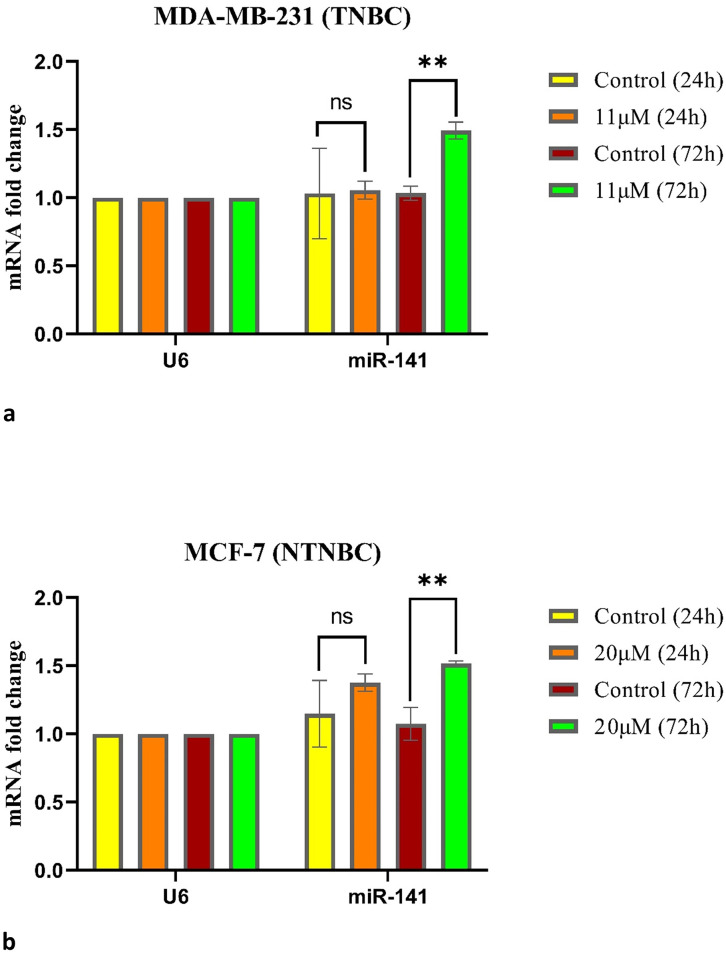
We found that ribociclib can inhibit cell growth in a dose- and time-dependent manner. We examined the mRNA expression of 4 genes. After ribociclib treatment, the mRNA expression of CDK6 and MYH10 decreased (p < 0.01, p < 0.05). The mRNA expression of CDON increased (p<0.05), but no significant changes were observed in ZEB1 mRNA expression. Furthermore, the qRT‒PCR results for miR-141 showed that the expression of miR-141 increased (p<0.01) after 72 h of treatment with ribociclib.
患有乳腺癌,特别是三阴性乳腺癌的患者,预后较差。目前还没有有效的治疗方法。由于对化疗和放疗等传统治疗方法的耐药性,需要发现新的治疗策略来治疗这种疾病。瑞博西利是一种选择性 CDK4/6 抑制剂。大约 20%的 HR+乳腺癌患者对 CDK4/6 抑制剂产生原发性耐药,超过 30%的患者出现继发性耐药。由于大多数患者在 CDK4/6 抑制剂治疗期间发生耐药,因此管理这种疾病变得更加具有挑战性。许多恶性肿瘤异常表达 microRNA (miR)-141,它参与了几种细胞过程,包括耐药性、增殖、上皮间质转化、迁移和侵袭。
在本研究中,我们在 DMEM-F12 培养基中培养 MDA-MB-231 和 MCF-7 细胞。通过 MTT assay 我们测定了瑞博西利对乳腺癌细胞的细胞毒性作用,并确定了它的 IC50。然后,我们在 24 小时和 72 小时两个时间点用瑞博西利处理细胞。之后,分离 RNA 并逆转录为 cDNA。最后,我们通过 qRT-PCR 评估瑞博西利如何影响目的基因的表达水平。
我们发现瑞博西利可以剂量和时间依赖的方式抑制细胞生长。我们检测了 4 个基因的 mRNA 表达。瑞博西利处理后,CDK6 和 MYH10 的 mRNA 表达降低(p<0.01,p<0.05)。CDON 的 mRNA 表达增加(p<0.05),但 ZEB1 的 mRNA 表达没有明显变化。此外,瑞博西利处理 72 小时后 miR-141 的 qRT-PCR 结果显示 miR-141 的表达增加(p<0.01)。