Development of Nursing Practices Unit, Valais Hospitals, Sion, Switzerland.
Social Affairs and Human Resources, Valais Hospitals, Sion, Switzerland.
JMIR Public Health Surveill. 2024 Aug 28;10:e47465. doi: 10.2196/47465.
Hospitalized patients infected with SARS-CoV-2 should recover within a few weeks. However, even those with mild versions can experience symptoms lasting 4 weeks or longer. These post-COVID-19 condition (PCC) comprise various new, returning, or ongoing symptoms that can last for months or years and cause disability. Few studies have investigated PCC using self-reports from discharged patients infected with SARS-CoV-2 to complement clinical and biomarker studies.
This study aimed to investigate self-reported, persistent PCC among patients infected with SARS-CoV-2 who were discharged during the second and third waves of the COVID-19 pandemic.
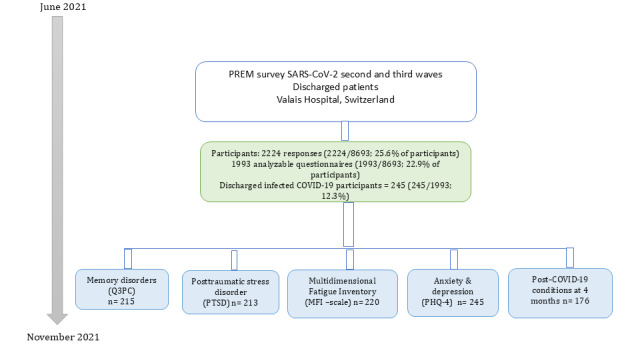
We designed, pretested, and posted an ad hoc paper questionnaire to all eligible inpatients discharged between October 2020 and April 2021. At 4 months post discharge, we collected data on PCC and scores for the Multidimensional Fatigue Inventory (MFI), the Patient Health Questionnaire-4 (PHQ-4), a Brief Memory Screening Scale (Q3PC), and a posttraumatic stress disorder scale (PCL-5). Descriptive, inferential, and multivariate linear regression statistics assessed PCC symptomatology, associations, and differences regarding sociodemographic characteristics and hospital length of stay (LOS). We examined whether our variables of interest significantly predicted MFI scores.
Of the 1993 valid questionnaires returned, 245 were from discharged patients with SARS-CoV-2 (median age 71, IQR 62.7-77 years). Only 28.2% (69/245) of respondents were symptom-free after 4 months. Women had significantly more persistent PCC symptoms than men (P≤.001). Patients with a hospital LOS ≥11 days had more PCC symptoms as well (P<.001)-women had more symptoms and longer LOS. No significant differences were found between age groups (18-64, 65-74, and ≥75 years old; P=.50) or between intensive care units and other hospitalization units (P=.09). Patients self-reported significantly higher PHQ-4 scores during their hospitalization than at 4 months later (P<.001). Three-fourth (187/245, 76.4%) of the respondents reported memory loss and concentration disorders (Q3PC). No significant differences in the median MFI score (56, IQR 1-3, range 50-60]) were associated with sociodemographic variables. Patients with a hospital LOS of ≥11 days had a significantly higher median PCL-5 score (P<.001). Multivariate linear regression allowed us to calculate that the combination of PHQ-4, Q3PC, and PCL-5 scores, adjusted for age, sex, and LOS (of either ≥11 days [median 2 symptoms, IQR 1-5] or <11 days), did not significantly predict MFI scores (R=0.09; F =1.5; P=.22; adjusted R=0.06).
The majority of inpatients infected with SARS-CoV-2 presented with PCC 4 months after discharge, with complex clinical pictures. Only one-third of them were symptom-free during that time. Based on our findings, MFI scores were not directly related to self-reported depression, anxiety, or posttraumatic scores adjusted for age, sex, or LOS. Further research is needed to explore PCC and fatigue based on self-reported health experiences of discharged inpatients infected with SARS-CoV-2.
感染 SARS-CoV-2 的住院患者应在数周内康复。然而,即使是轻症患者也可能会出现持续 4 周或更长时间的症状。这些新冠后症状(PCC)包括各种新出现的、复发的或持续存在的症状,可能会持续数月甚至数年,并导致残疾。很少有研究使用从感染 SARS-CoV-2 的出院患者那里获得的自我报告来补充临床和生物标志物研究,以调查 PCC。
本研究旨在调查第二波和第三波 COVID-19 大流行期间出院的感染 SARS-CoV-2 患者的自我报告的持续性 PCC。
我们设计、预测试并向所有 2020 年 10 月至 2021 年 4 月间出院的符合条件的住院患者发布了一份特定的纸质问卷。在出院后 4 个月时,我们收集了 PCC 数据以及多维疲劳量表(MFI)、患者健康问卷-4(PHQ-4)、简要记忆筛查量表(Q3PC)和创伤后应激障碍量表(PCL-5)的评分。我们使用描述性、推断性和多元线性回归统计方法评估了 PCC 症状、关联和与社会人口学特征和住院时间(LOS)相关的差异。我们还检验了我们感兴趣的变量是否显著预测了 MFI 评分。
在 1993 份有效问卷中,有 245 份来自出院的 SARS-CoV-2 患者(中位年龄 71 岁,IQR 62.7-77 岁)。只有 28.2%(69/245)的患者在 4 个月后没有症状。女性的持续性 PCC 症状明显多于男性(P≤.001)。住院时间≥11 天的患者也有更多的 PCC 症状(P<.001)——女性的症状和 LOS 都更长。年龄组(18-64、65-74 和≥75 岁;P=.50)或重症监护病房和其他住院病房之间(P=.09)没有发现显著差异。住院期间患者的 PHQ-4 评分明显高于 4 个月后(P<.001)。四分之三(187/245,76.4%)的受访者报告有记忆和注意力障碍(Q3PC)。中位 MFI 评分(56,IQR 1-3,范围 50-60])与社会人口学变量无关。住院时间≥11 天的患者 PCL-5 评分中位数显著更高(P<.001)。多元线性回归允许我们计算,在调整年龄、性别和 LOS(≥11 天[中位数 2 个症状,IQR 1-5]或<11 天)后,PHQ-4、Q3PC 和 PCL-5 评分的组合不能显著预测 MFI 评分(R=0.09;F =1.5;P=.22;调整 R=0.06)。
大多数感染 SARS-CoV-2 的住院患者在出院后 4 个月出现 PCC,其临床表现复杂。在此期间,只有三分之一的患者没有症状。根据我们的发现,MFI 评分与年龄、性别或 LOS 调整后的自我报告的抑郁、焦虑或创伤后评分没有直接关系。需要进一步研究,以基于感染 SARS-CoV-2 的出院住院患者的自我报告的健康体验来探索 PCC 和疲劳。
