Center for Health, Work & Environment, Colorado School of Public Health, University of Colorado, Aurora, CO, USA.
Department of Environmental and Occupational Health, Colorado School of Public Health, University of Colorado, 13001 E 17th Pl B119, Aurora, CO, 80045, USA.
BMC Nephrol. 2024 Aug 28;25(1):277. doi: 10.1186/s12882-024-03706-8.
Exposure to extreme heat impacts millions of people worldwide and outdoor workers are among the populations most affected by hot temperatures. Heat stress induces several biological responses in humans, including the production of heat shock proteins (HSP) and antibodies against HSP (anti-HSP) which may play a central role in the body's cellular response to a hot environment.
This longitudinal study investigated the impact of elevated temperatures and humidity on the presence of HSP70 and anti-HSP70 and examined relationships with markers of kidney function in an at-risk workforce under conditions of extreme heat and exertion in Guatemala.
We collected ambient temperature and relative humidity data as well as biomarkers and clinical data from 40 sugarcane workers at the start and the end of a 6-month harvest. We used generalized mixed-effects models to estimate temperature effects on HSP70 and anti-HSP70 levels. In addition, we examined trends between HSP70 and anti-HSP70 levels and markers of kidney function across the harvest.
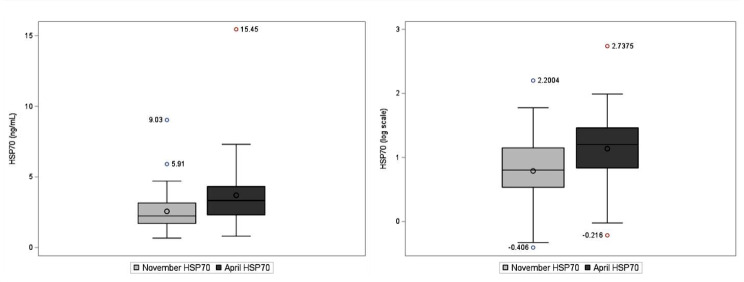
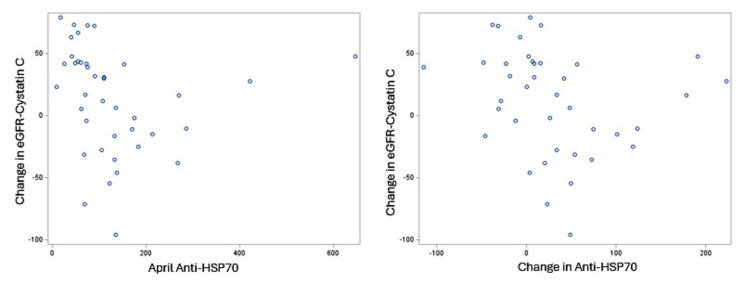
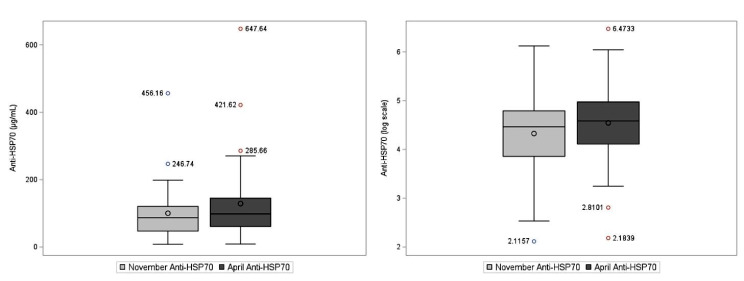
At the end of the harvest, temperatures were higher, and workers had, on average, higher levels of HSP70 and anti-HSP70 compared to the beginning of the season. We observed significant increasing trends with temperature indices, heat index, and HSP70 levels. Maximum temperature was associated with HSP70 increments after controlling for age, systolic and diastolic blood pressure (β: 0.21, 95% Confidence Interval: 0.09, 0.33). Kidney function decline across the harvest was associated with both higher levels of anti-HSP70 levels at the end of the harvest as well as greater increases in anti-HSP70 levels across the harvest.
These results suggest that workplace heat exposure may increase the production of HSP70 and anti-HSP70 levels and that there may be a relationship between increasing anti-HSP70 antibodies and the development of renal injury. HSP70 holds promise as a biomarker of heat stress in exposed populations.
暴露在极端高温下会影响全球数百万人,户外工作者是受高温影响最大的人群之一。热应激会引起人体的多种生物学反应,包括热休克蛋白(HSP)的产生和针对 HSP 的抗体(抗 HSP)。这些反应可能在人体对热环境的细胞反应中发挥核心作用。
本纵向研究调查了高温和高湿度对 HSP70 存在的影响,以及 HSP70 和抗 HSP70 与危 workforce 人群肾功能标志物之间的关系,该人群在危 workforce 人群中处于极端高温和剧烈运动的条件下。
我们在危 workforce 人群中,在 6 个月的收获开始和结束时,从 40 名甘蔗工人那里收集了环境温度和相对湿度数据以及生物标志物和临床数据。我们使用广义混合效应模型来估计温度对 HSP70 和抗 HSP70 水平的影响。此外,我们还检查了收获过程中 HSP70 和抗 HSP70 水平与肾功能标志物之间的趋势。
在收获结束时,温度较高,与季节开始时相比,工人的 HSP70 和抗 HSP70 水平平均较高。我们观察到与温度指数、热指数和 HSP70 水平呈显著增加趋势。在控制年龄、收缩压和舒张压后,最高温度与 HSP70 增量相关(β:0.21,95%置信区间:0.09,0.33)。整个收获过程中肾功能下降与收获结束时抗 HSP70 水平升高以及整个收获过程中抗 HSP70 水平升高有关。
这些结果表明,工作场所热暴露可能会增加 HSP70 和抗 HSP70 水平的产生,并且抗 HSP70 抗体的增加可能与肾脏损伤的发展有关。HSP70 有望成为暴露人群热应激的生物标志物。