Kotewicz Magdalena, Krajewski Piotr K, Jaworek Andrzej K, Szepietowski Jacek C
University Centre of General Dermatology and Oncodermatology, Wroclaw Medical University, 50-368 Wroclaw, Poland.
Department of Dermatology, Jagiellonian University, 31-008 Kraków, Poland.
J Clin Med. 2024 Aug 19;13(16):4890. doi: 10.3390/jcm13164890.
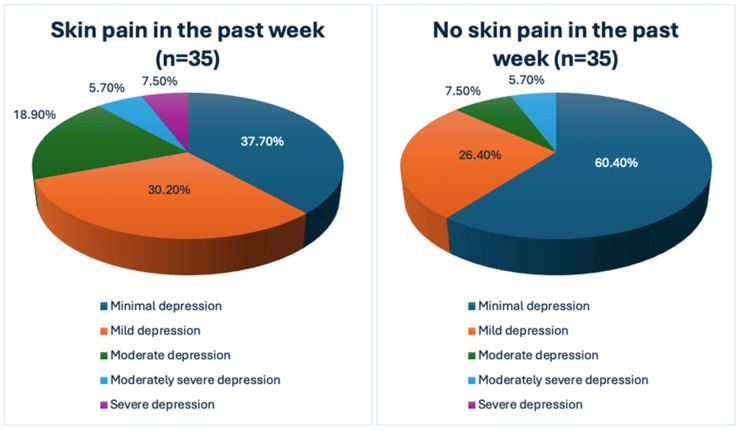
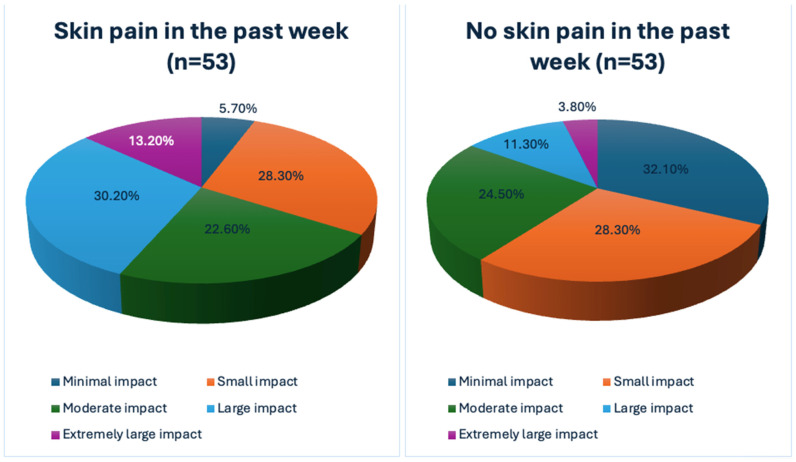
Psoriasis is a chronic inflammatory disease that negatively impacts patients' quality of life (QoL) and mental health. Itch and pain are prevalent symptoms of psoriasis and contribute to the psychosocial burden of this disease. This study aimed to evaluate the impact of skin pain on the prevalence and severity of symptoms of anxiety and depression and on the QoL in psoriasis patients. The studied population comprised 106 adults with psoriasis (34% female; mean age 42.1 ± 13.0 years). Disease severity was measured with the Psoriasis Area and Severity Index (PASI). The intensity of skin pain was assessed with the NRS and the Short Form McGill Pain Questionnaire (SF-MPQ). The Generalized Anxiety Disorder-7 (GAD-7) and Patient Health Questionnaire-9 (PHQ-9) questionnaires were used to estimate the severity of depression and anxiety, respectively, as was the Hospital Anxiety and Depression Scale (HADS). Quality of life (QoL) was studied using the Dermatology Life Quality Index (DLQI). Regarding anxiety assessment, females reported significantly higher scores with the HADS-A (8.42 ± 4.85 points vs. 5.14 ± 3.9 points; < 0.001) and the GAD-7 compared to men (7.50 ± 5.58 points vs. 5.24 ± 4.79 points; = 0.036). Similarly, the severity of depression was significantly higher in women, as measured with the PHQ-9 (7.50 ± 5.58 points vs. 5.24 ± 4.79 points, = 0.021). Psoriasis patients with skin pain scored significantly higher in HADS Total score ( = 0.043), HADS-A ( = 0.022), PHQ-9 ( = 0.035), and DLQI ( < 0.001) than the rest of the studied group. The intensity of skin pain measured with the SF-MPQ correlated significantly with HADS Total score ( = 0.021), HADS-A ( < 0.001), HADS-D ( = 0.038), and PHQ-9 ( < 0.001). Additionally, there was a significant correlation between the intensity of cutaneous pain assessed using the VAS and the PHQ-9 ( = 0.022). Skin pain significantly influences the well-being of patients with psoriasis as well as the symptoms of anxiety and depression. In particular, women with psoriasis are at increased risk of developing anxiety and depression. Our findings underline the necessity for a multidisciplinary approach to the management of this dermatosis.
银屑病是一种慢性炎症性疾病,会对患者的生活质量(QoL)和心理健康产生负面影响。瘙痒和疼痛是银屑病的常见症状,会加重这种疾病的社会心理负担。本研究旨在评估皮肤疼痛对银屑病患者焦虑和抑郁症状的患病率及严重程度以及生活质量的影响。研究人群包括106名成年银屑病患者(女性占34%;平均年龄42.1±13.0岁)。采用银屑病面积和严重程度指数(PASI)来衡量疾病严重程度。使用数字评定量表(NRS)和简化麦吉尔疼痛问卷(SF - MPQ)评估皮肤疼痛强度。分别使用广泛性焦虑障碍7项量表(GAD - 7)和患者健康问卷9项量表(PHQ - 9)以及医院焦虑抑郁量表(HADS)来评估抑郁和焦虑的严重程度。使用皮肤病生活质量指数(DLQI)研究生活质量(QoL)。在焦虑评估方面,女性在HADS - A量表(8.42±4.85分 vs. 5.14±3.9分;<0.001)和GAD - 7量表上的得分显著高于男性(7.50±5.58分 vs. 5.24±4.79分;=0.036)。同样,用PHQ - 9量表测量,女性的抑郁严重程度显著更高(7.50±5.58分 vs. 5.24±4.79分,=0.021)。有皮肤疼痛的银屑病患者在HADS总分(=0.043)、HADS - A(=0.022)、PHQ -9(=0.035)和DLQI(<0.001)上的得分显著高于研究组的其他患者。用SF - MPQ测量的皮肤疼痛强度与HADS总分(=0.021)、HADS - A(<0.001)、HADS - D(=0.038)和PHQ -9(<0.001)显著相关。此外,使用视觉模拟评分法(VAS)评估的皮肤疼痛强度与PHQ -9之间存在显著相关性(=0.022)。皮肤疼痛显著影响银屑病患者的幸福感以及焦虑和抑郁症状。特别是,患银屑病的女性患焦虑和抑郁的风险增加。我们的研究结果强调了对这种皮肤病进行多学科管理的必要性。