Department of Medical and Surgical Sciences, University Magna Græcia of Catanzaro, 88100 Catanzaro, Italy.
Geriatric Division, University Hospital "Renato Dulbecco", 88100 Catanzaro, Italy.
Int J Mol Sci. 2024 Aug 13;25(16):8811. doi: 10.3390/ijms25168811.
Heart failure (HF) with preserved ejection fraction (HFpEF) represents a major comorbidity in the elderly and is associated with cognitive impairment (CoI) and type 2 diabetes mellitus (T2DM). In this context, there is an increase in oxidative stress and platelet activation biomarkers. The aim of this study was to evaluate the effects of 6 months' treatment with SGLT2i on functional, mood-related, and cognitive aspects, assessed by performing a comprehensive geriatric assessment (CGA), and on oxidative stress and platelet activation biomarkers, in a cohort of HFpEF elderly patients with T2DM. We recruited 150 elderly outpatients (mean age 75.8 ± 7.4 years).
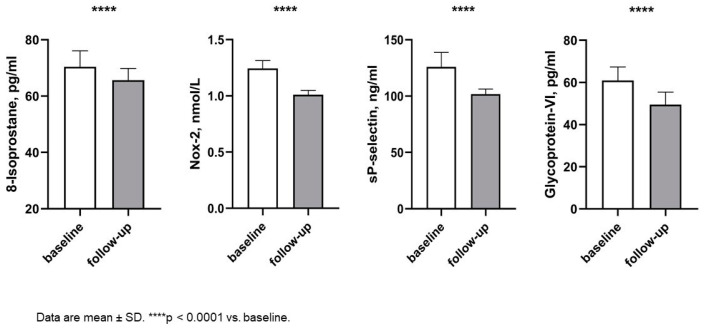
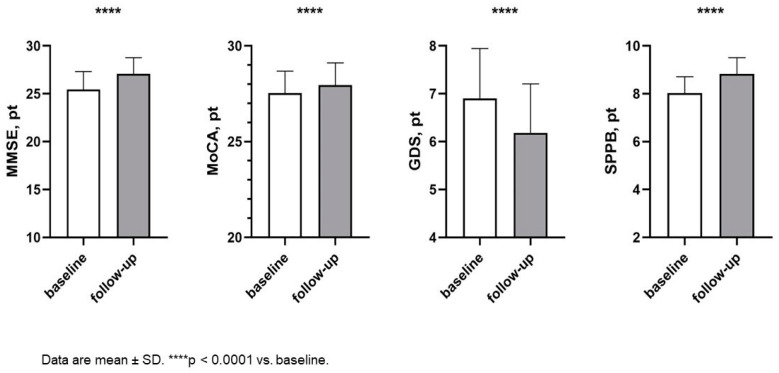
At six-month follow-up, there was a significant improvement in MMSE ( < 0.0001), MoCA ( < 0.0001), GDS score ( < 0.0001), and SPPB ( < 0.0001). Moreover, we observed a significant reduction in Nox-2 ( < 0.0001), 8-Isoprostane ( < 0.0001), Sp-Selectin ( < 0.0001), and Gp-VI ( < 0.0001). Considering ΔMMSE as the dependent variable, ΔE/e', ΔNox-2, ΔHOMA, Δ8-Isoprostane, and ΔUricemia were associated for 59.6% with ΔMMSE. When ΔMoCA was considered as the dependent variable, ΔHOMA, ΔE/e', Δ8-Isoprostane, ΔNox-2 and ΔUricemia were associated for 59.2%. Considering ΔGDS as the dependent variable, ΔHOMA, ΔNox-2, Δ8-Isoprostane, and ΔUricemia were associated with 41.6% of ΔGDS variation. Finally, ΔHOMA was the main predictor of ΔSPPB, which was associated with 21.3% with ΔSPPB, Δ8-Isoprostane, ΔNox-2, ΔE/e', and ΔUricemia added another 24.1%.
The use of SGLT2i in elderly patients with T2DM and HFpEF significantly contributes to improving CGA scales and biomarkers of OS and PA.
射血分数保留的心力衰竭(HFpEF)是老年人的主要合并症,与认知障碍(CoI)和 2 型糖尿病(T2DM)有关。在这种情况下,氧化应激和血小板激活生物标志物增加。本研究的目的是评估 SGLT2i 治疗 6 个月对 HFpEF 合并 T2DM 的老年人的功能、与情绪相关和认知方面的影响,通过进行全面老年评估(CGA)进行评估,以及对氧化应激和血小板激活生物标志物的影响。我们招募了 150 名老年门诊患者(平均年龄 75.8 ± 7.4 岁)。
在 6 个月的随访中,MMSE(<0.0001)、MoCA(<0.0001)、GDS 评分(<0.0001)和 SPPB(<0.0001)均有显著改善。此外,我们观察到 Nox-2(<0.0001)、8-异前列腺素(<0.0001)、Sp-选择素(<0.0001)和 Gp-VI(<0.0001)显著降低。考虑到 ΔMMSE 为因变量,ΔE/e'、ΔNox-2、ΔHOMA、Δ8-Isoprostane 和 ΔUricemia 与 ΔMMSE 相关 59.6%。当考虑 ΔMoCA 为因变量时,ΔHOMA、ΔE/e'、Δ8-Isoprostane、ΔNox-2 和 ΔUricemia 与 59.2%的 ΔMoCA 相关。考虑到 ΔGDS 为因变量,ΔHOMA、ΔNox-2、Δ8-Isoprostane 和 ΔUricemia 与 41.6%的 ΔGDS 变化相关。最后,ΔHOMA 是 ΔSPPB 的主要预测因子,与 ΔSPPB 相关 21.3%,与 Δ8-Isoprostane、ΔNox-2、ΔE/e'和 ΔUricemia 相加,又与 24.1%的 ΔSPPB 相关。
在 T2DM 和 HFpEF 合并症的老年患者中使用 SGLT2i 可显著改善 CGA 量表以及 OS 和 PA 的生物标志物。