Soto-Vidal Concepción, Calvo-Fuente Victoria, Hidalgo-Galante Ezequiel, Cerezo-Téllez Ester, Pérez-Martín Yolanda, Pacheco-da-Costa Soraya
Neuromusculoskeletal Physical Therapy in Stages of Life Research Group (FINEMEV), Department of Nursing and Physical Therapy, Faculty of Medicine and Health Sciences, Universidad de Alcalá, Autovía A2, km 33.200, Alcalá de Henares, 28805 Madrid, Spain.
Physical Medicine and Rehabilitation Service, Ramón y Cajal University Hospital, Ctra. Colmenar Viejo km 9.100, 28034 Madrid, Spain.
J Pers Med. 2024 Aug 22;14(8):891. doi: 10.3390/jpm14080891.
Stroke survivors experience significant alterations in their daily functionality that has a negative impact on their functionality, participation, and quality of life. Person-centered approaches in Physical Therapy interventions that are focused on functional and meaningful goals help to minimize the impact of the alterations. Therefore, the aim of this study is to assess the effectiveness of a Physical Therapy intervention based on a goal-oriented approach with task-specific training for improving functionality, participation, and quality of life for people with Stroke.
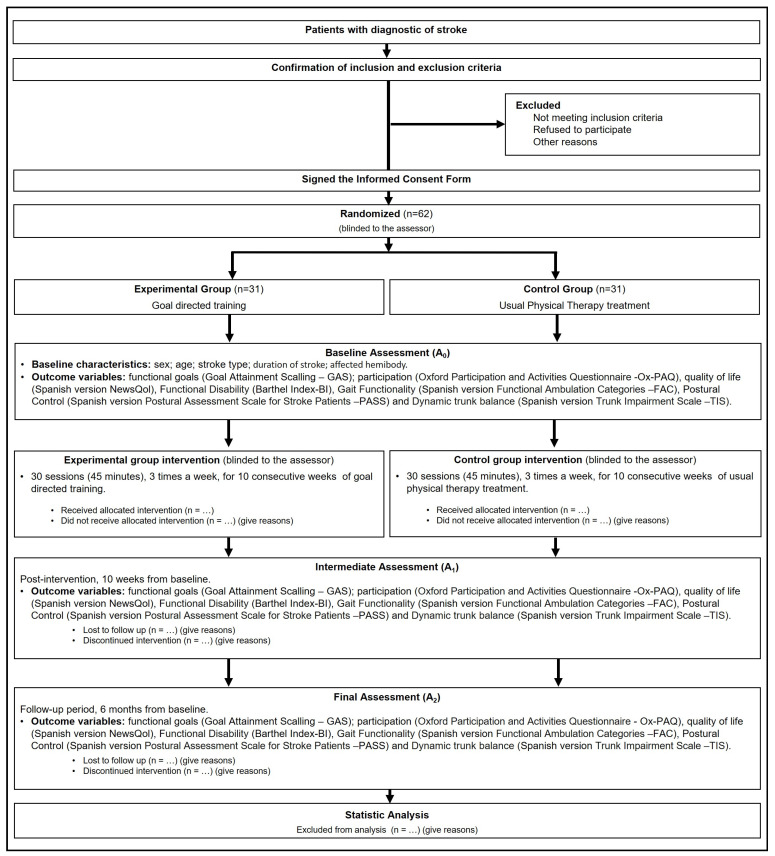
A single-blinded randomized controlled clinical trial will be developed. Adults over 50 years old diagnosed with Stroke over 6 months will be included in this study. Participants (n = 62) will be randomly allocated into two groups: The experimental group (n = 31) will receive 30 sessions, three per week during 10 weeks, of Physical Therapy sessions of goal-directed and task-specific training. The control group (n = 31) will follow the same intervention intensity of their usual Physical Therapy treatment. The primary outcome variables quality of life (NewsQol), participation (Ox-PAQ), and gait functionality (FAC) and the secondary outcome variables functional disability (BI), postural control (PASS), dynamic trunk balance (TIS), and functional goals (GAS) will be measured at baseline, after group interventions (10 weeks), and 6 months after the baseline. Statistical analyses will include repeated-measures ANOVA, Student's -test, or the Mann-Whitney U-test, with a 95% confidence interval and significance level of < 0.05.
Person-centered approaches in Physical Therapy interventions may yield better outcomes in functionality, participation, and quality of life for Stroke patients compared to standardized interventions.
ClinicalTrials.gov: NCT06165666 (December 2023).
中风幸存者在日常功能方面经历了显著改变,这对他们的功能、参与度和生活质量产生了负面影响。以患者为中心的物理治疗干预方法,专注于功能性和有意义的目标,有助于将这些改变的影响降至最低。因此,本研究的目的是评估基于目标导向方法并结合特定任务训练的物理治疗干预对改善中风患者的功能、参与度和生活质量的有效性。
将开展一项单盲随机对照临床试验。本研究将纳入年龄在50岁以上、中风超过6个月的成年人。参与者(n = 62)将被随机分为两组:实验组(n = 31)将接受为期10周、每周三次、共30节的目标导向和特定任务训练的物理治疗课程。对照组(n = 31)将遵循其常规物理治疗的相同干预强度。主要结局变量生活质量(NewsQol)、参与度(Ox-PAQ)和步态功能(FAC)以及次要结局变量功能残疾(BI)、姿势控制(PASS)、动态躯干平衡(TIS)和功能目标(GAS)将在基线、组间干预后(10周)以及基线后6个月进行测量。统计分析将包括重复测量方差分析、学生t检验或曼-惠特尼U检验,置信区间为95%,显著性水平为<0.05。
与标准化干预相比,以患者为中心的物理治疗干预方法可能会为中风患者在功能、参与度和生活质量方面带来更好的结果。
ClinicalTrials.gov:NCT06165666(2023年12月)。