Venkatesh Ramesh, Gandhi Priyanka, Choudhary Ayushi, Kathare Rupal, Chhablani Jay, Prabhu Vishma, Bavaskar Snehal, Hande Prathiba, Shetty Rohit, Reddy Nikitha Gurram, Rani Padmaja Kumari, Yadav Naresh Kumar
Department of Retina and Vitreous, Narayana Nethralaya, Bengaluru 560010, India.
Medical Retina and Vitreoretinal Surgery, University of Pittsburgh School of Medicine, Pittsburg, PA 15213, USA.
Diagnostics (Basel). 2024 Aug 13;14(16):1765. doi: 10.3390/diagnostics14161765.
This study aims to assess systemic risk factors in diabetes mellitus (DM) patients and predict diabetic retinopathy (DR) using a Random Forest (RF) classification model.
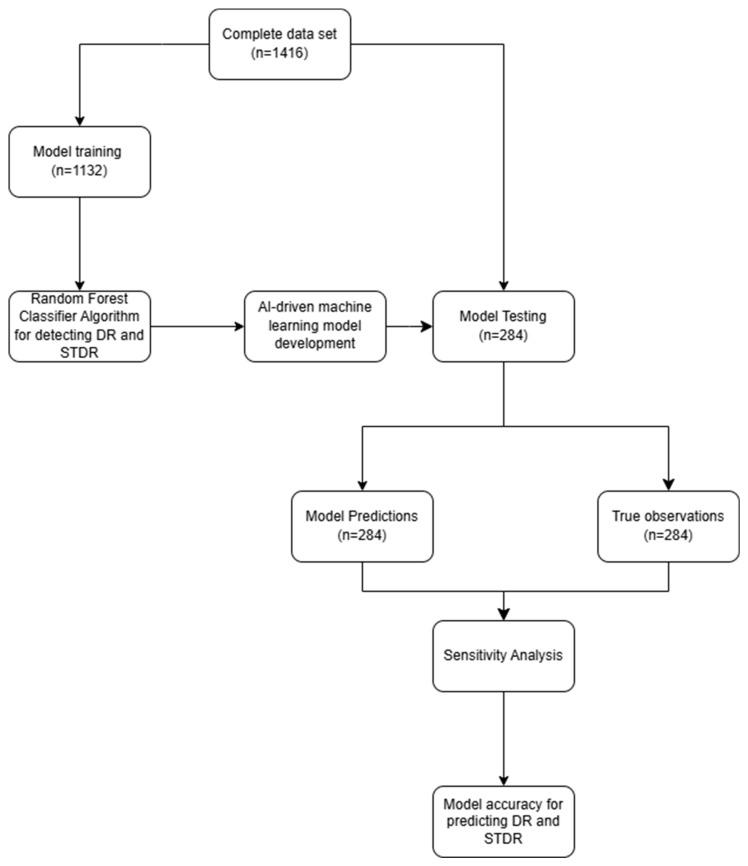
We included DM patients presenting to the retina clinic for first-time DR screening. Data on age, gender, diabetes type, treatment history, DM control status, family history, pregnancy history, and systemic comorbidities were collected. DR and sight-threatening DR (STDR) were diagnosed via a dilated fundus examination. The dataset was split 80:20 into training and testing sets. The RF model was trained to detect DR and STDR separately, and its performance was evaluated using misclassification rates, sensitivity, and specificity.
Data from 1416 DM patients were analyzed. The RF model was trained on 1132 (80%) patients. The misclassification rates were 0% for DR and ~20% for STDR in the training set. External testing on 284 (20%) patients showed 100% accuracy, sensitivity, and specificity for DR detection. For STDR, the model achieved 76% (95% CI-70.7%-80.7%) accuracy, 53% (95% CI-39.2%-66.6%) sensitivity, and 80% (95% CI-74.6%-84.7%) specificity.
The RF model effectively predicts DR in DM patients using systemic risk factors, potentially reducing unnecessary referrals for DR screening. However, further validation with diverse datasets is necessary to establish its reliability for clinical use.
本研究旨在评估糖尿病(DM)患者的全身风险因素,并使用随机森林(RF)分类模型预测糖尿病视网膜病变(DR)。
我们纳入了首次到视网膜诊所进行DR筛查的DM患者。收集了年龄、性别、糖尿病类型、治疗史、DM控制状况、家族史、妊娠史和全身合并症的数据。通过散瞳眼底检查诊断DR和威胁视力的DR(STDR)。数据集按80:20分为训练集和测试集。训练RF模型分别检测DR和STDR,并使用错误分类率、敏感性和特异性评估其性能。
分析了1416例DM患者的数据。RF模型在1132例(80%)患者上进行训练。训练集中DR的错误分类率为0%,STDR的错误分类率约为20%。对284例(20%)患者进行外部测试,DR检测的准确率、敏感性和特异性均为100%。对于STDR,该模型的准确率为76%(95%CI-70.7%-80.7%),敏感性为53%(95%CI-39.2%-66.6%),特异性为80%(95%CI-74.6%-84.7%)。
RF模型利用全身风险因素有效预测DM患者的DR,可能减少不必要的DR筛查转诊。然而,需要用不同的数据集进行进一步验证,以确定其临床应用的可靠性。