Department of Lichenology and Bryology, Botanische Staatssammlung München, SNSB-BSM, 80638 Munich, Germany.
Senckenberg Research Institute and Natural History Museum, 60325 Frankfurt am Main, Germany.
Genes (Basel). 2024 Aug 5;15(8):1029. doi: 10.3390/genes15081029.
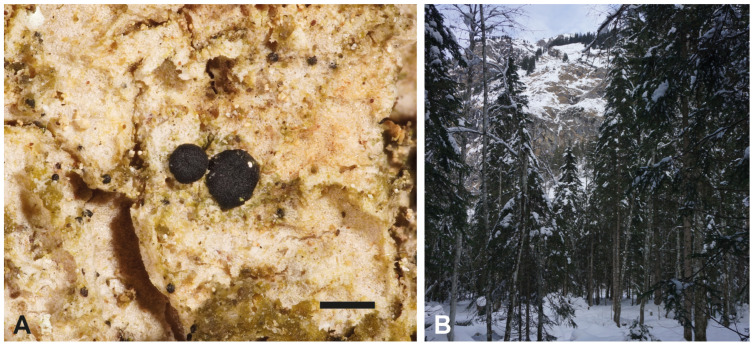
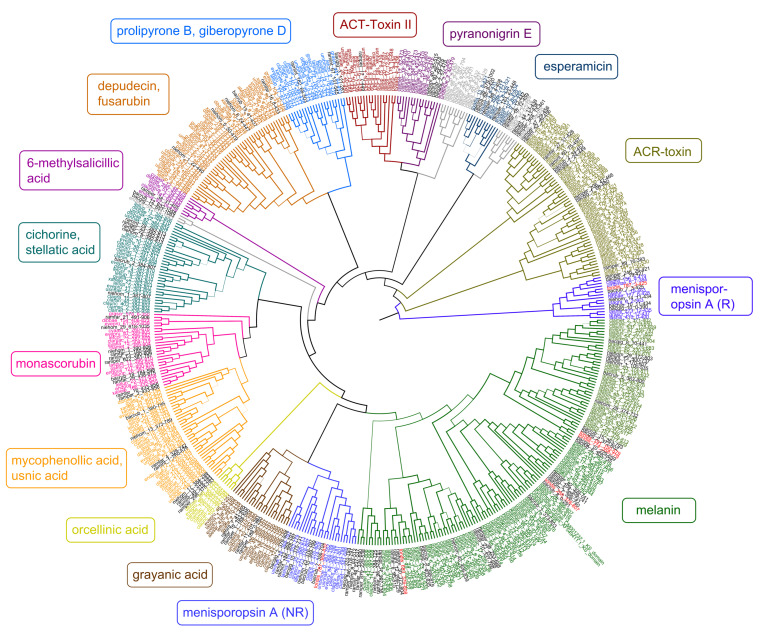
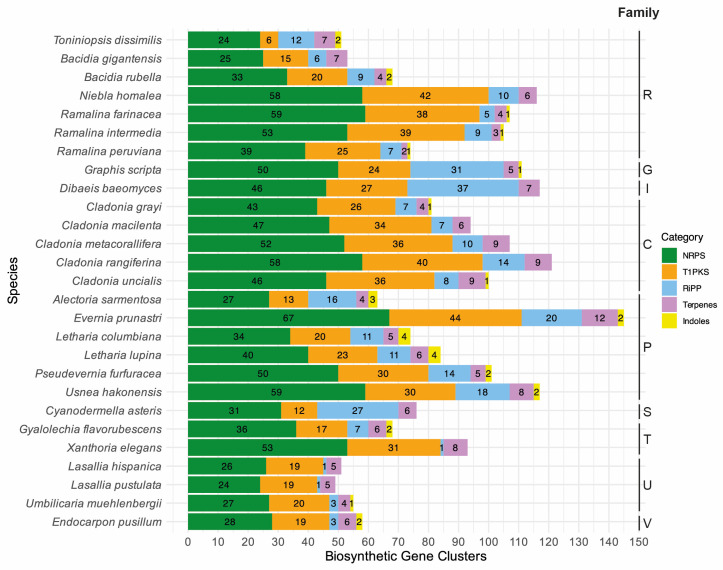
Lichens have developed numerous adaptations to optimize their survival in various environmental conditions, largely by producing secondary compounds by the fungal partner. They often have antibiotic properties and are involved in protection against intensive UV radiation, pathogens, and herbivores. To contribute to the knowledge of the arsenal of secondary compounds in a crustose lichen species, we sequenced and assembled the genome of , an indicator of old-growth forests, using Oxford Nanopore Technologies (ONT, Oxford, UK) long reads. Our analyses focused on biosynthetic gene clusters (BGCs) and specifically on Type I Polyketide (T1PKS) genes involved in the biosynthesis of polyketides. We used the comparative genomic approach to compare the genome of with six other members of the family Ramalinaceae and twenty additional lichen genomes from the database. With only six T1PKS genes, a comparatively low number of biosynthetic genes are present in the genome; from those, two-thirds are putatively involved in melanin biosynthesis. The comparative analyses showed at least three potential pathways of melanin biosynthesis in , namely via the formation of 1,3,6,8-tetrahydroxynaphthalene, naphthopyrone, or YWA1 putative precursors, which highlights its importance in . In addition, we report the occurrence of genes encoding ribosomally synthesized and posttranslationally modified peptides (RiPPs) in lichens, with their highest number in compared to other Ramalinaceae genomes. So far, no function has been assigned to RiPP-like proteins in lichens, which leaves potential for future research on this topic.
地衣已经发展出许多适应性,以优化其在各种环境条件下的生存能力,主要是通过真菌伙伴产生次生化合物来实现。它们通常具有抗生素特性,并参与抵御高强度紫外线辐射、病原体和食草动物的侵害。为了增加对一种壳状地衣物种次生化合物库的了解,我们使用 Oxford Nanopore Technologies(ONT,英国牛津)的长读测序技术对作为古老森林指示物种的 进行了基因组测序和组装。我们的分析重点是生物合成基因簇(BGCs),特别是参与聚酮化合物生物合成的 I 型聚酮(T1PKS)基因。我们采用比较基因组学方法,将 的基因组与 Ramalinaceae 家族的其他六个成员以及数据库中的二十个其他地衣基因组进行了比较。 基因组中只存在六个 T1PKS 基因,相对较少的生物合成基因存在;其中三分之二被推测与黑色素生物合成有关。比较分析表明, 在 中至少存在三种黑色素生物合成的潜在途径,即通过形成 1,3,6,8-四羟基萘、萘并吡喃酮或 YWA1 假定前体,这突显了其在地衣中的重要性。此外,我们还报告了地衣中核糖体合成和翻译后修饰肽(RiPPs)基因的存在,与其他 Ramalinaceae 基因组相比, 在这方面的基因数量最多。到目前为止,地衣中 RiPP 样蛋白的功能尚未被分配,这为该领域的未来研究留下了潜力。