Zanotta Nunzia, Magni Elena, De Seta Francesco, Petix Vincenzo, Sossi Karin, Colli Claudia, Monasta Lorenzo, Suligoi Barbara, Comar Manola
Department of Advanced Translational Microbiology, Institute for Maternal and Child Health IRCCS Burlo Garofolo, 34137 Trieste, Italy.
Clinical Epidemiology and Public Health Research Unit, Institute for Maternal and Child Health IRCCS Burlo Garofolo, 34137 Trieste, Italy.
Microorganisms. 2024 Aug 6;12(8):1600. doi: 10.3390/microorganisms12081600.
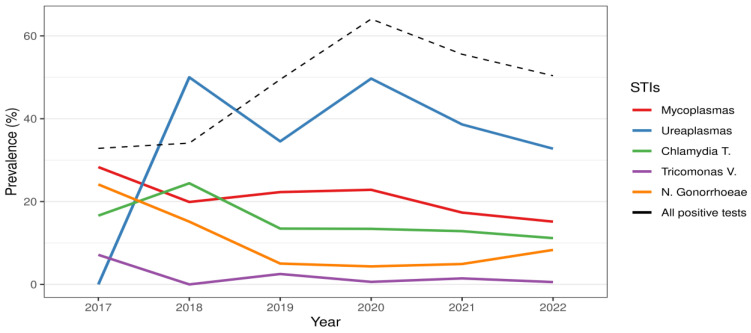
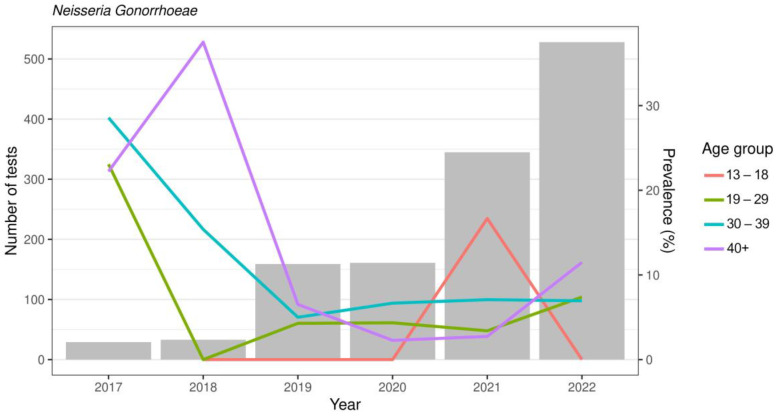
Recent European data show an increase in sexually transmitted infections (STIs), particularly , among young heterosexuals, surpassing pre-pandemic numbers. Italy's varied local health restrictions during the COVID-19 pandemic likely affected STI management and reporting. To evaluate COVID-19's impact on STI spread in Italy, we analyzed microbiological data from before and during the pandemic in an area with minimal restrictions on clinical services. This retrospective study (2017-2022) included 5503 subjects: 2586 from STI clinics (STD group) and 3687 diagnosed with primary infertility (ART group). Samples were tested for /, , , and by a multiplex PCR. During the pandemic, overall STI prevalence increased significantly ( < 0.01). was the most frequent microorganism in the STD group (26.1% vs. 23.9%), with a notable increase in women (52.1% vs. 32.7%) ( < 0.001). and positive rates decreased significantly ( < 0.001 and < 0.01, respectively). cases rose among young people (19-29), predominantly heterosexual, with high ciprofloxacin resistance. In the ART group, was the most common infection, particularly in young infertile women ( = 0.01). This study indicates a notable rise in STIs among young people, including heterosexuals, despite social restrictions. The long-term impact of this trend requires further evaluation.
欧洲近期的数据显示,性传播感染(STIs)有所增加,尤其是在年轻异性恋者中,已超过疫情前的数字。意大利在新冠疫情期间实施的各种地方卫生限制措施可能影响了性传播感染的管理和报告。为了评估新冠疫情对意大利性传播感染传播的影响,我们分析了疫情前和疫情期间一个临床服务限制最少地区的微生物学数据。这项回顾性研究(2017 - 2022年)纳入了5503名受试者:2586名来自性传播感染诊所(STD组),3687名被诊断为原发性不孕症(ART组)。样本通过多重聚合酶链反应检测了/、、、和。在疫情期间,性传播感染的总体患病率显著上升(<0.01)。是STD组中最常见的微生物(26.1%对23.9%),女性中有显著增加(52.1%对32.7%)(<0.001)。和的阳性率显著下降(分别为<0.001和<0.01)。在19 - 29岁的年轻人中,病例有所增加,主要是异性恋,对环丙沙星耐药性高。在ART组中,是最常见的感染,尤其是在年轻不孕女性中(=0.01)。这项研究表明,尽管有社会限制,包括异性恋者在内的年轻人中性传播感染显著增加。这一趋势的长期影响需要进一步评估。