Mora Valentina P, Kalergis Alexis M, Bohmwald Karen
Instituto de Ciencias Biomédicas, Facultad de Ciencias de la Salud, Universidad Autónoma de Chile, Santiago 8910060, Chile.
Millennium Institute on Immunology and Immunotherapy (MIII), Facultad de Ciencias Biológicas, Pontificia Universidad Católica de Chile, Santiago 8331150, Chile.
Microorganisms. 2024 Aug 20;12(8):1713. doi: 10.3390/microorganisms12081713.
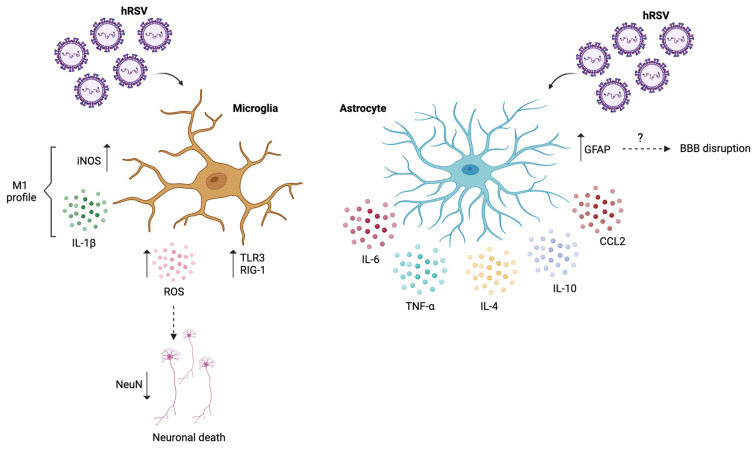
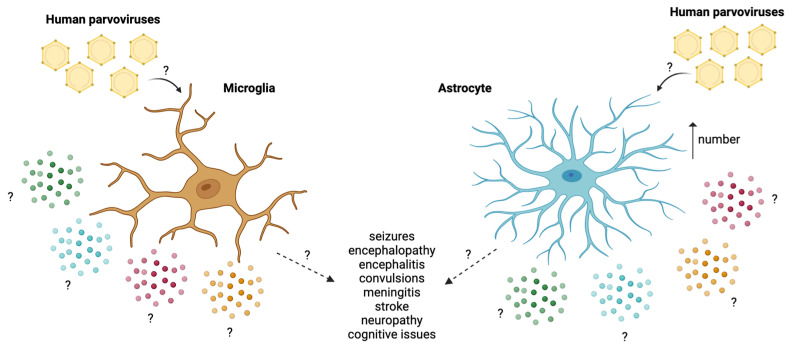
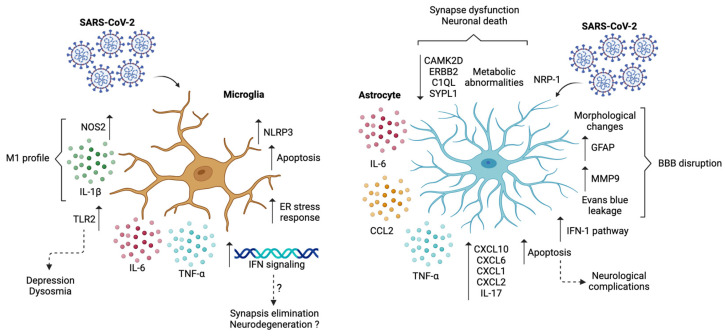
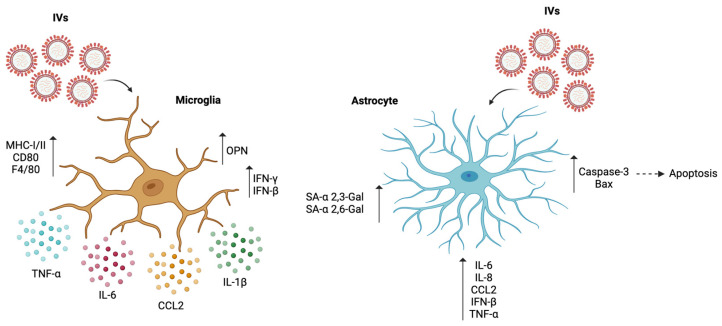
Respiratory viral infections pose a significant public health threat, particularly in children and older adults, with high mortality rates. Some of these pathogens are the human respiratory syncytial virus (hRSV), severe acute respiratory coronavirus-2 (SARS-CoV-2), influenza viruses (IV), human parvovirus B19 (B19V), and human bocavirus 1 (HBoV1). These viruses cause various respiratory symptoms, including cough, fever, bronchiolitis, and pneumonia. Notably, these viruses can also impact the central nervous system (CNS), leading to acute manifestations such as seizures, encephalopathies, encephalitis, neurological sequelae, and long-term complications. The precise mechanisms by which these viruses affect the CNS are not fully understood. Glial cells, specifically microglia and astrocytes within the CNS, play pivotal roles in maintaining brain homeostasis and regulating immune responses. Exploring how these cells interact with viral pathogens, such as hRSV, SARS-CoV-2, IVs, B19V, and HBoV1, offers crucial insights into the significant impact of respiratory viruses on the CNS. This review article examines hRSV, SARS-CoV-2, IV, B19V, and HBoV1 interactions with microglia and astrocytes, shedding light on potential neurological consequences.
呼吸道病毒感染对公共卫生构成重大威胁,尤其是对儿童和老年人,死亡率很高。其中一些病原体包括人类呼吸道合胞病毒(hRSV)、严重急性呼吸综合征冠状病毒2(SARS-CoV-2)、流感病毒(IV)、人类细小病毒B19(B19V)和人类博卡病毒1(HBoV1)。这些病毒会引发各种呼吸道症状,包括咳嗽、发烧、细支气管炎和肺炎。值得注意的是,这些病毒还会影响中枢神经系统(CNS),导致癫痫发作、脑病、脑炎、神经后遗症和长期并发症等急性表现。这些病毒影响中枢神经系统的确切机制尚未完全了解。神经胶质细胞,特别是中枢神经系统内的小胶质细胞和星形胶质细胞,在维持大脑内环境稳定和调节免疫反应方面发挥着关键作用。探索这些细胞如何与hRSV、SARS-CoV-2、IVs、B19V和HBoV1等病毒病原体相互作用,有助于深入了解呼吸道病毒对中枢神经系统的重大影响。这篇综述文章研究了hRSV、SARS-CoV-2、IV、B19V和HBoV1与小胶质细胞和星形胶质细胞的相互作用,揭示了潜在的神经学后果。