Medicinal and Aromatic Plants Research Department, Horticulture Research Institute, Agricultural Research Center, Giza 12619, Egypt.
Food Science and Nutrition Department, Faculty of Science, University of Tabuk, Tabuk 71491, Saudi Arabia.
Nutrients. 2024 Aug 10;16(16):2635. doi: 10.3390/nu16162635.
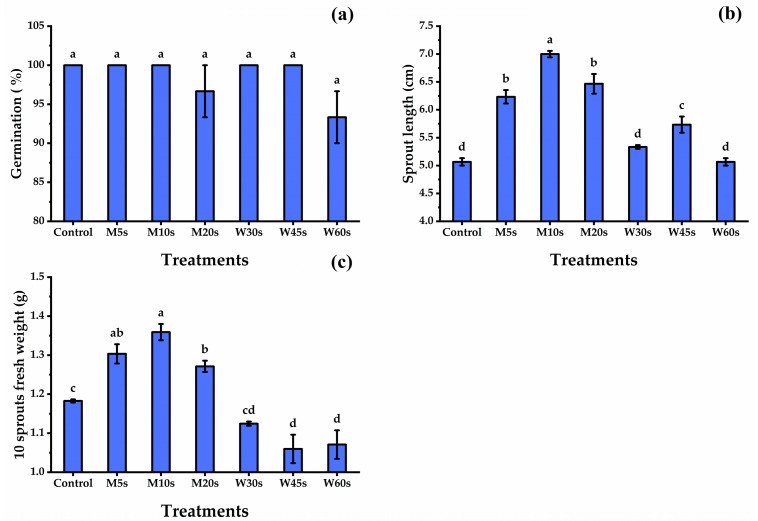
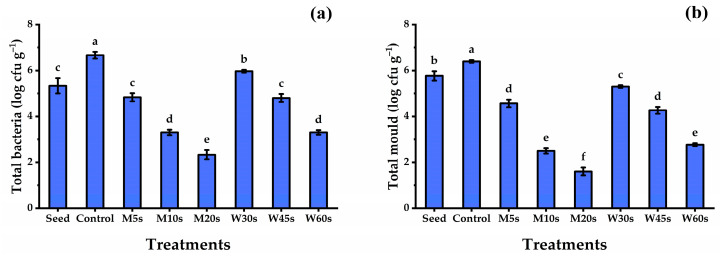
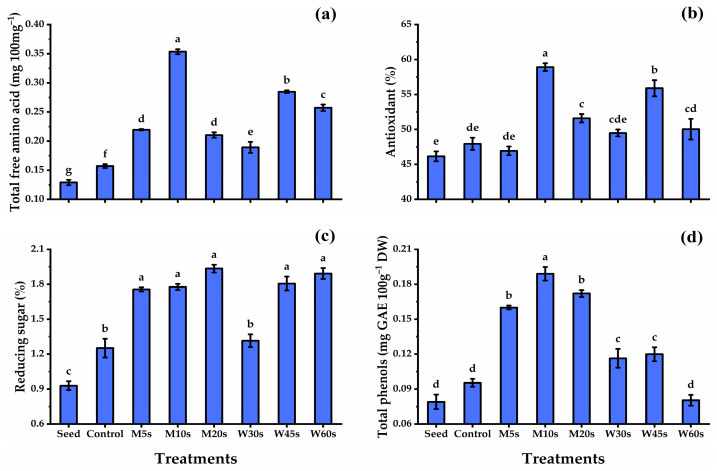
Sprouts are an attractive food product that contains high amounts of nutritional substances and has pro-health features. Sprout consumption has strongly increased despite its potential risk to health due to its microbial load. Both the safety and shelf life of sprouts may be negatively affected by a high microbial load. To reduce the microbial contamination in sprouts before consumption, the initial microbial load on the seeds needs to be controlled. Many herbal sprouts have been recommended for diabetes, and fenugreek is one of these sprouts. Thus, the current experiment aimed at disinfecting fenugreek seeds using microwave (5, 10, and 20 s) and hot water (30, 45, and 60 s) treatments for different durations. The best-disinfected sprouts with the highest nutritional properties were used to evaluate their influence on streptozocin-induced diabetic rats in comparison with fenugreek seed feeding. Microwave treatments showed the highest sprout length, fresh weight, total free amino acids, antioxidants, reducing sugars, and total phenols. Additionally, microwave seed treatments showed the lowest bacteria and mold counts on sprouts produced relative to hot water treatments, and the best seed treatment was a microwave for 20 s, which gave the best values in this respect. Feeding diabetic rats with different fenugreek seeds or sprout rates (0, 5, 7.5, and 10% /) improved body weight, restricted the growth of glucose levels, lowered total cholesterol and triglycerides, and improved HDL compared with the positive control group, and fenugreek sprouts at higher rates showed the maximum improvements in blood glucose, total cholesterol, and triglycerides. Treating fenugreek seed with microwave radiation for 20 s to disinfect the seeds before sprouting is recommended for lowering the microbial load with optimum nutritional and antioxidant activity, and feeding diabetic rats with these sprouts at the rate of 7.5 and 10% had promising effects on hyperglycemia and associated disorders.
芽苗菜是一种具有吸引力的食品,含有大量营养物质,并具有促进健康的特性。尽管芽苗菜由于其微生物负荷而存在潜在的健康风险,但由于其潜在的健康益处,其消费需求大幅增加。高微生物负荷可能会对芽苗菜的安全性和保质期产生负面影响。为了在食用前降低芽苗菜中的微生物污染,需要控制种子的初始微生物负荷。许多草药芽苗菜被推荐用于糖尿病,其中之一是葫芦巴芽苗菜。因此,本实验旨在使用微波(5、10 和 20 秒)和热水(30、45 和 60 秒)处理不同时间来消毒葫芦巴种子。将具有最佳消毒效果和最高营养价值的芽苗菜用于评估其对链脲佐菌素诱导的糖尿病大鼠的影响,并与葫芦巴种子喂养进行比较。微波处理显示出最高的芽苗菜长度、鲜重、总游离氨基酸、抗氧化剂、还原糖和总酚。此外,与热水处理相比,微波种子处理在生产的芽苗菜上显示出最低的细菌和霉菌计数,最佳的种子处理是微波处理 20 秒,在这方面效果最佳。用不同剂量的葫芦巴种子或芽苗菜喂养(0、5、7.5 和 10%/)糖尿病大鼠可改善体重,限制葡萄糖水平的增长,降低总胆固醇和甘油三酯,改善 HDL 与阳性对照组相比,较高剂量的葫芦巴芽苗菜在降低血糖、总胆固醇和甘油三酯方面显示出最大的改善。建议在发芽前用微波辐射处理 20 秒来消毒葫芦巴种子,以降低微生物负荷并保持最佳的营养和抗氧化活性,用这些芽苗菜以 7.5%和 10%的剂量喂养糖尿病大鼠对高血糖和相关疾病有积极的影响。