School of Public Health, Hengyang Medical School, University of South China, Hengyang 421009, China.
Hunan Provincial Key Laboratory of Clinical Epidemiology, Department of Social Medicine and Health Management, Xiangya School of Public Health, Central South University, Changsha 410000, China.
Nutrients. 2024 Aug 11;16(16):2658. doi: 10.3390/nu16162658.
Perchlorate, nitrate, and thiocyanate are widely recognized as endocrine disrupting chemicals, which are closely related to thyroid function. Animal and human studies show a correlation between thyroid hormone and bone mineral density (BMD). However, it remains unknown whether perchlorate, nitrate, and thiocyanate were associated with BMD. This study aimed to explore the association between perchlorate, nitrate, and thiocyanate exposure with BMD.
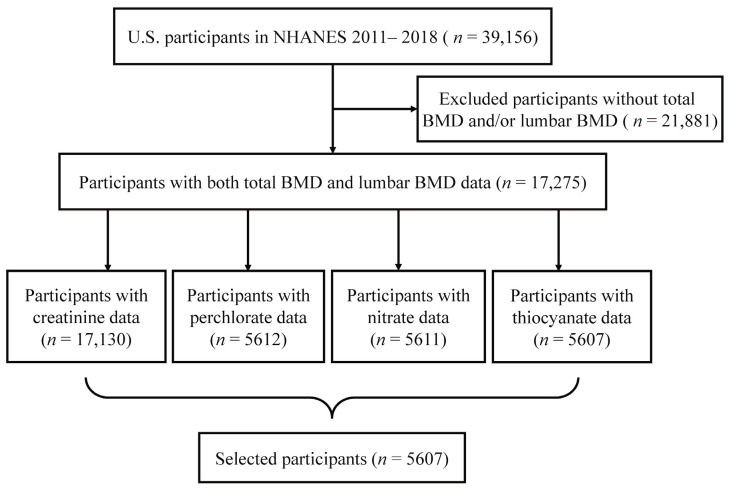
A cross-sectional analysis among 5607 participants from the 2011-2018 National Health and Nutrition Examination Survey (NHANES) was conducted in the present study. Perchlorate, nitrate, and thiocyanate were detected in urine by ion chromatography. Survey-weighted generalized linear regression, restricted cubic splines, and qgcomp models were used to assess the association of BMDs with single and mixed perchlorate, nitrate, and thiocyanate exposures. In addition, age, gender, and BMI stratified these associations.
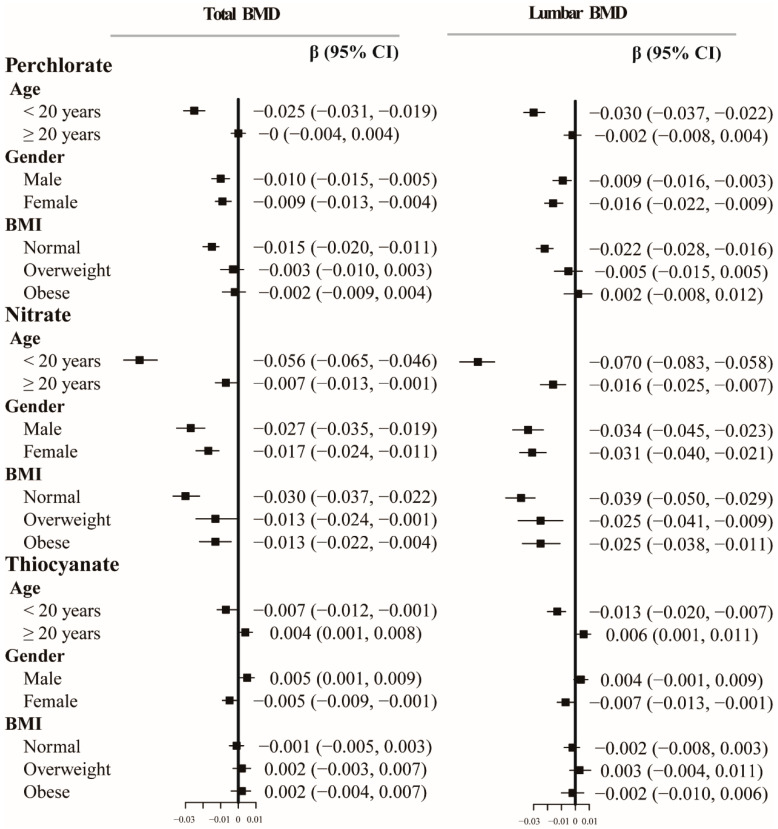
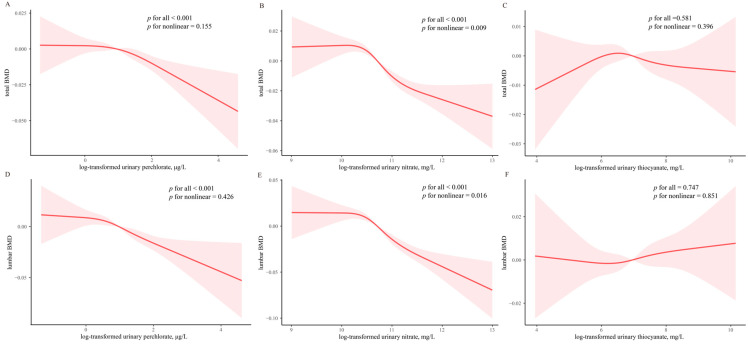
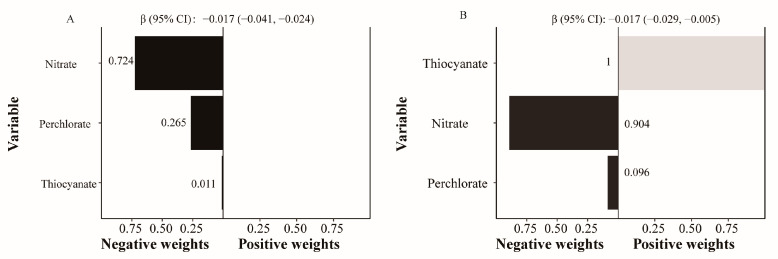
Negative associations were found between perchlorate and nitrate with BMDs. Furthermore, based on the qgcomp model results, the combined association of perchlorate, nitrate, and thiocyanate exposure was negatively associated with BMDs (β = -0.017, 95% CI: -0.041, -0.024 for total BMD; β = -0.017, 95% CI: -0.029, -0.005 for lumbar BMD). Additionally, there was a significant effect after gender, age, and BMI stratification between perchlorate, nitrate, and thiocyanate with BMDs in the normal weight group (β = -0.015, 95% CI: -0.020, -0.011 for total BMD; β = -0.022, 95% CI: -0.028, -0.016 for lumbar BMD) and children and adolescents group (β = -0.025, 95% CI: -0.031, -0.019 for total BMD; β -0.017, 95% CI: -0.029, -0.005 for lumbar BMD).
The present study indicated a negative correlation between BMDs and urinary perchlorate, nitrate, and thiocyanate levels, with nitrate being the main contributor to the mixture effect. People with normal weight and children and adolescents were more likely to be affected.
高氯酸盐、硝酸盐和硫氰酸盐被广泛认为是内分泌干扰物,与甲状腺功能密切相关。动物和人体研究表明,甲状腺激素与骨矿物质密度(BMD)之间存在相关性。然而,目前尚不清楚高氯酸盐、硝酸盐和硫氰酸盐是否与 BMD 有关。本研究旨在探讨高氯酸盐、硝酸盐和硫氰酸盐暴露与 BMD 之间的关系。
本研究对 2011-2018 年全国健康与营养调查(NHANES)中的 5607 名参与者进行了横断面分析。通过离子色谱法检测尿液中的高氯酸盐、硝酸盐和硫氰酸盐。采用调查加权广义线性回归、限制立方样条和 qgcomp 模型评估单一和混合高氯酸盐、硝酸盐和硫氰酸盐暴露与 BMD 之间的关联。此外,还对年龄、性别和 BMI 进行了分层,以评估这些关联。
高氯酸盐和硝酸盐与 BMD 呈负相关。此外,根据 qgcomp 模型结果,高氯酸盐、硝酸盐和硫氰酸盐联合暴露与 BMD 呈负相关(总 BMD:β=-0.017,95%CI:-0.041,-0.024;腰椎 BMD:β=-0.017,95%CI:-0.029,-0.005)。此外,在正常体重组(总 BMD:β=-0.015,95%CI:-0.020,-0.011;腰椎 BMD:β=-0.022,95%CI:-0.028,-0.016)和儿童和青少年组(总 BMD:β=-0.025,95%CI:-0.031,-0.019;腰椎 BMD:β=-0.017,95%CI:-0.029,-0.005)中,高氯酸盐、硝酸盐和硫氰酸盐与 BMD 之间的关联在性别、年龄和 BMI 分层后存在显著差异。
本研究表明,BMD 与尿中高氯酸盐、硝酸盐和硫氰酸盐水平呈负相关,其中硝酸盐是混合物效应的主要贡献者。正常体重人群和儿童青少年更容易受到影响。