First Department of Neurology, Aiginition Hospital, School of Medicine, National and Kapodistrian University of Athens, 11528 Athens, Greece.
Computational Neuroimaging Group (CNG), School of Medicine, Trinity College Dublin, D08 NHY1 Dublin, Ireland.
Nutrients. 2024 Aug 19;16(16):2766. doi: 10.3390/nu16162766.
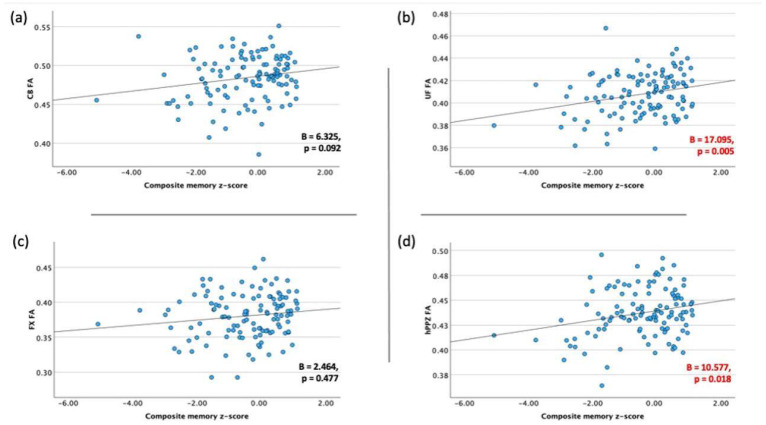
(1) Background: Many studies link food intake with clinical cognitive outcomes, but evidence for brain biomarkers, such as memory-related limbic white matter (WM) tracts, is limited. We examined the association between food groups, limbic WM tracts integrity, and memory performance in community-dwelling individuals. (2) Methods: We included 117 non-demented individuals (ALBION study). Verbal and visual episodic memory tests were administered, and a composite z-score was calculated. Diffusion tensor imaging tractography was applied for limbic WM tracts (fornix-FX, cingulum bundle-CB, uncinate fasciculus-UF, hippocampal perforant pathway zone-hPPZ). Food intake was evaluated through four 24-h recalls. We applied linear regression models adjusted for demographics and energy intake. (3) Results: We found significant associations between (a) higher low-to-moderate alcohol intake and higher FX fractional anisotropy (FA), (b) higher full-fat dairy intake and lower hPPZ FA, and (c) higher red meat and cold cuts intake and lower hPPZ FA. None of the food groups was associated with memory performance. (4) Conclusions: Despite non-significant associations between food groups and memory, possibly due to participants' cognitive profile and/or compensatory mechanisms, the study documented a possible beneficial role of low-to-moderate alcohol and a harmful role of full-fat dairy and red meat and cold cuts on limbic WM tracts.
(1) 背景:许多研究将食物摄入与临床认知结果联系起来,但关于脑生物标志物(如与记忆相关的边缘白质[WM]束)的证据有限。我们研究了食物组与边缘 WM 束完整性以及记忆表现之间的关联,这些研究对象均为社区居民。
(2) 方法:我们纳入了 117 名非痴呆个体(ALBION 研究)。对其进行了言语和视觉情节记忆测试,并计算了综合 z 分数。应用弥散张量成像纤维束追踪技术来对边缘 WM 束(穹窿-FX、扣带束-CB、钩束-UF、海马投射通路区-hPPZ)进行分析。通过四次 24 小时回忆来评估食物摄入量。我们应用了线性回归模型,该模型调整了人口统计学和能量摄入。
(3) 结果:我们发现(a)较低到中度饮酒量与较高的 FX 各向异性分数(FA)之间存在显著关联,(b)全脂乳制品摄入量与 hPPZ FA 降低之间存在显著关联,(c)红肉和冷切肉摄入量与 hPPZ FA 降低之间存在显著关联。没有任何一种食物组与记忆表现相关。
(4) 结论:尽管食物组与记忆之间存在非显著关联,其原因可能是参与者的认知特征和/或代偿机制,但本研究记录了低到中度饮酒可能具有有益作用,而全脂乳制品、红肉和冷切肉可能具有有害作用,这些作用可能与边缘 WM 束有关。