Mandalawatta Heshadi Primrose, Rajendra K C, Fairfax Kirsten, Hewitt Alex W
Menzies Institute for Medical Research, University of Tasmania, Hobart, TAS, Australia.
School of Medicine, University of Tasmania, Hobart, TAS, Australia.
Mol Ther Nucleic Acids. 2024 Jul 19;35(3):102280. doi: 10.1016/j.omtn.2024.102280. eCollection 2024 Sep 10.
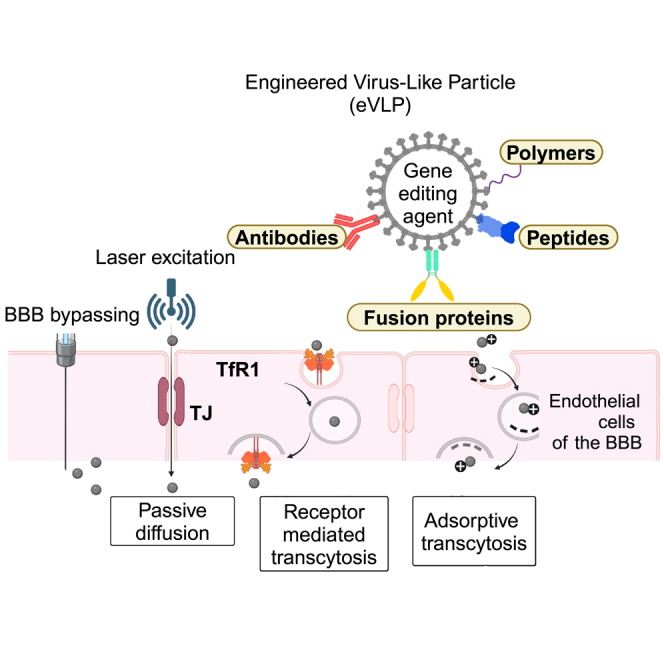
Recent advances in gene therapy and gene-editing techniques offer the very real potential for successful treatment of neurological diseases. However, drug delivery constraints continue to impede viable therapeutic interventions targeting the brain due to its anatomical complexity and highly restrictive microvasculature that is impervious to many molecules. Realizing the therapeutic potential of gene-based therapies requires robust encapsulation and safe and efficient delivery to the target cells. Although viral vectors have been widely used for targeted delivery of gene-based therapies, drawbacks such as host genome integration, prolonged expression, undesired off-target mutations, and immunogenicity have led to the development of alternative strategies. Engineered virus-like particles (eVLPs) are an emerging, promising platform that can be engineered to achieve neurotropism through pseudotyping. This review outlines strategies to improve eVLP neurotropism for therapeutic brain delivery of gene-editing agents.
基因治疗和基因编辑技术的最新进展为成功治疗神经疾病提供了切实可行的潜力。然而,由于大脑的解剖结构复杂且其微血管高度受限,许多分子难以穿透,药物递送限制继续阻碍针对大脑的可行治疗干预。要实现基于基因疗法的治疗潜力,需要强大的封装以及安全有效地递送至靶细胞。尽管病毒载体已广泛用于基于基因疗法的靶向递送,但诸如宿主基因组整合、延长表达、意外的脱靶突变和免疫原性等缺点促使了替代策略的发展。工程化病毒样颗粒(eVLPs)是一个新兴的、有前景的平台,可以通过假型化进行工程设计以实现嗜神经性。本综述概述了改善eVLPs嗜神经性以实现基因编辑剂治疗性脑递送的策略。