Mohammadian Gol Tahereh, Ureña-Bailén Guillermo, Hou Yujuan, Sinn Ralph, Antony Justin S, Handgretinger Rupert, Mezger Markus
Department of Hematology and Oncology, University Children's Hospital, University of Tübingen, Tübingen, Germany.
Abu Dhabi Stem Cells Center, Abu Dhabi, United Arab Emirates.
Front Genome Ed. 2023 Jan 6;4:1037290. doi: 10.3389/fgeed.2022.1037290. eCollection 2022.
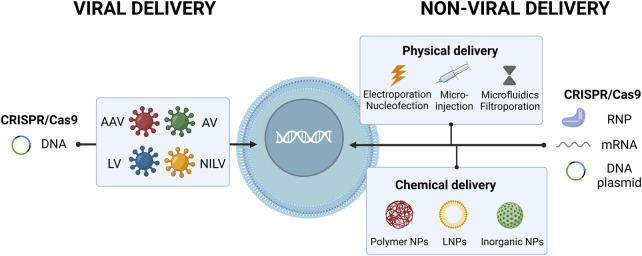
Blood disorders are a group of diseases including hematological neoplasms, clotting disorders and orphan immune deficiency diseases that affects human health. Current improvements in genome editing based therapeutics demonstrated preclinical and clinical proof to treat different blood disorders. Genome editing components such as Cas nucleases, guide RNAs and base editors are supplied in the form of either a plasmid, an mRNA, or a ribonucleoprotein complex. The most common delivery vehicles for such components include viral vectors (e.g., AAVs and RV), non-viral vectors (e.g., LNPs and polymers) and physical delivery methods (e.g., electroporation and microinjection). Each of the delivery vehicles specified above has its own advantages and disadvantages and the development of a safe transferring method for and application of genome editing components is still a big challenge. Moreover, the delivery of genome editing payload to the target blood cells possess key challenges to provide a possible cure for patients with inherited monogenic blood diseases and hematological neoplastic tumors. Here, we critically review and summarize the progress and challenges related to the delivery of genome editing elements to relevant blood cells in an or setting. In addition, we have attempted to provide a future clinical perspective of genome editing to treat blood disorders with possible clinical grade improvements in delivery methods.
血液疾病是一组影响人类健康的疾病,包括血液系统肿瘤、凝血障碍和罕见免疫缺陷疾病。目前基于基因组编辑的治疗方法的改进已在临床前和临床阶段证明了其对不同血液疾病的治疗效果。基因组编辑组件,如Cas核酸酶、引导RNA和碱基编辑器,以质粒、mRNA或核糖核蛋白复合物的形式提供。用于此类组件的最常见递送载体包括病毒载体(如腺相关病毒和逆转录病毒)、非病毒载体(如脂质纳米颗粒和聚合物)以及物理递送方法(如电穿孔和显微注射)。上述每种递送载体都有其自身的优缺点,开发一种安全的基因组编辑组件递送和应用方法仍然是一个巨大的挑战。此外,将基因组编辑有效载荷递送至靶血细胞面临着关键挑战,这对于为患有遗传性单基因血液疾病和血液系统肿瘤的患者提供可能的治愈方法至关重要。在此,我们批判性地回顾和总结了在体内或体外环境中将基因组编辑元件递送至相关血细胞的进展和挑战。此外,我们试图从未来临床角度探讨基因组编辑在治疗血液疾病方面的应用,并可能在递送方法上实现临床级别的改进。