• 文献检索
  • 文档翻译
  • 深度研究
  • 学术资讯
  • Suppr Zotero 插件Zotero 插件
  • 邀请有礼
  • 套餐&价格
  • 历史记录
应用&插件
Suppr Zotero 插件Zotero 插件浏览器插件Mac 客户端Windows 客户端微信小程序
定价
高级版会员购买积分包购买API积分包
服务
文献检索文档翻译深度研究API 文档MCP 服务
关于我们
关于 Suppr公司介绍联系我们用户协议隐私条款
关注我们

Suppr 超能文献

核心技术专利:CN118964589B侵权必究
粤ICP备2023148730 号-1Suppr @ 2026

文献检索

告别复杂PubMed语法,用中文像聊天一样搜索,搜遍4000万医学文献。AI智能推荐,让科研检索更轻松。

立即免费搜索

文件翻译

保留排版,准确专业,支持PDF/Word/PPT等文件格式,支持 12+语言互译。

免费翻译文档

深度研究

AI帮你快速写综述,25分钟生成高质量综述,智能提取关键信息,辅助科研写作。

立即免费体验

医疗保健中人工智能采用的障碍和促进因素:范围综述。

Barriers to and Facilitators of Artificial Intelligence Adoption in Health Care: Scoping Review.

机构信息

Department of Health Information Science, University of Victoria, Victoria, BC, Canada.

出版信息

JMIR Hum Factors. 2024 Aug 29;11:e48633. doi: 10.2196/48633.

DOI:10.2196/48633
PMID:39207831
原文链接:https://pmc.ncbi.nlm.nih.gov/articles/PMC11393514/
Abstract

BACKGROUND

Artificial intelligence (AI) use cases in health care are on the rise, with the potential to improve operational efficiency and care outcomes. However, the translation of AI into practical, everyday use has been limited, as its effectiveness relies on successful implementation and adoption by clinicians, patients, and other health care stakeholders.

OBJECTIVE

As adoption is a key factor in the successful proliferation of an innovation, this scoping review aimed at presenting an overview of the barriers to and facilitators of AI adoption in health care.

METHODS

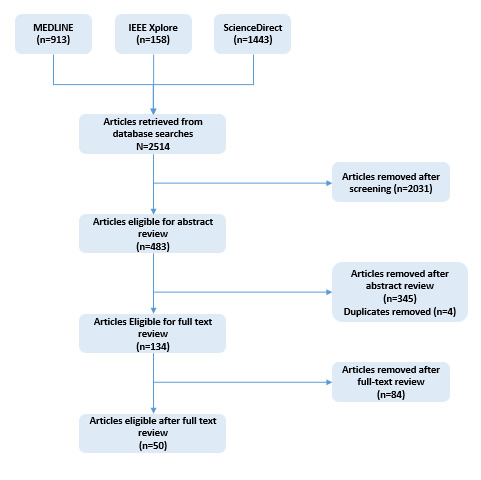
A scoping review was conducted using the guidance provided by the Joanna Briggs Institute and the framework proposed by Arksey and O'Malley. MEDLINE, IEEE Xplore, and ScienceDirect databases were searched to identify publications in English that reported on the barriers to or facilitators of AI adoption in health care. This review focused on articles published between January 2011 and December 2023. The review did not have any limitations regarding the health care setting (hospital or community) or the population (patients, clinicians, physicians, or health care administrators). A thematic analysis was conducted on the selected articles to map factors associated with the barriers to and facilitators of AI adoption in health care.

RESULTS

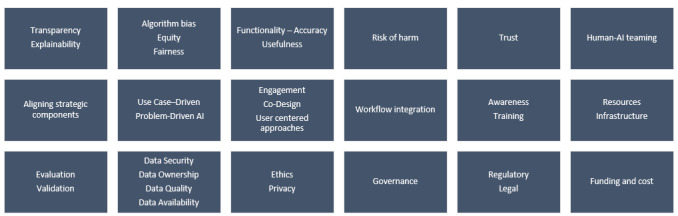
A total of 2514 articles were identified in the initial search. After title and abstract reviews, 50 (1.99%) articles were included in the final analysis. These articles were reviewed for the barriers to and facilitators of AI adoption in health care. Most articles were empirical studies, literature reviews, reports, and thought articles. Approximately 18 categories of barriers and facilitators were identified. These were organized sequentially to provide considerations for AI development, implementation, and the overall structure needed to facilitate adoption.

CONCLUSIONS

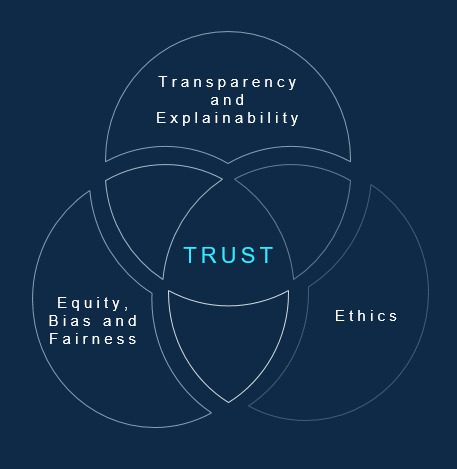
The literature review revealed that trust is a significant catalyst of adoption, and it was found to be impacted by several barriers identified in this review. A governance structure can be a key facilitator, among others, in ensuring all the elements identified as barriers are addressed appropriately. The findings demonstrate that the implementation of AI in health care is still, in many ways, dependent on the establishment of regulatory and legal frameworks. Further research into a combination of governance and implementation frameworks, models, or theories to enhance trust that would specifically enable adoption is needed to provide the necessary guidance to those translating AI research into practice. Future research could also be expanded to include attempts at understanding patients' perspectives on complex, high-risk AI use cases and how the use of AI applications affects clinical practice and patient care, including sociotechnical considerations, as more algorithms are implemented in actual clinical environments.
摘要

背景

人工智能(AI)在医疗保健中的应用案例正在增加,有可能提高运营效率和护理效果。然而,由于其有效性依赖于临床医生、患者和其他医疗保健利益相关者的成功实施和采用,因此将 AI 转化为实际的日常使用一直受到限制。

目的

由于采用是创新成功传播的关键因素,因此本范围界定综述旨在介绍医疗保健中采用 AI 的障碍和促进因素概述。

方法

本研究使用 Joanna Briggs 研究所提供的指南和 Arksey 和 O'Malley 提出的框架进行范围界定综述。检索了 MEDLINE、IEEE Xplore 和 ScienceDirect 数据库,以确定以英文发表的报告医疗保健中 AI 采用障碍或促进因素的出版物。本综述重点关注 2011 年 1 月至 2023 年 12 月期间发表的文章。本综述对医疗保健环境(医院或社区)或人群(患者、临床医生、医生或医疗保健管理人员)没有任何限制。对选定文章进行了主题分析,以绘制与医疗保健中 AI 采用障碍和促进因素相关的因素图。

结果

在最初的搜索中确定了 2514 篇文章。经过标题和摘要审查,最终有 50 篇(1.99%)文章被纳入最终分析。这些文章回顾了医疗保健中 AI 采用的障碍和促进因素。大多数文章是实证研究、文献综述、报告和思想文章。确定了大约 18 个类别的障碍和促进因素。这些因素按顺序排列,以提供 AI 开发、实施和促进采用所需的整体结构方面的考虑因素。

结论

文献综述表明,信任是采用的重要催化剂,并且发现它受到本综述中确定的几个障碍的影响。治理结构可以是一个关键的促进因素,除此之外,还可以确保适当解决确定的所有障碍。研究结果表明,在许多方面,医疗保健中 AI 的实施仍然依赖于建立监管和法律框架。需要进一步研究治理和实施框架、模型或理论的组合,以增强信任,这将专门为将 AI 研究转化为实践的人提供必要的指导。未来的研究还可以扩展到尝试了解患者对复杂、高风险 AI 使用案例的看法,以及 AI 应用的使用如何影响临床实践和患者护理,包括社会技术考虑因素,因为越来越多的算法在实际临床环境中实施。

https://cdn.ncbi.nlm.nih.gov/pmc/blobs/2b59/11393514/bed68ad50f03/humanfactors_v11i1e48633_fig3.jpg
https://cdn.ncbi.nlm.nih.gov/pmc/blobs/2b59/11393514/c87268e5e115/humanfactors_v11i1e48633_fig1.jpg
https://cdn.ncbi.nlm.nih.gov/pmc/blobs/2b59/11393514/7e6938e9e02f/humanfactors_v11i1e48633_fig2.jpg
https://cdn.ncbi.nlm.nih.gov/pmc/blobs/2b59/11393514/bed68ad50f03/humanfactors_v11i1e48633_fig3.jpg
https://cdn.ncbi.nlm.nih.gov/pmc/blobs/2b59/11393514/c87268e5e115/humanfactors_v11i1e48633_fig1.jpg
https://cdn.ncbi.nlm.nih.gov/pmc/blobs/2b59/11393514/7e6938e9e02f/humanfactors_v11i1e48633_fig2.jpg
https://cdn.ncbi.nlm.nih.gov/pmc/blobs/2b59/11393514/bed68ad50f03/humanfactors_v11i1e48633_fig3.jpg

相似文献

1
Barriers to and Facilitators of Artificial Intelligence Adoption in Health Care: Scoping Review.医疗保健中人工智能采用的障碍和促进因素:范围综述。
JMIR Hum Factors. 2024 Aug 29;11:e48633. doi: 10.2196/48633.
2
Barriers to and facilitators of clinician acceptance and use of artificial intelligence in healthcare settings: a scoping review.医疗环境中临床医生接受和使用人工智能的障碍与促进因素:一项范围综述
BMJ Open. 2025 Apr 15;15(4):e092624. doi: 10.1136/bmjopen-2024-092624.
3
Perceptions and Needs of Artificial Intelligence in Health Care to Increase Adoption: Scoping Review.医疗保健中人工智能的认知和需求以提高采用率:范围综述。
J Med Internet Res. 2022 Jan 14;24(1):e32939. doi: 10.2196/32939.
4
Mapping and Summarizing the Research on AI Systems for Automating Medical History Taking and Triage: Scoping Review.绘制并总结用于自动采集病史和分诊的人工智能系统的研究:范围综述
J Med Internet Res. 2025 Feb 6;27:e53741. doi: 10.2196/53741.
5
Implementation Frameworks for Artificial Intelligence Translation Into Health Care Practice: Scoping Review.人工智能在医疗实践中的翻译实施框架:范围综述。
J Med Internet Res. 2022 Jan 27;24(1):e32215. doi: 10.2196/32215.
6
Barriers and facilitators of artificial intelligence conception and implementation for breast imaging diagnosis in clinical practice: a scoping review.人工神经网络在乳腺影像诊断临床实践中应用的障碍和促进因素:范围综述。
Eur Radiol. 2024 Mar;34(3):2096-2109. doi: 10.1007/s00330-023-10181-6. Epub 2023 Sep 2.
7
Health Care Social Robots in the Age of Generative AI: Protocol for a Scoping Review.生成式人工智能时代的医疗保健社交机器人:一项范围综述的方案
JMIR Res Protoc. 2025 Apr 14;14:e63017. doi: 10.2196/63017.
8
Integration of Artificial Intelligence Into Sociotechnical Work Systems-Effects of Artificial Intelligence Solutions in Medical Imaging on Clinical Efficiency: Protocol for a Systematic Literature Review.将人工智能整合到社会技术工作系统中——医学成像中人工智能解决方案对临床效率的影响:一项系统文献综述方案
JMIR Res Protoc. 2022 Dec 1;11(12):e40485. doi: 10.2196/40485.
9
Artificial Intelligence Applications in Health Care Practice: Scoping Review.人工智能在医疗实践中的应用:范围综述。
J Med Internet Res. 2022 Oct 5;24(10):e40238. doi: 10.2196/40238.
10
Implementing AI in Hospitals to Achieve a Learning Health System: Systematic Review of Current Enablers and Barriers.在医院中实施人工智能以实现学习型医疗体系:对当前推动因素和障碍的系统评价。
J Med Internet Res. 2024 Aug 2;26:e49655. doi: 10.2196/49655.

引用本文的文献

1
Nurses' Intention to Integrate AI Into Their Practice: Survey Study in Canada.护士将人工智能融入实践的意愿:加拿大的调查研究
JMIR Nurs. 2025 Sep 5;8:e76795. doi: 10.2196/76795.
2
The BrainHealth Databank: a systems approach to data-driven mental health care and research.脑健康数据库:一种数据驱动的精神卫生保健与研究的系统方法。
Front Neuroinform. 2025 Aug 13;19:1616981. doi: 10.3389/fninf.2025.1616981. eCollection 2025.
3
Barriers and Facilitators to Artificial Intelligence Implementation in Diabetes Management from Healthcare Workers' Perspective: A Scoping Review.

本文引用的文献

1
The Adoption of AI in Mental Health Care-Perspectives From Mental Health Professionals: Qualitative Descriptive Study.心理健康护理中人工智能的应用——心理健康专业人员的观点:定性描述性研究
JMIR Form Res. 2023 Dec 7;7:e47847. doi: 10.2196/47847.
2
Exploring the antecedents of AI adoption for effective HRM practices in the Indian pharmaceutical sector.探索印度制药行业采用人工智能以实现有效人力资源管理实践的先行因素。
Front Pharmacol. 2023 Nov 14;14:1215706. doi: 10.3389/fphar.2023.1215706. eCollection 2023.
3
We're implementing AI now, so why not ask us what to do? - How AI providers perceive and navigate the spread of diagnostic AI in complex healthcare systems.
从医护人员视角看人工智能在糖尿病管理中应用的障碍与促进因素:一项范围综述
Medicina (Kaunas). 2025 Aug 1;61(8):1403. doi: 10.3390/medicina61081403.
4
Designing Artificial Intelligence-Powered Health Care Assistants to Reach Vulnerable Populations: A Discrete Choice Experiment Among South African University Students.设计人工智能驱动的医疗保健助手以惠及弱势群体:南非大学生的离散选择实验
Mayo Clin Proc Digit Health. 2025 Jul 10;3(3):100248. doi: 10.1016/j.mcpdig.2025.100248. eCollection 2025 Sep.
5
Health Care Professionals' Experiences and Opinions About Generative AI and Ambient Scribes in Clinical Documentation: Protocol for a Scoping Review.医疗保健专业人员对生成式人工智能和临床文档中的环境抄写员的经验与看法:一项范围综述的方案
JMIR Res Protoc. 2025 Aug 8;14:e73602. doi: 10.2196/73602.
6
The mediating effects of technology trust and perceived value in the relationship between eHealth literacy and attitude toward the usage of artificial intelligence in nursing: a cross-sectional study.技术信任和感知价值在电子健康素养与护士对人工智能使用态度关系中的中介作用:一项横断面研究。
BMC Nurs. 2025 Jul 29;24(1):989. doi: 10.1186/s12912-025-03577-w.
7
Integrating New Technologies in Lipidology: A Comprehensive Review.脂质学中新技术的整合:全面综述
J Clin Med. 2025 Jul 14;14(14):4984. doi: 10.3390/jcm14144984.
8
Facilitators and Barriers to Implementing AI in Routine Medical Imaging: Systematic Review and Qualitative Analysis.常规医学影像中实施人工智能的促进因素和障碍:系统评价与定性分析
J Med Internet Res. 2025 Jul 21;27:e63649. doi: 10.2196/63649.
9
Solicitude toward artificial intelligence among health care providers and its relation to their patient's safety culture in Saudi Arabia.沙特阿拉伯医疗服务提供者对人工智能的关切及其与患者安全文化的关系。
BMC Health Serv Res. 2025 Jul 2;25(1):889. doi: 10.1186/s12913-025-13001-3.
10
Societal factors influencing the implementation of AI-driven technologies in (smart) hospitals.影响(智能)医院中人工智能驱动技术实施的社会因素。
PLoS One. 2025 Jun 12;20(6):e0325718. doi: 10.1371/journal.pone.0325718. eCollection 2025.
我们现在正在实施人工智能,那么为什么不问问我们该怎么做呢? - 人工智能提供商如何看待和驾驭诊断人工智能在复杂医疗保健系统中的传播。
Soc Sci Med. 2024 Jan;340:116442. doi: 10.1016/j.socscimed.2023.116442. Epub 2023 Nov 22.
4
Exploring the feasibility of an artificial intelligence based clinical decision support system for cutaneous melanoma detection in primary care - a mixed method study.探索基于人工智能的临床决策支持系统在初级保健中用于皮肤黑色素瘤检测的可行性——一项混合方法研究。
Scand J Prim Health Care. 2024 Mar;42(1):51-60. doi: 10.1080/02813432.2023.2283190. Epub 2024 Feb 7.
5
Perspectives of Patients With Chronic Diseases on Future Acceptance of AI-Based Home Care Systems: Cross-Sectional Web-Based Survey Study.慢性病患者对未来接受基于人工智能的家庭护理系统的看法:基于网络的横断面调查研究。
JMIR Hum Factors. 2023 Nov 6;10:e49788. doi: 10.2196/49788.
6
Physicians' Perspectives on AI in Clinical Decision Support Systems: Interview Study of the CURATE.AI Personalized Dose Optimization Platform.医生对临床决策支持系统中人工智能的看法:对 CURATE.AI 个性化剂量优化平台的访谈研究。
JMIR Hum Factors. 2023 Oct 30;10:e48476. doi: 10.2196/48476.
7
The implementation of artificial intelligence in radiology: a narrative review of patient perspectives.人工智能在放射学中的应用:患者视角的叙述性综述
Future Healthc J. 2023 Mar;10(1):63-68. doi: 10.7861/fhj.2022-0097.
8
Early experiences of integrating an artificial intelligence-based diagnostic decision support system into radiology settings: a qualitative study.将基于人工智能的诊断决策支持系统整合到放射科环境中的早期经验:一项定性研究。
J Am Med Inform Assoc. 2023 Dec 22;31(1):24-34. doi: 10.1093/jamia/ocad191.
9
Supporting primary care through symptom checking artificial intelligence: a study of patient and physician attitudes in Italian general practice.通过症状检查人工智能支持初级保健:意大利普通实践中患者和医生态度的研究。
BMC Prim Care. 2023 Sep 4;24(1):174. doi: 10.1186/s12875-023-02143-0.
10
ChatGPT and the Future of Digital Health: A Study on Healthcare Workers' Perceptions and Expectations.ChatGPT与数字健康的未来:一项关于医护人员认知与期望的研究。
Healthcare (Basel). 2023 Jun 21;11(13):1812. doi: 10.3390/healthcare11131812.