Queensland Digital Health Centre, Faculty of Medicine, The University of Queensland, Brisbane, Australia.
Digital Health Cooperative Research Centre, Australian Government, Sydney, Australia.
J Med Internet Res. 2024 Aug 2;26:e49655. doi: 10.2196/49655.
Efforts are underway to capitalize on the computational power of the data collected in electronic medical records (EMRs) to achieve a learning health system (LHS). Artificial intelligence (AI) in health care has promised to improve clinical outcomes, and many researchers are developing AI algorithms on retrospective data sets. Integrating these algorithms with real-time EMR data is rare. There is a poor understanding of the current enablers and barriers to empower this shift from data set-based use to real-time implementation of AI in health systems. Exploring these factors holds promise for uncovering actionable insights toward the successful integration of AI into clinical workflows.
The first objective was to conduct a systematic literature review to identify the evidence of enablers and barriers regarding the real-world implementation of AI in hospital settings. The second objective was to map the identified enablers and barriers to a 3-horizon framework to enable the successful digital health transformation of hospitals to achieve an LHS.
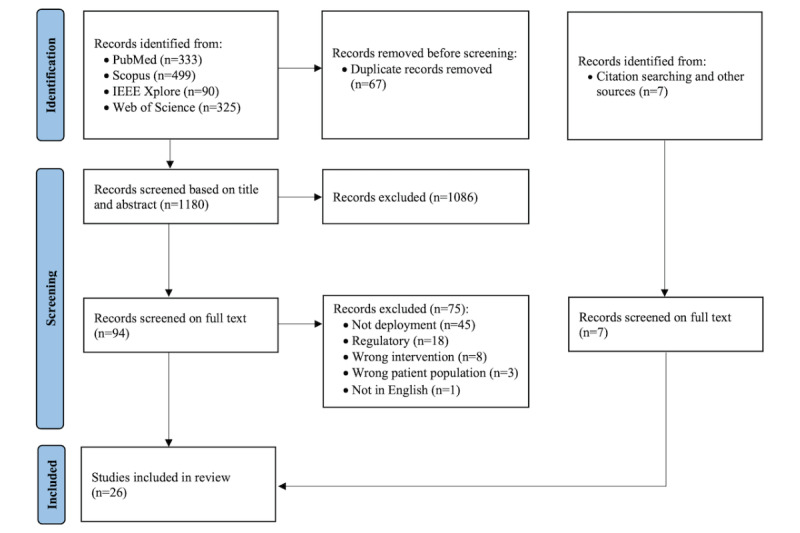
The PRISMA (Preferred Reporting Items for Systematic Reviews and Meta-Analyses) guidelines were adhered to. PubMed, Scopus, Web of Science, and IEEE Xplore were searched for studies published between January 2010 and January 2022. Articles with case studies and guidelines on the implementation of AI analytics in hospital settings using EMR data were included. We excluded studies conducted in primary and community care settings. Quality assessment of the identified papers was conducted using the Mixed Methods Appraisal Tool and ADAPTE frameworks. We coded evidence from the included studies that related to enablers of and barriers to AI implementation. The findings were mapped to the 3-horizon framework to provide a road map for hospitals to integrate AI analytics.
Of the 1247 studies screened, 26 (2.09%) met the inclusion criteria. In total, 65% (17/26) of the studies implemented AI analytics for enhancing the care of hospitalized patients, whereas the remaining 35% (9/26) provided implementation guidelines. Of the final 26 papers, the quality of 21 (81%) was assessed as poor. A total of 28 enablers was identified; 8 (29%) were new in this study. A total of 18 barriers was identified; 5 (28%) were newly found. Most of these newly identified factors were related to information and technology. Actionable recommendations for the implementation of AI toward achieving an LHS were provided by mapping the findings to a 3-horizon framework.
Significant issues exist in implementing AI in health care. Shifting from validating data sets to working with live data is challenging. This review incorporated the identified enablers and barriers into a 3-horizon framework, offering actionable recommendations for implementing AI analytics to achieve an LHS. The findings of this study can assist hospitals in steering their strategic planning toward successful adoption of AI.
目前正在努力利用电子病历(EMR)中收集的数据的计算能力来实现学习型健康系统(LHS)。医疗保健中的人工智能(AI)有望改善临床结果,许多研究人员正在回顾性数据集上开发 AI 算法。将这些算法与实时 EMR 数据集成很少见。对于赋予这种从基于数据集的使用转变为实时在健康系统中实施 AI 的能力的当前推动者和障碍,人们的理解很差。探索这些因素有望揭示成功将 AI 集成到临床工作流程中的可行见解。
第一项任务是进行系统的文献综述,以确定在医院环境中实际实施 AI 的证据的推动者和障碍。第二项任务是将确定的推动者和障碍映射到 3 个时间框架框架中,以实现医院的成功数字健康转型,从而实现 LHS。
遵守 PRISMA(系统评价和荟萃分析的首选报告项目)指南。在 PubMed、Scopus、Web of Science 和 IEEE Xplore 上搜索了 2010 年 1 月至 2022 年 1 月期间发表的研究。纳入了使用 EMR 数据在医院环境中实施 AI 分析的案例研究和指南的文章。我们排除了在初级和社区保健环境中进行的研究。使用混合方法评估工具和 ADAPTE 框架对确定的论文进行了质量评估。我们对与 AI 实施的推动者和障碍相关的纳入研究中的证据进行了编码。研究结果被映射到 3 个时间框架中,为医院提供了整合 AI 分析的路线图。
在筛选的 1247 篇研究中,有 26 篇(2.09%)符合纳入标准。总共,65%(17/26)的研究为增强住院患者的护理实施了 AI 分析,而其余 35%(9/26)提供了实施指南。在最终的 26 篇论文中,有 21 篇(81%)的质量评估较差。确定了 28 个推动者;其中 8 个(29%)是本研究中的新发现。确定了 18 个障碍;其中 5 个(28%)是新发现的。这些新发现的因素大多与信息和技术有关。通过将研究结果映射到 3 个时间框架,为实现 LHS 提供了实施 AI 的可行建议。
在医疗保健中实施 AI 存在重大问题。从验证数据集转变为使用实时数据具有挑战性。本综述将确定的推动者和障碍纳入 3 个时间框架,为实现 LHS 提供了实施 AI 分析的可行建议。本研究的结果可以帮助医院朝着成功采用 AI 的战略规划方向前进。