Aix Marseille University, INSERM, INRAE, C2VN, Marseille, France.
Department of Hematology, Centre Hospitalier Universitaire Timone, Marseille, France.
Blood Adv. 2024 Nov 12;8(21):5467-5478. doi: 10.1182/bloodadvances.2024013546.
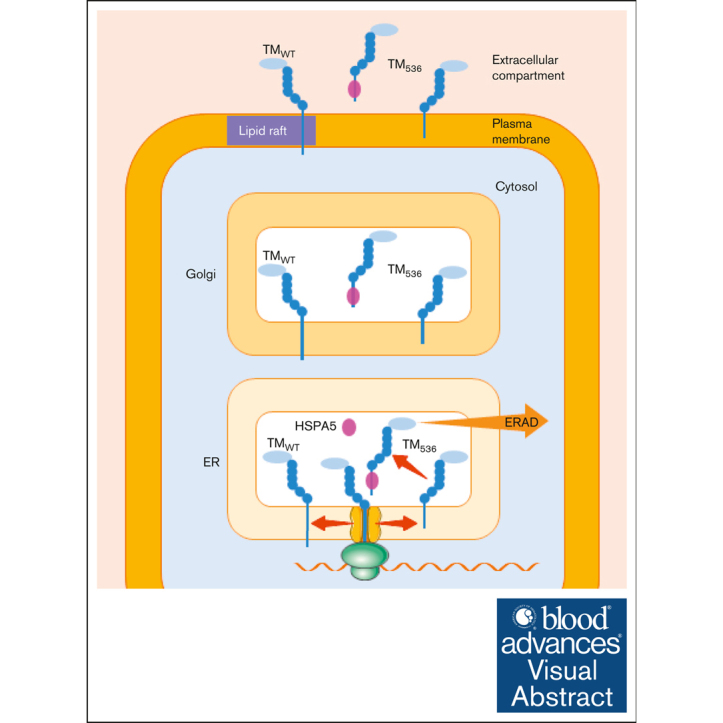
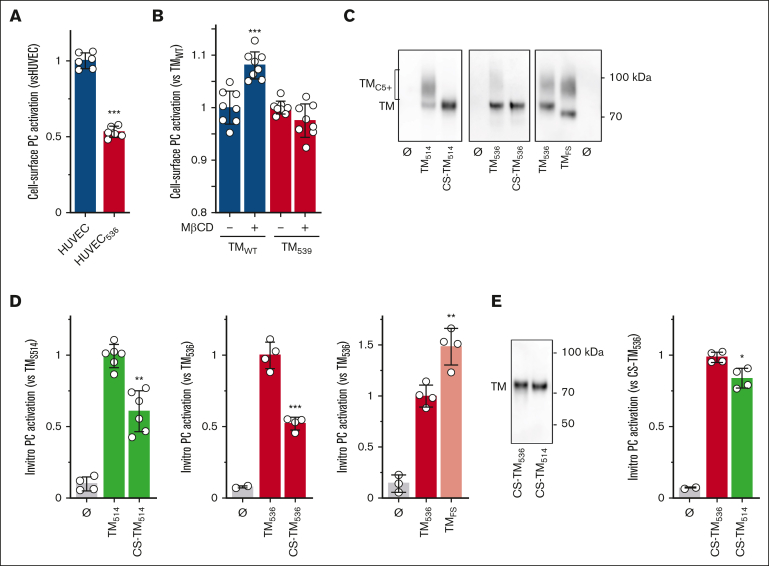
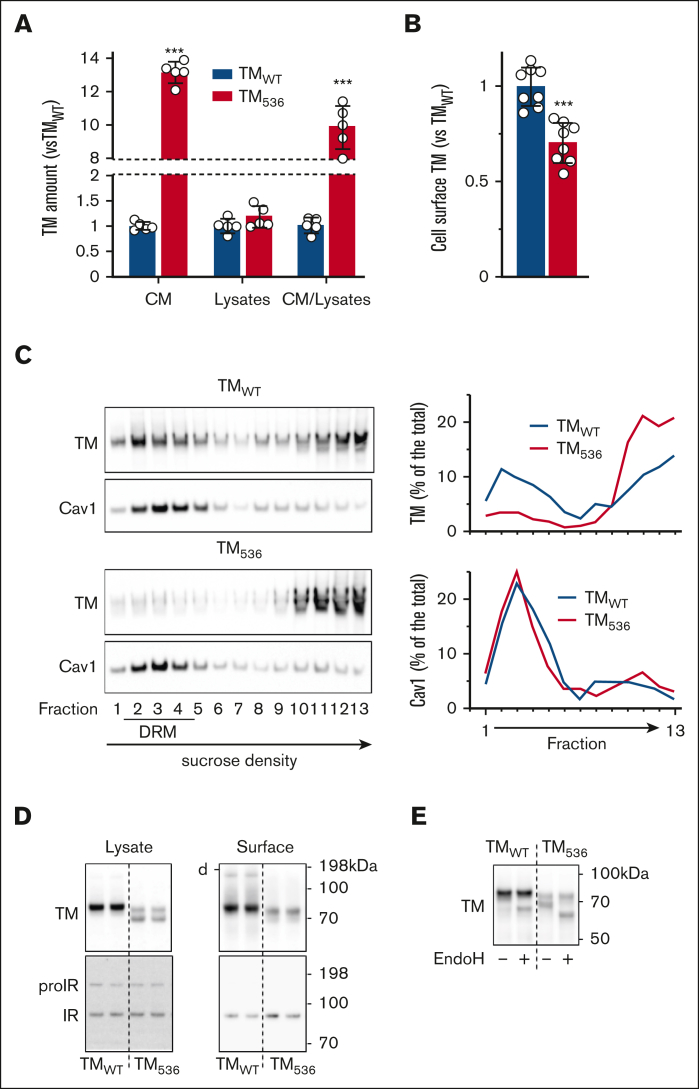
Expression of the thrombomodulin (TM) variant c.1611C>A (p.Cys537Stop) leads to the synthesis of a protein with no cytoplasmic tail and a transmembrane domain shortened by 3 amino acids (TM536). However, little is known regarding the release mechanism and properties of TM536. Using umbilical vein endothelial cells and peripheral blood-derived endothelial colony-forming cells from a heterozygous carrier of the TM536 variant as well as overexpression cell models, we demonstrated that TM536 is released from cells by an unusual mechanism. First, TM536 is inserted into the endoplasmic reticulum (ER) membrane, then, because of the low hydrophobicity of its intramembrane domain, it escapes from it and follows the conventional secretory pathway to be released into the extracellular compartment without the involvement of proteolysis. This particular secretion mechanism yields a soluble TM536, which is poorly modified by chondroitin sulfate glycosaminoglycan compared with conventionally secreted soluble forms of TM, and therefore has a suboptimal capacity to mediate thrombin-dependent activation of protein C (PC). We also showed that TM536 cellular trafficking was altered, with retention in the early secretory pathway and increased sensitivity to ER-associated degradation. As expected, activation of ER-associated degradation increased TM536 degradation and reduced its release. The expression of TM536 at the cell surface was low, and its distribution in lipid raft-like membrane microdomains was altered, resulting in low thrombin-dependent PC activation on the cell surface.
血栓调节蛋白(TM)变体 c.1611C>A(p.Cys537Stop)的表达导致合成一种没有细胞质尾巴和跨膜结构域缩短 3 个氨基酸的蛋白(TM536)。然而,关于 TM536 的释放机制和性质知之甚少。我们使用携带 TM536 变体的杂合子脐静脉内皮细胞和外周血衍生的内皮细胞集落形成细胞以及过表达细胞模型,证明 TM536 通过一种不寻常的机制从细胞中释放。首先,TM536 插入内质网(ER)膜,然后,由于其跨膜结构域的低疏水性,它从 ER 膜中逸出,并遵循常规的分泌途径,在没有蛋白水解参与的情况下被释放到细胞外腔室中。这种特殊的分泌机制产生了一种可溶性 TM536,与传统分泌的可溶性 TM 形式相比,它的硫酸软骨素糖胺聚糖修饰较差,因此介导凝血酶依赖性蛋白 C(PC)激活的能力较差。我们还表明,TM536 的细胞内运输发生改变,滞留在内质网相关降解早期分泌途径中,并增加对 ER 相关降解的敏感性。正如预期的那样,ER 相关降解的激活增加了 TM536 的降解并减少了其释放。TM536 在细胞表面的表达水平较低,其在脂质筏样膜微区的分布也发生改变,导致细胞表面凝血酶依赖性 PC 激活降低。