Botany and Microbiology Department, Faculty of Science, Benha University, Benha, 13511, Egypt.
Biochemistry Department, Faculty of Agriculture, Benha University, Benha, Egypt.
Sci Rep. 2024 Aug 29;14(1):20131. doi: 10.1038/s41598-024-69451-y.
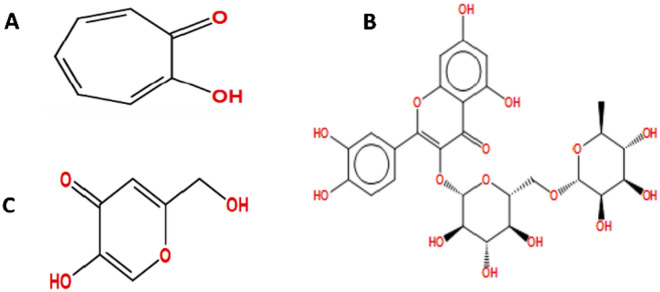
Tyrosinase is a binuclear copper-containing enzyme that catalyzes the conversation of monophenols to diphenols via o-hydroxylation and then the oxidation of o-diphenols to o-quinones which is profoundly linked to eukaryotic melanin synthesis and fruits browning. The hyperpigmentation due to unusual tyrosinase activity has gained growing health concern. Plants and their metabolites are considered promising and effective sources for potent antityrosinase enzymes. Hence, searching for potent, specific tyrosinase inhibitor from different plant extracts is an alternative approach in regulating overproduction of tyrosinase. Among the tested extracts, the hydro-alcoholic extract of Moringa oleifera L. leaves displayed the potent anti-tyrosinase activity (IC = 98.93 µg/ml) in a dose-dependent manner using -DOPA as substrate; however, the kojic acid showed IC of 88.92 µg/ml. The tyrosinase-diphenolase (TYR-Di) kinetic analysis revealed mixed inhibition type for the Ocimum basilicum L. and Artemisia annua L. extracts, while the Coriandrum sativum L. extract displayed a non-competitive type of inhibition. Interestingly, the extract of Moringa oleifera L. leaves exhibited a competitive inhibition, low inhibition constant of free enzyme ( ) value and no Pan-Assay Interfering Substances, hinting the presence of strong potent inhibitors. The major putative antityrosinase compound in the extract was resolved, and chemically identified as rutin based on various spectroscopic analyses using UV-Vis, FTIR, mass spectrometry, and H NMR. The in silico computational molecular docking has been performed using rutin and A. bisporus tyrosinase (PDB code: 2Y9X). The binding energy of the predicted interaction between tropolone native ligand, kojic acid, and rutin against 2Y9X was respectively - 5.28, - 4.69, and - 7.75 kcal/mol. The docking simulation results revealed the reliable binding of rutin to the amino acid residues (ASN, HIS, SER) in the tyrosinase catalytic site. Based on the developed results, rutin extracted from M. oleifera L. leaves has the capability to be powerful anti-pigment agent with a potential application in cosmeceutical area. In vivo studies are required to unravel the safety and efficiency of rutin as antityrosinase compound.
酪氨酸酶是一种双核含铜酶,通过 o-羟化作用催化单酚转化为二酚,然后将邻二酚氧化为邻醌,这与真核黑色素合成和果实褐变密切相关。由于异常的酪氨酸酶活性导致的色素沉着引起了越来越多的健康关注。植物及其代谢产物被认为是具有潜力和有效的强效酪氨酸酶抑制剂来源。因此,从不同植物提取物中寻找强效、特异的酪氨酸酶抑制剂是调节酪氨酸酶过度产生的一种替代方法。在测试的提取物中,辣木叶的水醇提取物以剂量依赖的方式使用 -DOPA 作为底物显示出强效的抗酪氨酸酶活性(IC=98.93µg/ml);然而,曲酸的 IC 为 88.92µg/ml。酪氨酸酶-二酚酶(TYR-Di)动力学分析表明,罗勒和青蒿提取物对 Ocimum basilicum L.和 Artemisia annua L.提取物表现出混合抑制类型,而 Coriandrum sativum L.提取物表现出非竞争性抑制类型。有趣的是,辣木叶提取物表现出竞争性抑制,游离酶的低抑制常数( )值和没有泛分析干扰物质(Pan-Assay Interfering Substances),提示存在强有效的抑制剂。根据使用 UV-Vis、FTIR、质谱和 1H NMR 的各种光谱分析,从提取物中分离并化学鉴定出主要的假定抗酪氨酸酶化合物为芦丁。使用芦丁和 A. bisporus 酪氨酸酶(PDB 代码:2Y9X)进行了计算机分子对接的计算。预测的 tropolone 天然配体、曲酸和芦丁与 2Y9X 之间相互作用的结合能分别为-5.28、-4.69 和-7.75kcal/mol。对接模拟结果表明,芦丁可靠地结合到酪氨酸酶催化位点的氨基酸残基(ASN、HIS、SER)上。基于所开发的结果,辣木叶提取物中的芦丁具有成为强大的抗色素剂的能力,具有在化妆品领域的潜在应用。需要进行体内研究以揭示芦丁作为抗酪氨酸酶化合物的安全性和效率。